Peng Xianjun, Wu Qingqing, Teng Linhong, Tang Feng, Pi Zhi, Shen Shihua
Key Laboratory of Plant Resources, Institute of Botany, the Chinese Academy of Sciences, Beijing, 100093, People's Republic of China.
University of the Chinese Academy of Sciences, Beijing, People's Republic of China.
BMC Plant Biol. 2015 Apr 19;15:108. doi: 10.1186/s12870-015-0489-2.
Several studies have focused on cold tolerance in multiple regulated levels. However, a genome-scale molecular analysis of the regulated network under the control of transcription factors (TFs) is still lacking, especially for trees. To comprehensively identify the TFs that regulate cold stress response in the paper mulberry and understand their regulatory interactions, transcriptomic data was used to assess changes in gene expression induced by exposure to cold.
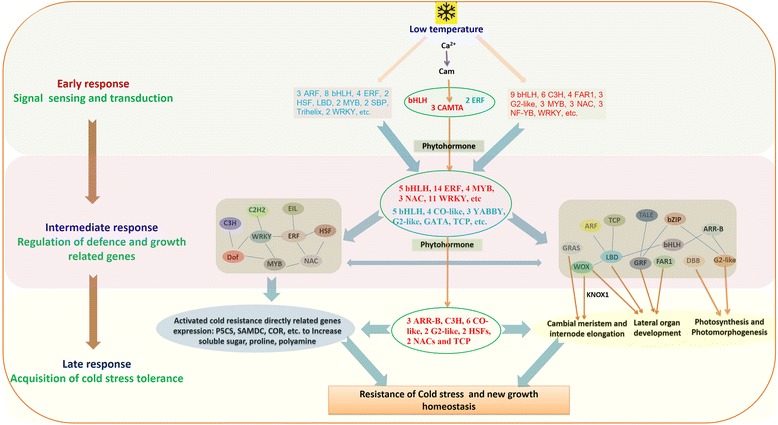
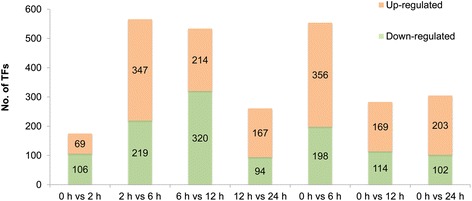
Results indicated that 794 TFs, belonging to 47 families and comprising more than 59% of the total TFs of this plant, were involved in the cold stress response. They were clustered into three groups, namely early, intermediate and late responsive groups which contained 95, 550 and 149 TFs, respectively. Among of these differentially expressed TFs, one bHLH, two ERFs and three CAMTAs were considered to be the key TFs functioning in the primary signal transduction. After that, at the intermediate stage of cold stress, there were mainly two biological processes that were regulated by TFs, namely cold stress resistance (including 5 bHLH, 14 ERFs, one HSF, 4 MYBs, 3 NACs, 11 WRKYs and so on) and growth and development of lateral organ or apical meristem (including ARR-B, B3, 5 bHLHs, 2 C2H2, 4 CO-like, 2 ERF, 3 HD-ZIP, 3 YABBYs, G2-like, GATA, GRAS and TCP). In late responsive group, 3 ARR-B, C3H, 6 CO-like, 2 G2-like, 2 HSFs, 2 NACs and TCP. Most of them presented the up-regulated expression at 12 or 24 hours after cold stress implied their important roles for the new growth homeostasis under cold stress.
Our study identified the key TFs that function in the regulatory cascades mediating the activation of downstream genes during cold tress tolerance in the paper mulberry. Based on the analysis, we found that the AP2/ERF, bHLH, MYB, NAC and WRKY families might play the central and significant roles during cold stress response in the paper mulberry just as in other species. Meanwhile, many other TF families previously reported as involving in regulation of growth and development, including ARF, DBB, G2-like, GRF, GRAS, LBD, WOX and YAABY exhibited their important potential function in growth regulation under cold stress.
多项研究聚焦于多个调控水平下的耐寒性。然而,转录因子(TFs)调控网络的全基因组分子分析仍然缺乏,尤其是对于树木而言。为全面鉴定调控构树冷胁迫响应的转录因子并了解其调控相互作用,利用转录组数据评估冷处理诱导的基因表达变化。
结果表明,794个转录因子属于47个家族,占该植物转录因子总数的59%以上,参与了冷胁迫响应。它们被分为三组,即早期、中期和晚期响应组,分别包含95、550和149个转录因子。在这些差异表达的转录因子中,一个bHLH、两个ERF和三个CAMTA被认为是在初级信号转导中起作用的关键转录因子。之后,在冷胁迫的中期,主要有两个生物学过程受转录因子调控,即抗冷胁迫(包括5个bHLH、14个ERF、1个HSF、4个MYB、3个NAC、11个WRKY等)和侧器官或顶端分生组织的生长发育(包括ARR-B、B3、5个bHLH、2个C2H2、4个CO-like、2个ERF、3个HD-ZIP、3个YABBY、G2-like、GATA、GRAS和TCP)。在晚期响应组中,有3个ARR-B、C3H、6个CO-like、2个G2-like、2个HSF、2个NAC和TCP。它们中的大多数在冷胁迫后12或24小时呈现上调表达,这暗示了它们在冷胁迫下新的生长稳态中的重要作用。
我们的研究鉴定了在构树耐冷胁迫过程中介导下游基因激活的调控级联中起作用的关键转录因子。基于分析,我们发现AP2/ERF、bHLH、MYB、NAC和WRKY家族在构树冷胁迫响应中可能与其他物种一样发挥核心和重要作用。同时,许多先前报道参与生长发育调控的其他转录因子家族,包括ARF、DBB、G2-like、GRF、GRAS、LBD、WOX和YAABY在冷胁迫下的生长调控中展现出重要的潜在功能。