Harris Jenine K, Mart Adelina, Moreland-Russell Sarah, Caburnay Charlene A
Washington University in St. Louis, 1 Brookings Dr, CB 1196, St. Louis, MO, 63130. Email:
Brown School, Washington University in St. Louis, St. Louis, Missouri.
Prev Chronic Dis. 2015 May 7;12:E62. doi: 10.5888/pcd12.140402.
Social media are widely used by the general public and by public health and health care professionals. Emerging evidence suggests engagement with public health information on social media may influence health behavior. However, the volume of data accumulating daily on Twitter and other social media is a challenge for researchers with limited resources to further examine how social media influence health. To address this challenge, we used crowdsourcing to facilitate the examination of topics associated with engagement with diabetes information on Twitter.
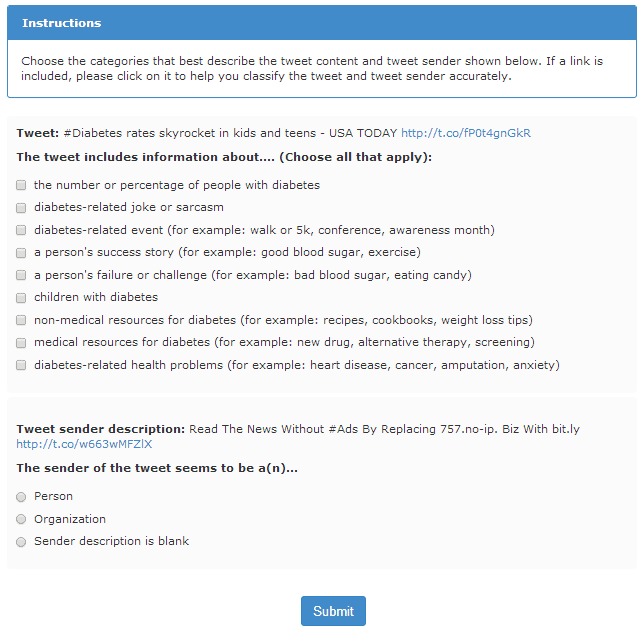
We took a random sample of 100 tweets that included the hashtag "#diabetes" from each day during a constructed week in May and June 2014. Crowdsourcing through Amazon's Mechanical Turk platform was used to classify tweets into 9 topic categories and their senders into 3 Twitter user categories. Descriptive statistics and Tweedie regression were used to identify tweet and Twitter user characteristics associated with 2 measures of engagement, "favoriting" and "retweeting."
Classification was reliable for tweet topics and Twitter user type. The most common tweet topics were medical and nonmedical resources for diabetes. Tweets that included information about diabetes-related health problems were positively and significantly associated with engagement. Tweets about diabetes prevalence, nonmedical resources for diabetes, and jokes or sarcasm about diabetes were significantly negatively associated with engagement.
Crowdsourcing is a reliable, quick, and economical option for classifying tweets. Public health practitioners aiming to engage constituents around diabetes may want to focus on topics positively associated with engagement.
社交媒体被公众以及公共卫生和医疗保健专业人员广泛使用。新出现的证据表明,在社交媒体上参与公共卫生信息可能会影响健康行为。然而,推特和其他社交媒体上每天积累的数据量,对于资源有限的研究人员来说,是进一步研究社交媒体如何影响健康的一项挑战。为应对这一挑战,我们利用众包来促进对与推特上糖尿病信息参与度相关主题的研究。
我们在2014年5月和6月选定的一周内,每天从包含“#糖尿病”标签的推文中随机抽取100条样本。通过亚马逊的Mechanical Turk平台进行众包,将推文分类为9个主题类别,并将推文发送者分类为3个推特用户类别。使用描述性统计和Tweedie回归来确定与两种参与度衡量指标“点赞”和“转发”相关的推文及推特用户特征。
推文主题和推特用户类型的分类是可靠的。最常见的推文主题是糖尿病的医疗和非医疗资源。包含糖尿病相关健康问题信息的推文与参与度呈正相关且具有显著性。关于糖尿病患病率、糖尿病非医疗资源以及关于糖尿病的笑话或讽刺的推文与参与度呈显著负相关。
众包是对推文进行分类的一种可靠、快速且经济的选择。旨在围绕糖尿病吸引选民的公共卫生从业者可能希望关注与参与度呈正相关的主题。