Naze Sebastien, Bernard Christophe, Jirsa Viktor
UMR1106 Inserm, Institut de Neurosciences des Systèmes, Marseille, France; Aix-Marseille University, Marseille, France.
PLoS Comput Biol. 2015 May 13;11(5):e1004209. doi: 10.1371/journal.pcbi.1004209. eCollection 2015 May.
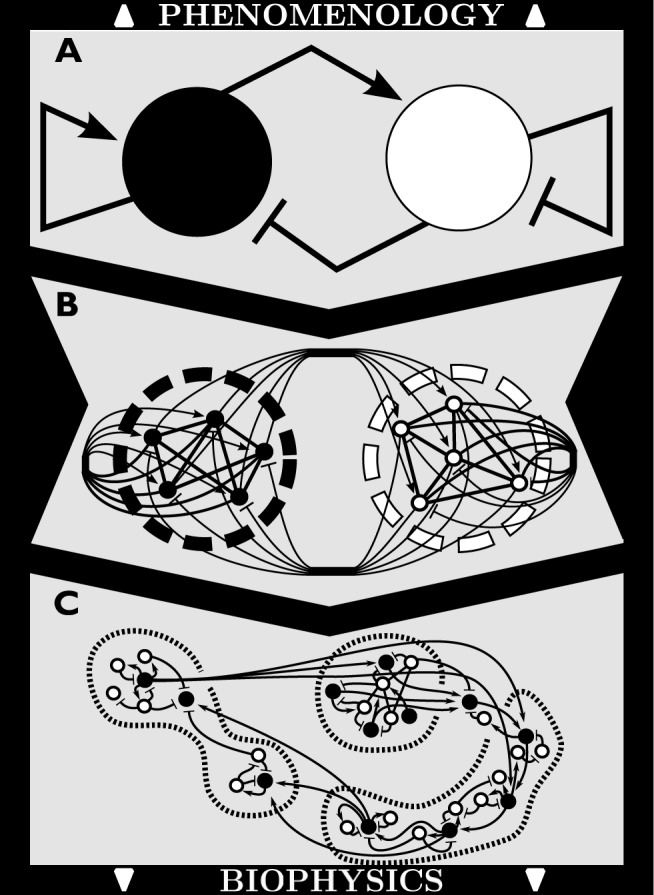
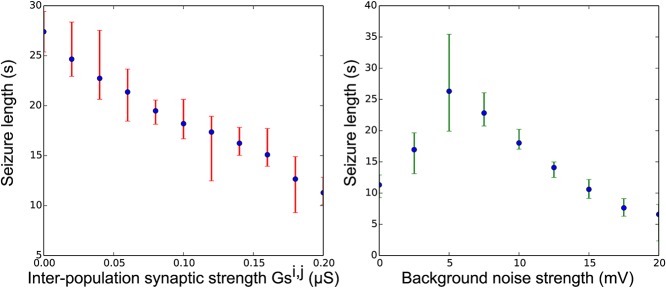
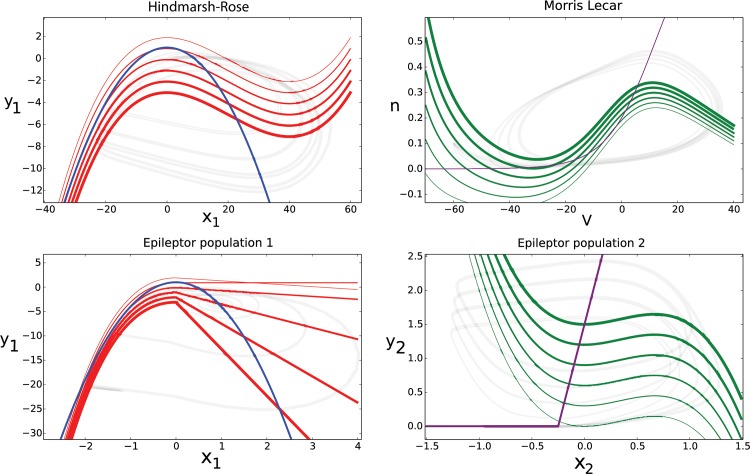
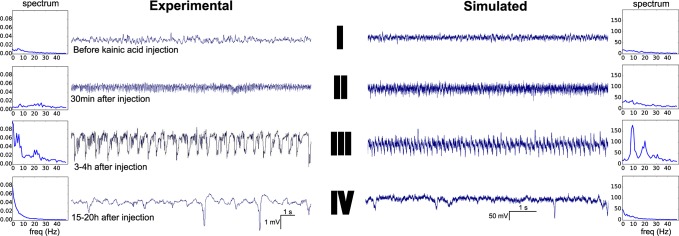
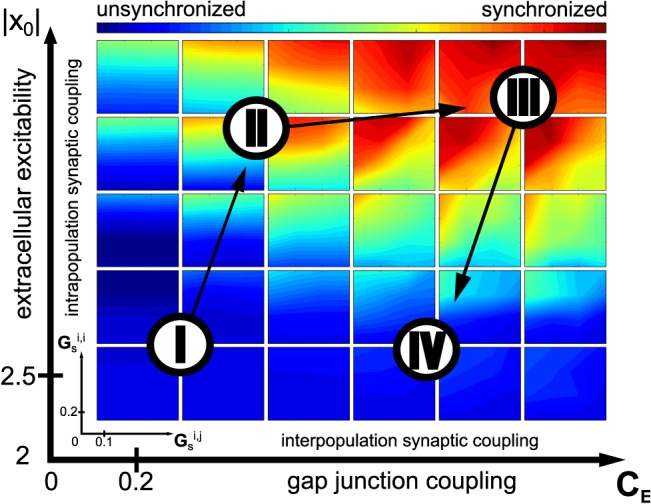
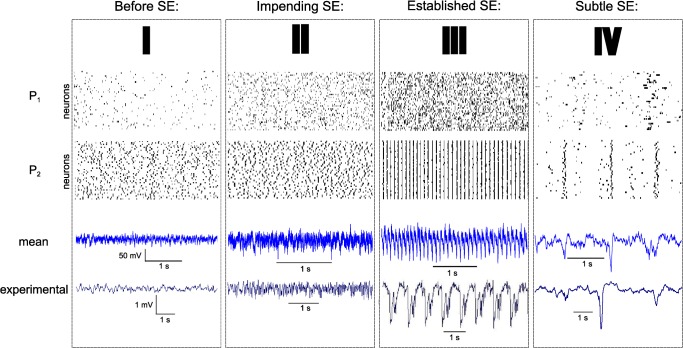
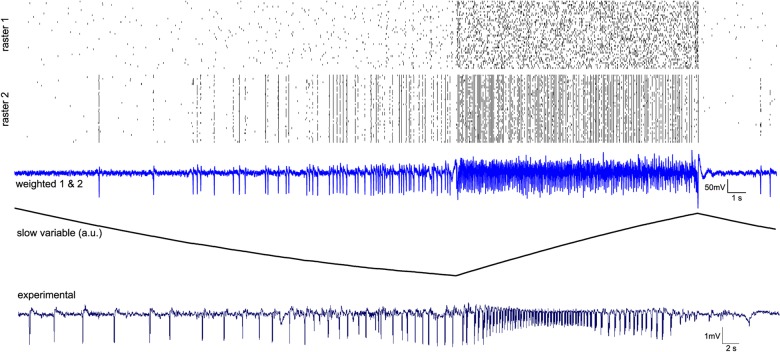
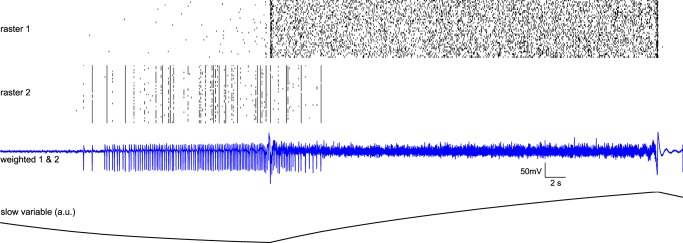
Epileptic seizure dynamics span multiple scales in space and time. Understanding seizure mechanisms requires identifying the relations between seizure components within and across these scales, together with the analysis of their dynamical repertoire. Mathematical models have been developed to reproduce seizure dynamics across scales ranging from the single neuron to the neural population. In this study, we develop a network model of spiking neurons and systematically investigate the conditions, under which the network displays the emergent dynamic behaviors known from the Epileptor, which is a well-investigated abstract model of epileptic neural activity. This approach allows us to study the biophysical parameters and variables leading to epileptiform discharges at cellular and network levels. Our network model is composed of two neuronal populations, characterized by fast excitatory bursting neurons and regular spiking inhibitory neurons, embedded in a common extracellular environment represented by a slow variable. By systematically analyzing the parameter landscape offered by the simulation framework, we reproduce typical sequences of neural activity observed during status epilepticus. We find that exogenous fluctuations from extracellular environment and electro-tonic couplings play a major role in the progression of the seizure, which supports previous studies and further validates our model. We also investigate the influence of chemical synaptic coupling in the generation of spontaneous seizure-like events. Our results argue towards a temporal shift of typical spike waves with fast discharges as synaptic strengths are varied. We demonstrate that spike waves, including interictal spikes, are generated primarily by inhibitory neurons, whereas fast discharges during the wave part are due to excitatory neurons. Simulated traces are compared with in vivo experimental data from rodents at different stages of the disorder. We draw the conclusion that slow variations of global excitability, due to exogenous fluctuations from extracellular environment, and gap junction communication push the system into paroxysmal regimes. We discuss potential mechanisms underlying such machinery and the relevance of our approach, supporting previous detailed modeling studies and reflecting on the limitations of our methodology.
癫痫发作动力学在空间和时间上跨越多个尺度。理解癫痫发作机制需要识别这些尺度内和跨尺度的发作成分之间的关系,并分析它们的动态特征。已经开发了数学模型来再现从单个神经元到神经群体的跨尺度癫痫发作动力学。在本研究中,我们开发了一个尖峰神经元网络模型,并系统地研究了该网络显示出从癫痫发作模拟器中已知的涌现动态行为的条件,癫痫发作模拟器是一个经过充分研究的癫痫神经活动抽象模型。这种方法使我们能够在细胞和网络水平上研究导致癫痫样放电的生物物理参数和变量。我们的网络模型由两个神经元群体组成,其特征是快速兴奋性爆发神经元和规则发放抑制性神经元,嵌入在由一个慢变量表示的共同细胞外环境中。通过系统地分析模拟框架提供的参数空间,我们再现了癫痫持续状态期间观察到的典型神经活动序列。我们发现细胞外环境的外源性波动和电紧张耦合在癫痫发作的进展中起主要作用,这支持了先前的研究并进一步验证了我们的模型。我们还研究了化学突触耦合在自发癫痫样事件产生中的影响。我们的结果表明,随着突触强度的变化,典型的快速放电尖峰波会出现时间偏移。我们证明,尖峰波,包括发作间期尖峰,主要由抑制性神经元产生,而波部分的快速放电则归因于兴奋性神经元。将模拟轨迹与来自处于疾病不同阶段的啮齿动物的体内实验数据进行比较。我们得出结论,由于细胞外环境的外源性波动导致的全局兴奋性的缓慢变化以及缝隙连接通信将系统推向阵发性状态。我们讨论了这种机制背后的潜在机制以及我们方法的相关性,支持先前的详细建模研究并反思了我们方法的局限性。