Hermance Meghan E, Thangamani Saravanan
Department of Pathology, University of Texas Medical Branch, Galveston, Texas, USA.
Department of Pathology, University of Texas Medical Branch, Galveston, Texas, USA Institute for Human Infections and Immunity, University of Texas Medical Branch, Galveston, Texas, USA Galveston National Laboratory, University of Texas Medical Branch, Galveston, Texas, USA
J Virol. 2015 Aug;89(15):7852-60. doi: 10.1128/JVI.01056-15. Epub 2015 May 20.
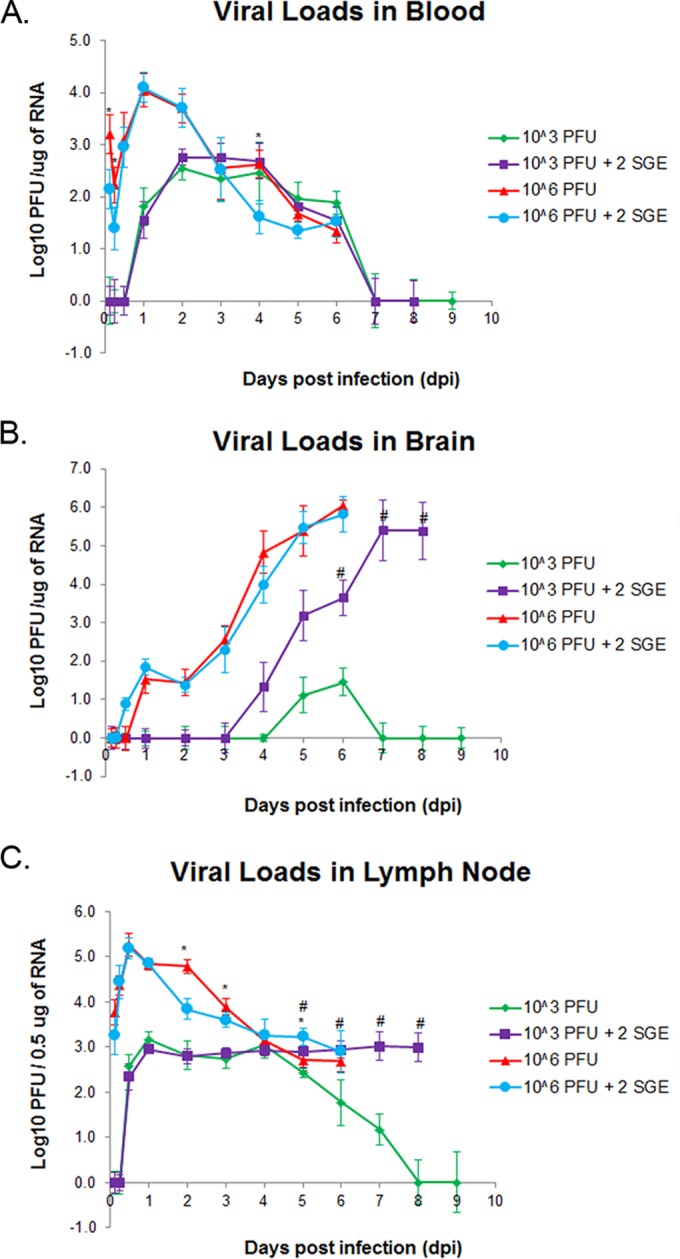
Powassan virus (POWV) is an encephalitic tick-borne flavivirus which can result in serious neuroinvasive disease with up to a 10% case fatality rate. The study objective was to determine whether the salivary gland extract (SGE) from Ixodes scapularis ticks facilitates the transmission and dissemination of POWV in a process known as saliva-activated transmission. Groups of BALB/c mice were footpad inoculated with either a high dose of POWV with and without SGE or a low dose of POWV with and without SGE. Mice from each group were sacrificed daily. Organ viral loads and gene expression profiles were evaluated by quantitative real-time PCR. Both groups of mice infected with high-dose POWV showed severe neurological signs of disease preceding death. The presence of SGE did not affect POWV transmission or disease outcome for mice infected with the high dose of POWV. Neuroinvasion, paralysis, and death occurred for all mice infected with the low dose of POWV plus SGE; however, for mice infected with the low dose of POWV in the absence of SGE, there were no clinical signs of infection and no mice succumbed to disease. Although this group displayed low-level viremias, all mice were completely healthy, and it was the only group in which POWV was cleared from the lymph nodes. We conclude that saliva-activated transmission occurs in mice infected with a low dose of POWV. Our study is the first to demonstrate virus dose-dependent saliva-activated transmission, warranting further investigation of the specific salivary factors responsible for enhancing POWV transmission.
Powassan virus (POWV) is a tick-borne flavivirus that continues to emerge in the United States, as is evident by the surge in number and expanding geographic range of confirmed cases in the past decade. This neuroinvasive virus is transmitted to humans by infected tick bites. Successful tick feeding is facilitated by a collection of pharmacologically active factors in tick saliva. In a process known as saliva-activated transmission, tick bioactive salivary molecules are thought to modulate the host environment, making it more favorable for the transmission and establishment of a pathogen. This phenomenon has been demonstrated for several tick-borne pathogens; however, a systematic investigation of the role of tick saliva on dissemination and pathogenesis of a tick-borne viral disease has never been attempted before. This study will fill that gap by systematically examining whether the presence of tick saliva contributes to the transmission and dissemination of POWV in mice.
波瓦桑病毒(POWV)是一种由蜱传播的脑炎黄病毒,可导致严重的神经侵袭性疾病,病死率高达10%。本研究的目的是确定肩突硬蜱的唾液腺提取物(SGE)是否在一种称为唾液激活传播的过程中促进POWV的传播和扩散。将BALB/c小鼠分组,分别通过足垫接种高剂量POWV(有无SGE)或低剂量POWV(有无SGE)。每天处死每组中的小鼠。通过定量实时PCR评估器官病毒载量和基因表达谱。两组感染高剂量POWV的小鼠在死亡前均表现出严重的神经疾病症状。SGE的存在对感染高剂量POWV的小鼠的POWV传播或疾病结局没有影响。所有感染低剂量POWV加SGE的小鼠均发生神经侵袭、麻痹和死亡;然而,对于在无SGE情况下感染低剂量POWV的小鼠,没有感染的临床症状,也没有小鼠死于疾病。尽管该组显示出低水平病毒血症,但所有小鼠都完全健康,并且这是唯一一组POWV从淋巴结清除的小鼠。我们得出结论,唾液激活传播发生在感染低剂量POWV的小鼠中。我们的研究首次证明了病毒剂量依赖性的唾液激活传播,有必要进一步研究负责增强POWV传播的特定唾液因子。
波瓦桑病毒(POWV)是一种由蜱传播的黄病毒,在美国仍不断出现,过去十年确诊病例数量的激增和地理范围的扩大就证明了这一点。这种神经侵袭性病毒通过受感染的蜱叮咬传播给人类。蜱唾液中的一系列药理活性因子有助于蜱成功进食。在一种称为唾液激活传播的过程中,蜱的生物活性唾液分子被认为会调节宿主环境,使其更有利于病原体的传播和定植。这种现象已在几种由蜱传播的病原体中得到证明;然而,此前从未有人尝试对蜱唾液在蜱传播病毒性疾病的传播和发病机制中的作用进行系统研究。本研究将通过系统检查蜱唾液的存在是否有助于POWV在小鼠中的传播和扩散来填补这一空白。