Casaponsa Aina, Antón Eneko, Pérez Alejandro, Duñabeitia Jon A
Basque Center on Cognition, Brain and Language Donostia, Spain.
Front Psychol. 2015 May 6;6:588. doi: 10.3389/fpsyg.2015.00588. eCollection 2015.
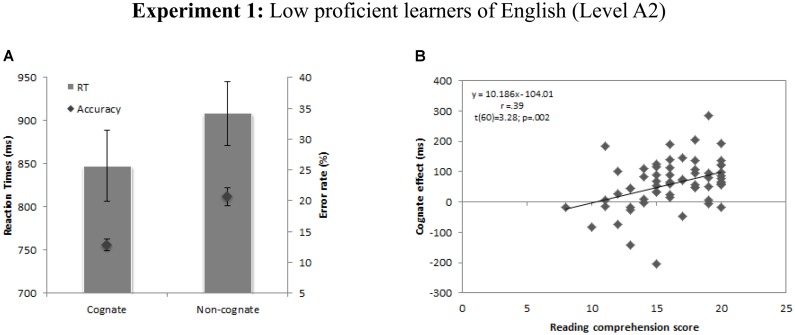
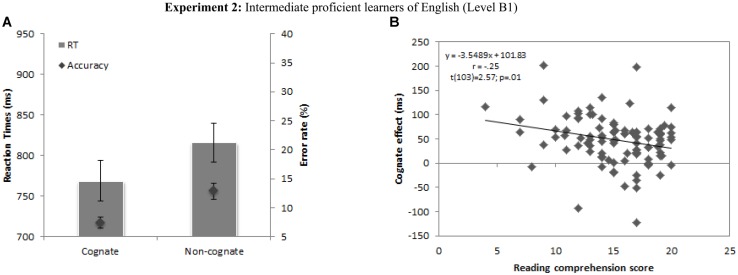
Numerous studies have shown that the native language influences foreign word recognition and that this influence is modulated by the proficiency in the non-native language. Here we explored how the degree of reliance on cross-language similarity (as measured by the cognate facilitation effect) together with other domain-general cognitive factors contribute to reading comprehension achievement in a non-native language at different stages of the learning process. We tested two groups of native speakers of Spanish learning English at elementary and intermediate levels in an academic context. A regression model approach showed that domain-general cognitive skills are good predictors of second language reading achievement independently of the level of proficiency. Critically, we found that individual differences in the degree of reliance on the native language predicted foreign language reading achievement, showing a markedly different pattern between proficiency groups. At lower levels of proficiency the cognate facilitation effect was positively related with reading achievement, while this relation became negative at intermediate levels of foreign language learning. We conclude that the link between native- and foreign-language lexical representations helps participants at initial stages of the learning process, whereas it is no longer the case at intermediate levels of proficiency, when reliance on cross-language similarity is inversely related to successful non-native reading achievement. Thus, at intermediate levels of proficiency strong and direct mappings from the non-native lexical forms to semantic concepts are needed to achieve good non-native reading comprehension, in line with the premises of current models of bilingual lexico-semantic organization.
大量研究表明,母语会影响外语单词识别,且这种影响会受到非母语熟练程度的调节。在此,我们探究了对跨语言相似性的依赖程度(通过同源词促进效应衡量)以及其他领域通用认知因素如何在学习过程的不同阶段对外语阅读理解成绩产生影响。我们测试了两组在学术环境中学习英语的西班牙语母语者,他们分别处于初级和中级水平。回归模型方法表明,领域通用认知技能是第二语言阅读成绩的良好预测指标,与熟练程度无关。关键的是,我们发现对母语依赖程度的个体差异能够预测外语阅读成绩,在不同熟练程度组之间呈现出明显不同的模式。在较低熟练水平时,同源词促进效应与阅读成绩呈正相关,而在外语学习的中级水平时,这种关系变为负相关。我们得出结论,母语和外语词汇表征之间的联系在学习过程的初始阶段对参与者有帮助,而在中级熟练水平时情况则并非如此,此时对跨语言相似性的依赖与成功的非母语阅读成绩呈负相关。因此,在中级熟练水平时,需要从非母语词汇形式到语义概念的强大而直接的映射,以实现良好的非母语阅读理解,这与当前双语词汇语义组织模型的前提一致。