Scherr Andreas, Seifert Bruno, Kuster Martin, Meyer Anja, Fagerstroem Karl-Olov, Tamm Michael, Stolz Daiana
Clinic of Pneumology and Pulmonary Research, University Hospital Basel, Petersgraben 4, CH-4031, Basel, Switzerland.
Industrial Health Service, F. Hoffman- La Roche AG,, Basel, Switzerland.
BMC Public Health. 2015 May 30;15:520. doi: 10.1186/s12889-015-1854-7.
Concerns about postcessational weight gain might hamper rather than encourage smokers to quit smoking.
We conducted a comprehensive multi-institutional smoking cessation program for health care and industrial workers (n = 654) employed at University Hospital Basel (Switzerland) and two local health industry companies (Novartis International AG, F. Hoffmann-La Roche AG). The program contained counselling with an option of pharmacological support. Changes in body weight were observed during 24 months of follow-up. Factors associated with longitudinal weight gain (> 5 % of baseline weight) were identified by cox-regression analysis.
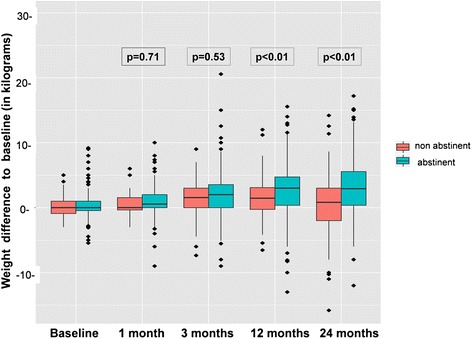
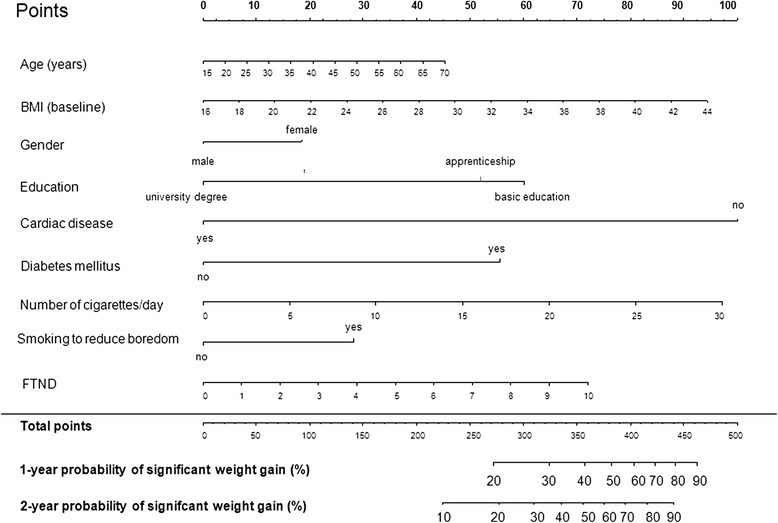
In 51 % of permanent quitters no significant changes of mean body weight were observed after 12 (0.52 kg, SD ± 2.87 kg) and 24 months (0.40 kg, SD ± 2.99 kg). Marked weight gain following smoking cessation was characterized by a wide margin of changes. In more than a half of former smokers (58 %) weight increases were moderate (< 5 kg), whereas excessive increases (> 10 kg) were seen in only 10 % of quitters. Lower baseline BMI (HR 0.60, 95 % CI 0.40- 0.80, p = 0.03), daily consumption of less than ten cigarettes (HR 0.53, 95 % CI 0.27- 0.63, p = 0.04) and ischemic cardiopathy (HR 0.21, 95 % CI 0.07-0.62; p < 0.01) were associated with a lower risk for weight gain. Employees with lower educational levels (HR 2.60, 95 % CI 1.60-5.50, p < 0.01), diabetes mellitus (HR 3.05, 95 % CI 2.20-8.06, p = 0.02) and those smoking to reduce boredom in life (HR 1.68, 95 % CI 1.21-2.33, p < 0.01) were at highest risk.
Marked postcessational weight gain occurs less often than expected, but remains difficult to be predicted. Our findings might be helpful to alleviate weight concerns in the average smoker willing to quit.
对戒烟后体重增加的担忧可能会阻碍而非鼓励吸烟者戒烟。
我们为瑞士巴塞尔大学医院及当地两家健康产业公司(诺华国际公司、罗氏公司)的医护人员和产业工人(n = 654)开展了一项全面的多机构戒烟项目。该项目包括咨询,并可选择药物支持。在24个月的随访期间观察体重变化。通过cox回归分析确定与纵向体重增加(>基线体重的5%)相关的因素。
在51%的永久戒烟者中,12个月(0.52千克,标准差±2.87千克)和24个月(0.40千克,标准差±2.99千克)后平均体重无显著变化。戒烟后明显的体重增加具有较大的变化幅度。超过一半的前吸烟者(58%)体重适度增加(<5千克),而只有10%的戒烟者体重过度增加(>10千克)。较低的基线体重指数(HR 0.60,95%可信区间0.40 - 0.80,p = 0.03)、每日吸烟少于10支(HR 0.53,95%可信区间0.27 - 0.63,p = 0.04)和缺血性心脏病(HR 0.21,95%可信区间0.07 - 0.62;p < 0.01)与体重增加风险较低相关。教育水平较低的员工(HR 2.60,95%可信区间1.60 - 5.50,p < 0.01)、糖尿病患者(HR 3.05,95%可信区间2.20 - 8.06,p = 0.02)以及那些为排解生活无聊而吸烟的人(HR 1.68,95%可信区间1.21 - 2.33,p < 0.01)风险最高。
戒烟后明显的体重增加比预期的少见,但仍难以预测。我们的研究结果可能有助于减轻愿意戒烟的普通吸烟者对体重的担忧。