Cope Robert C, Prowse Thomas A A, Ross Joshua V, Wittmann Talia A, Cassey Phillip
School of Mathematical Sciences , The University of Adelaide , Adelaide, South Australia 5005, Australia.
School of Biological Sciences , The University of Adelaide , Adelaide, South Australia 5005, Australia.
R Soc Open Sci. 2015 Apr 22;2(4):150039. doi: 10.1098/rsos.150039. eCollection 2015 Apr.
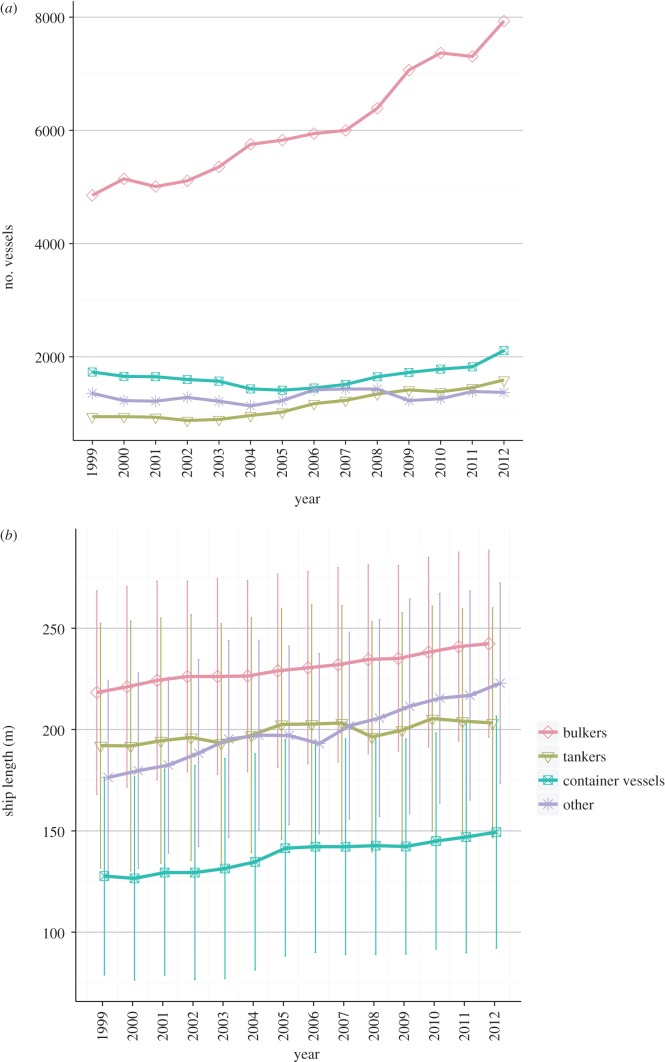
Biological invasions have the potential to cause extensive ecological and economic damage. Maritime trade facilitates biological invasions by transferring species in ballast water, and on ships' hulls. With volumes of maritime trade increasing globally, efforts to prevent these biological invasions are of significant importance. Both the International Maritime Organization and the Australian government have developed policy seeking to reduce the risk of these invasions. In this study, we constructed models for the transfer of ballast water into Australian waters, based on historic ballast survey data. We used these models to hindcast ballast water discharge over all vessels that arrived in Australian waters between 1999 and 2012. We used models for propagule survival to compare the risk of ballast-mediated propagule transport between ecoregions. We found that total annual ballast discharge volume into Australia more than doubled over the study period, with the vast majority of ballast water discharge and propagule pressure associated with bulk carrier traffic. As such, the ecoregions suffering the greatest risk are those associated with the export of mining commodities. As global marine trade continues to increase, effective monitoring and biosecurity policy will remain necessary to combat the risk of future marine invasion events.
生物入侵有可能造成广泛的生态和经济破坏。海上贸易通过压载水和船舶船体携带物种,从而促进了生物入侵。随着全球海上贸易量的增加,防范这些生物入侵的工作至关重要。国际海事组织和澳大利亚政府都制定了旨在降低这些入侵风险的政策。在本研究中,我们基于历史压载水调查数据,构建了压载水进入澳大利亚海域的转移模型。我们使用这些模型来推算1999年至2012年期间抵达澳大利亚海域的所有船舶的压载水排放情况。我们使用繁殖体存活模型来比较不同生态区域之间压载介导的繁殖体运输风险。我们发现,在研究期间,进入澳大利亚的年度压载水排放总量增加了一倍多,绝大多数压载水排放和繁殖体压力与散货船运输有关。因此,遭受风险最大的生态区域是那些与矿产品出口相关的区域。随着全球海洋贸易持续增长,有效的监测和生物安全政策对于应对未来海洋入侵事件的风险仍然必不可少。