Eck Institute for Global Health, University of Notre Dame, Notre Dame, IN, 46556, USA.
Centro de Investigación Para La Salud en América Latina, Facultad de Ciencias Exactas Y Naturales, Pontificia Universidad Católica del Ecuador, Calle San Pedro Y Pambahacienda, 170530, Nayón, Ecuador.
Malar J. 2020 Oct 2;19(1):354. doi: 10.1186/s12936-020-03426-y.
Understanding local anopheline vector species and their bionomic traits, as well as related human factors, can help combat gaps in protection.
In San José de Chamanga, Esmeraldas, at the Ecuadorian Pacific coast, anopheline mosquitoes were sampled by both human landing collections (HLCs) and indoor-resting aspirations (IAs) and identified using both morphological and molecular methods. Human behaviour observations (HBOs) (including temporal location and bed net use) were documented during HLCs as well as through community surveys to determine exposure to mosquito bites. A cross-sectional evaluation of Plasmodium falciparum and Plasmodium vivax infections was conducted alongside a malaria questionnaire.
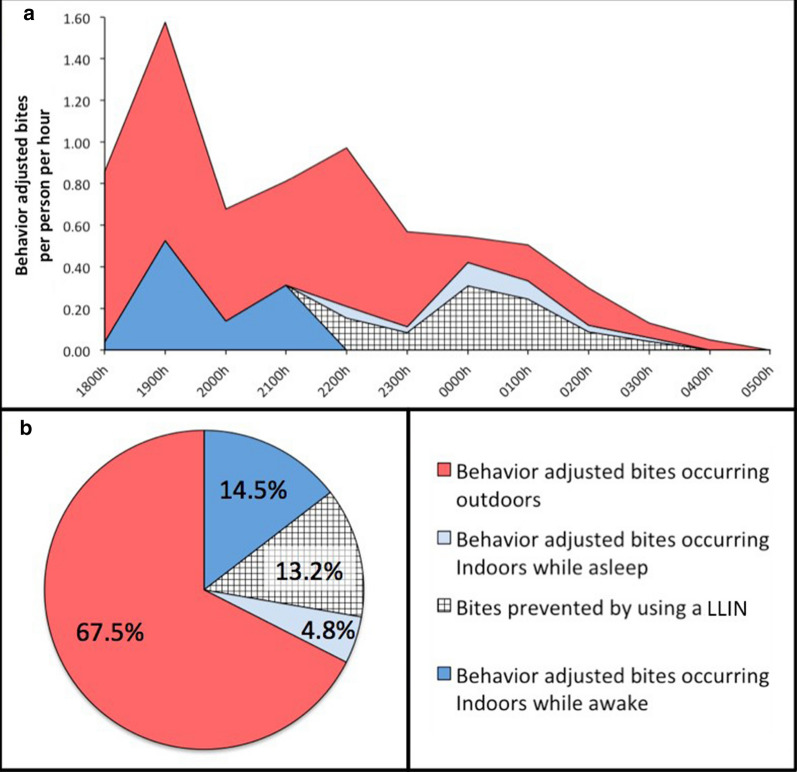
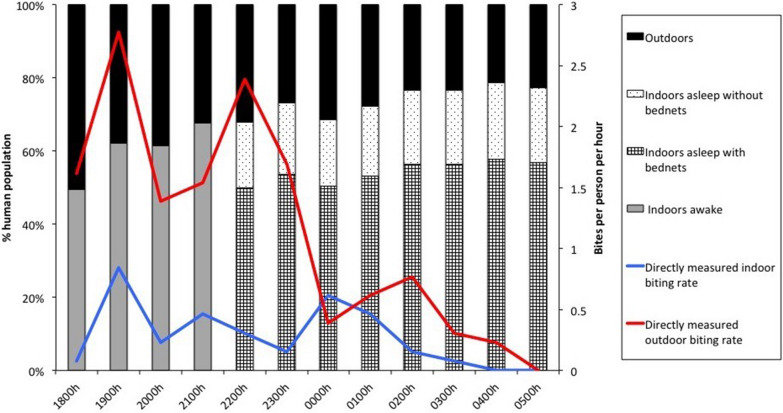
Among 222 anopheline specimens captured, based on molecular analysis, 218 were Nyssorhynchus albimanus, 3 Anopheles calderoni (n = 3), and one remains unidentified. Anopheline mean human-biting rate (HBR) outdoors was (13.69), and indoors (3.38) (p = 0.006). No anophelines were documented resting on walls during IAs. HBO-adjusted human landing rates suggested that the highest risk of being bitten was outdoors between 18.00 and 20.00 h. Human behaviour-adjusted biting rates suggest that overall, long-lasting insecticidal bed nets (LLINs) only protected against 13.2% of exposure to bites, with 86.8% of exposure during the night spent outside of bed net protection. The malaria survey found 2/398 individuals positive for asymptomatic P. falciparum infections. The questionnaire reported high (73.4%) bed net use, with low knowledge of malaria.
The exophagic feeding of anopheline vectors in San Jose de Chamanga, when analysed in conjunction with human behaviour, indicates a clear gap in protection even with high LLIN coverage. The lack of indoor-resting anophelines suggests that indoor residual spraying (IRS) may have limited effect. The presence of asymptomatic infections implies the presence of a human reservoir that may maintain transmission.
了解当地按蚊媒介物种及其生态特征以及相关的人类因素,可以帮助填补保护方面的空白。
在厄瓜多尔太平洋海岸的埃斯梅拉达斯省的圣何塞德查芒加,通过人类着陆采集(HLC)和室内滞留采集(IA)采集按蚊,并使用形态学和分子方法进行鉴定。在 HLC 期间以及通过社区调查记录人类行为观察(HBO)(包括时间和位置以及使用蚊帐),以确定蚊虫叮咬的暴露情况。同时进行了恶性疟原虫和间日疟原虫感染的横断面评估以及疟疾问卷调查。
在捕获的 222 只按蚊标本中,根据分子分析,218 只为 Nyssorhynchus albimanus,3 只为 Anopheles calderoni(n=3),还有一只未鉴定。室外按蚊平均人咬率(HBR)为(13.69),室内为(3.38)(p=0.006)。在 IA 期间,没有按蚊在墙上休息。经人类着陆率调整后的叮咬率表明,18.00 至 20.00 之间户外被叮咬的风险最高。经人类行为调整后的叮咬率表明,总的来说,长效驱虫蚊帐(LLIN)仅能预防 13.2%的蚊虫叮咬,86.8%的夜间暴露在蚊帐外。疟疾调查发现 2/398 名个体为无症状恶性疟原虫感染阳性。问卷调查报告说,蚊帐使用率高(73.4%),但对疟疾的了解很少。
圣何塞德查芒加的按蚊媒介具有外食性,结合人类行为分析,表明即使有高覆盖率的长效驱虫蚊帐,保护也存在明显差距。室内无滞留按蚊表明室内滞留喷洒(IRS)可能效果有限。无症状感染的存在意味着存在可能维持传播的人类储主。