
野生嘉赐树对啮齿动物二度烫伤的愈合作用。
Healing activity of Casearia sylvestris Sw. in second-degree scald burns in rodents.
作者信息
de Campos Evandro Pedro, Trombini Letícia Nava, Rodrigues Rafaela, Portella Décio Luis, Werner Adriana Carolina, Ferraz Miriele Cristina, de Oliveira Robson Vicente Machado, Cogo José Carlos, Oshima-Franco Yoko, Aranha Norberto, Gerenutti Marli
机构信息
Laboratory for the Toxicological Research (Lapetox), Department of Pharmaceutical Sciences, University of Sorocaba (UNISO), Cidade Universitária, Rodovia Raposo Tavares km 92.5, 18023-000, Sorocaba, São Paulo, Brazil.
Serpentarium of the Vale do Paraíba University (CEN-UNIVAP), Av Shishima Hifumi 2911, 12244-000, São José dos Campos, São Paulo, Brazil.
出版信息
BMC Res Notes. 2015 Jun 26;8:269. doi: 10.1186/s13104-015-1251-4.
BACKGROUND
Every year thousands of people are victims of burns, mainly scald burns. Many of these victims have small size wounds and superficial partial thickness and do not seek specialized medical care. As in Brazil Casearia sylvestris Sw., popularly known as guaçatonga is widely used for its analgesic, antiseptic and anti-inflammatory activities, this study sought to evaluate the effects of its hydroalcoholic extract in healing process of burns injuries.
METHODS
The obtained extract was validated applying a thin layer chromatography and sophisticated validation method using Bothrops jararacussu snake venom that is necrotic and inflammatory, and by which guaçatonga extract was able to neutralize the irreversible neuromuscular blockade induced by the venom. After induction of the scald injury, the animals were treated daily with saline solution spray; spray containing extract; biofilm; or biofilm impregnated with extract.
RESULTS
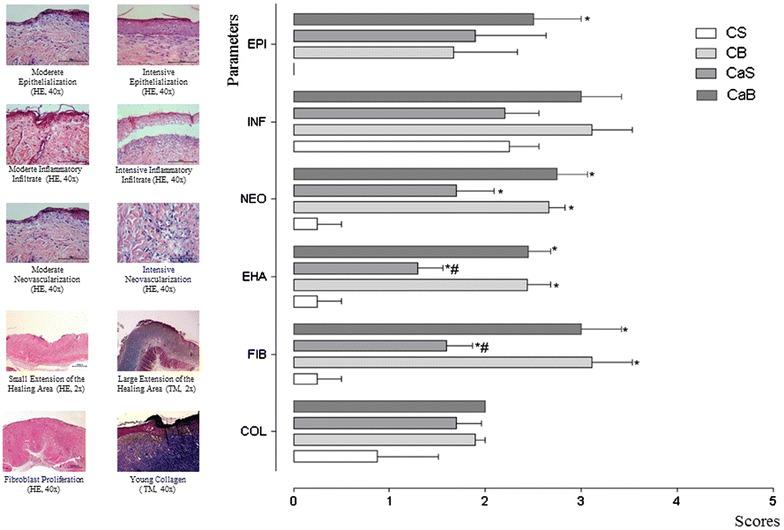
Significant differences were observed between the four groups studied considering: extension of the healing area, neovascularization, fibroblast proliferation, and epithelialization.
CONCLUSION
The anti-inflammatory and bactericidal effects of C. sylvestris Sw. suggests a potential therapeutic benefit in the treatment of inflammatory conditions in second-degree scald burn injuries, as well as, counteracting against the in vitro paralysis induced by B. jararacussu venom.
背景
每年都有成千上万的人成为烧伤的受害者,主要是烫伤。这些受害者中的许多人伤口面积小且为浅二度烧伤,并未寻求专业医疗护理。在巴西,野生酪梨(Casearia sylvestris Sw.),俗称瓜萨特onga,因其止痛、防腐和抗炎活性而被广泛使用,本研究旨在评估其水醇提取物对烧伤愈合过程的影响。
方法
通过薄层色谱法以及使用具坏死和炎症作用的巴西矛头蝮蛇毒的复杂验证方法对所得提取物进行验证,瓜萨特onga提取物能够中和该蛇毒诱导的不可逆神经肌肉阻滞。烫伤损伤诱导后,每天用盐溶液喷雾、含提取物的喷雾、生物膜或浸有提取物的生物膜对动物进行治疗。
结果
在所研究的四组之间观察到显著差异,考虑因素包括:愈合面积的扩展、新血管形成、成纤维细胞增殖和上皮形成。
结论
野生酪梨的抗炎和杀菌作用表明其在治疗二度烫伤烧伤的炎症方面具有潜在的治疗益处,以及对抗巴西矛头蝮蛇毒诱导的体外麻痹。


 Zotero 插件