Chou Chu-Kuang, Chen Shih-Ming, Li Yi-Chieh, Huang Tzu-Chuan, Lee Jen-Ai
Chia-Yi Christian Hospital, No. 539 Jhongsiao Rd., Chia-Yi City, 60002 Taiwan ; Department of Internal Medicine, National Taiwan University Hospital, No. 7 Chung-Shan South Road, Taipei City, 10002 Taiwan.
School of Pharmacy, College of Pharmacy, Taipei Medical University, No. 250 Wuxing St., Taipei, 11031 Taiwan, ROC.
Springerplus. 2015 Jul 3;4:312. doi: 10.1186/s40064-015-1106-4. eCollection 2015.
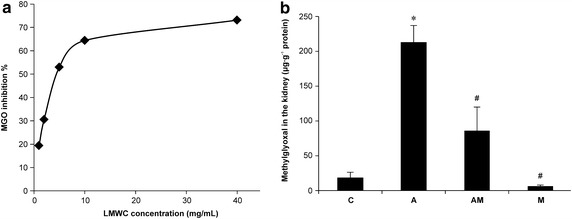
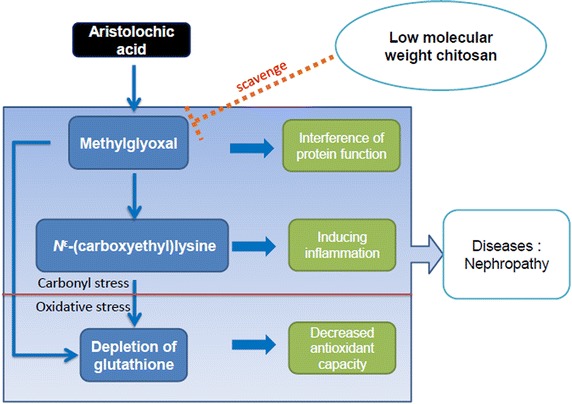
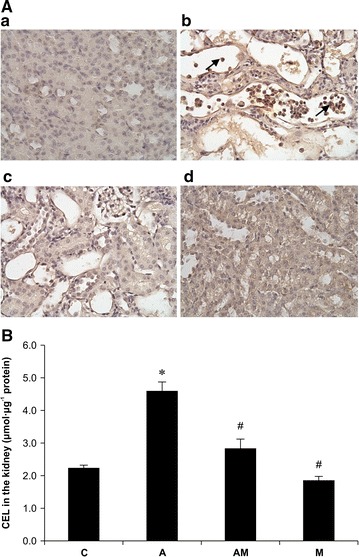
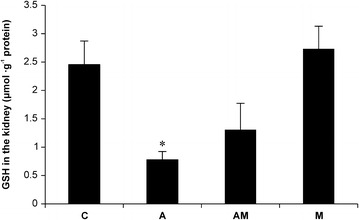
Methylglyoxal (MG) can cause protein glycation, resulting in cell damage and dysfunction. Accumulation of MG and its downstream metabolite N (ε)-(carboxyethyl)lysine (CEL) has been identified in several variations of nephropathy, including diabetic, hypertensive, and gentamicin-induced nephropathies. In this study, we investigated the effects of low-molecular-weight chitosan (lmw-chitosan) on MG-induced carbonyl stress in aristolochic acid-induced nephropathy. We used a buffer to investigate whether MG could be scavenged by lmw-chitosan in vitro. In addition, we also used a mouse model of aristolochic acid-induced nephropathy, which exhibits 12-fold greater accumulation of MG in the kidneys than that found in control animals, to examine whether lmw-chitosan could decrease MG levels in vivo. Examination of the binding of lmw-chitosan with MG in vitro demonstrated that the concentration of lmw-chitosan necessary to achieve 50% inhibition was 4.60 µg mL(-1). Treatment with lmw-chitosan (500 mg kg(-1) day(-1) orally) for 14 days significantly decreased renal MG accumulation from 212.86 ± 24.34 to 86.15 ± 33.79 µg g(-1) protein (p < 0.05) and CEL levels from 4.60 ± 0.27 to 2.84 ± 0.28 µmol µg(-1) protein (p < 0.05) in the aristolochic acid-induced nephropathy model. These data suggest that lmw-chitosan might represent a novel treatment modality for MG-related diseases such as nephropathy.