Tian Yuhang, Wu Danhua, Wu Dankai, Cui Yutao, Ren Guangkai, Wang Yanbing, Wang Jincheng, Peng Chuangang
Orthopedic Medical Center, The Second Hospital of Jilin University, Changchun, China.
The People's Hospital of Chaoyang District, Changchun, China.
Front Bioeng Biotechnol. 2022 May 4;10:899760. doi: 10.3389/fbioe.2022.899760. eCollection 2022.
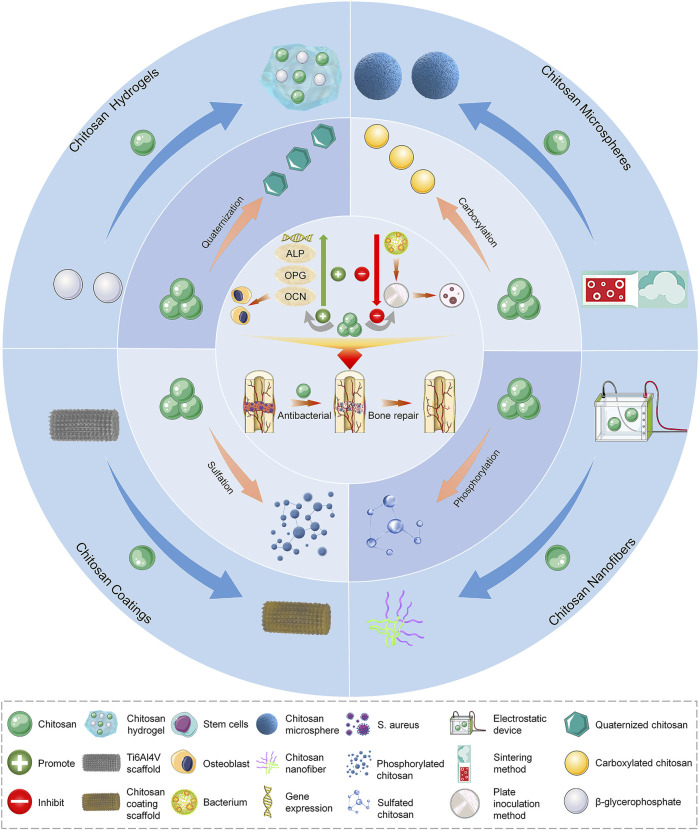
The treatment of infected bone defects includes infection control and repair of the bone defect. The development of biomaterials with anti-infection and osteogenic ability provides a promising strategy for the repair of infected bone defects. Owing to its antibacterial properties, chitosan (an emerging natural polymer) has been widely studied in bone tissue engineering. Moreover, it has been shown that chitosan promotes the adhesion and proliferation of osteoblast-related cells, and can serve as an ideal carrier for bone-promoting substances. In this review, the specific molecular mechanisms underlying the antibacterial effects of chitosan and its ability to promote bone repair are discussed. Furthermore, the properties of several kinds of functionalized chitosan are analyzed and compared with those of pure chitosan. The latest research on the combination of chitosan with different types of functionalized materials and biomolecules for the treatment of infected bone defects is also summarized. Finally, the current shortcomings of chitosan-based biomaterials for the treatment of infected bone defects and future research directions are discussed. This review provides a theoretical basis and advanced design strategies for the use of chitosan-based biomaterials in the treatment of infected bone defects.
感染性骨缺损的治疗包括控制感染和修复骨缺损。开发具有抗感染和成骨能力的生物材料为修复感染性骨缺损提供了一种有前景的策略。壳聚糖(一种新兴的天然聚合物)因其抗菌特性,已在骨组织工程中得到广泛研究。此外,研究表明壳聚糖可促进成骨相关细胞的黏附和增殖,并可作为促骨物质的理想载体。在本综述中,讨论了壳聚糖抗菌作用及其促进骨修复能力的具体分子机制。此外,分析了几种功能化壳聚糖的特性,并与纯壳聚糖的特性进行了比较。还总结了壳聚糖与不同类型功能化材料和生物分子联合用于治疗感染性骨缺损的最新研究。最后,讨论了基于壳聚糖的生物材料在治疗感染性骨缺损方面目前存在的不足及未来的研究方向。本综述为基于壳聚糖的生物材料用于治疗感染性骨缺损提供了理论依据和先进的设计策略。