Laue Tobias, Wrann Christiane D, Hoffmann-Castendiek Birgit, Pietsch Daniel, Hübner Lena, Kielstein Heike
Institute for Functional and Applied Anatomy, Hannover Medical School, Hannover, Germany ; Centre for Pediatrics and Adolescent Medicine, Hannover Medical School, Hannover, Germany.
Dana-Farber Cancer Institute, Beth Israel Deaconess Medical Center, Harvard Medical School, Boston, MA USA.
BMC Obes. 2015 Jan 24;2:1. doi: 10.1186/s40608-014-0033-1. eCollection 2015.
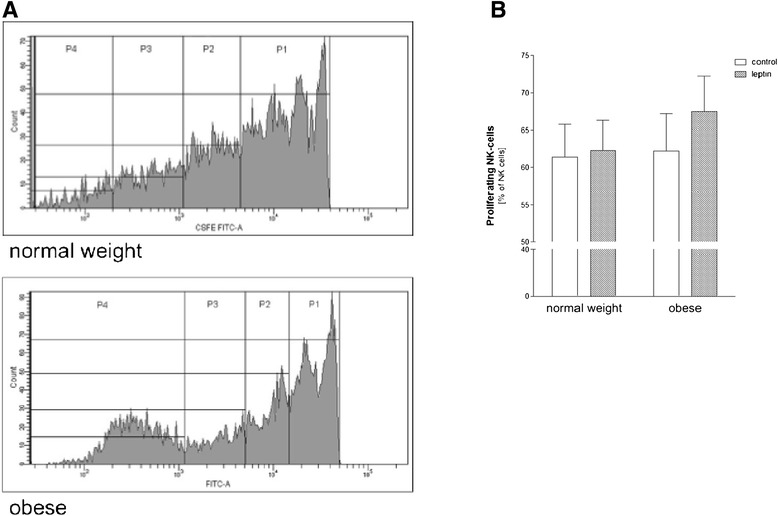
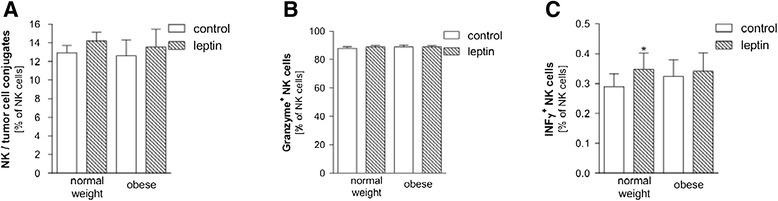
Obesity is associated with an elevated risk for several types of cancer and thus a major health hazard. However, the mechanism between overweight and cancer susceptibility is still elusive. Leptin, mainly produced by adipocytes links food intake and energy expenditure. In addition, recent studies have shown an immunomodulatory impact of leptin on NK cells. The purpose of the present study was to investigate whether leptin stimulation of NK cells from obese humans leads to altered functions as compared to NK cells from lean subjects. On the basis of body mass index 20 healthy individuals were classified in two groups: normal weight (<25 kg/m(2)) and obese (>30 kg/m(2)). Peripheral blood mononuclear cells (PBMC) were isolated from blood samples. We used flow cytometry to assess differences in phenotype and activity markers (CD107a, CD178 and TRAIL) of PBMCs between both groups. Furthermore, we determined after short-term in vitro leptin stimulation the phosphorylation of JAK2, downstream target of the intracellular signaling cascade of the leptin receptor, by Western Blotting and numbers of NK-cell-tumor-cell-conjugates as well as Granzyme(+) and IFN-γ(+) NK cells by flow cytometry. Finally, the proliferative capacity of control and long-term (7 days) leptin-stimulated NK cells was examined.
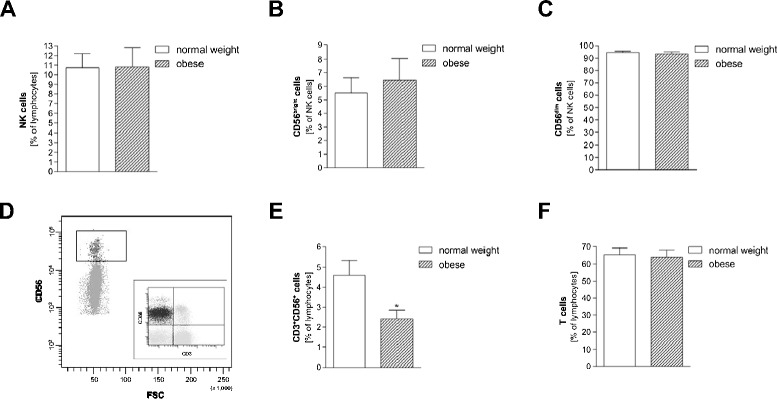
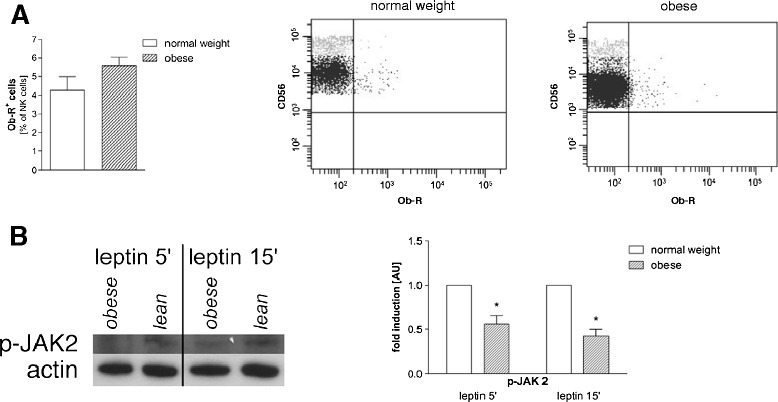
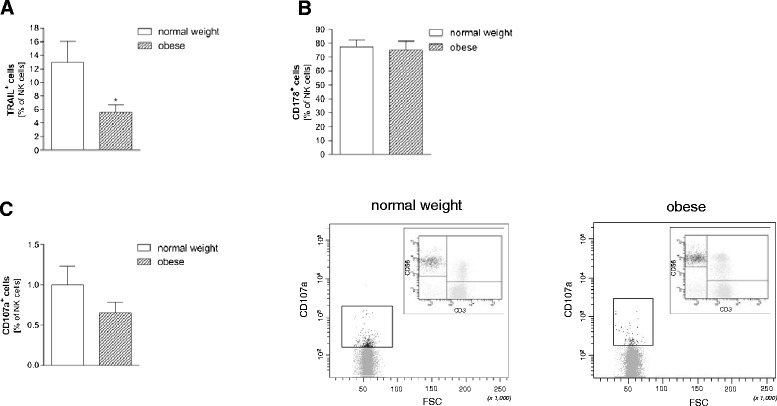
As opposed to similar NK cell counts, the number of CD3(+)CD56(+) cells was significantly lower in obese compared to lean subjects. Human NK cells express the leptin receptor (Ob-R). For further determination of Ob-R, intracellular target proteins of PBMCs were investigated by Western Blotting. Phosphorylation of JAK2 was lower in obese as compared to normal weight subjects. Furthermore, significantly lower levels of TNF-related apoptosis-inducing ligand (TRAIL) as an NK cell functional marker in obese subjects were found. In vitro leptin stimulation resulted in a higher production of interferon-γ in NK cells of normal weight subjects. Interestingly, long-term leptin stimulation had no significant influence on numbers of proliferating NK cells.
NK cells from obese healthy humans show functional deficits and altered responses after in vitro leptin challenge.
肥胖与多种癌症风险升高相关,因此是一项重大健康危害。然而,超重与癌症易感性之间的机制仍不清楚。瘦素主要由脂肪细胞产生,连接食物摄入和能量消耗。此外,最近的研究表明瘦素对自然杀伤(NK)细胞有免疫调节作用。本研究的目的是调查与瘦人来源的NK细胞相比,瘦素刺激肥胖人群的NK细胞是否会导致功能改变。根据体重指数,将20名健康个体分为两组:正常体重(<25kg/m²)和肥胖(>30kg/m²)。从血样中分离外周血单个核细胞(PBMC)。我们使用流式细胞术评估两组PBMC在表型和活性标志物(CD107a、CD178和肿瘤坏死因子相关凋亡诱导配体(TRAIL))方面的差异。此外,我们通过蛋白质免疫印迹法测定短期体外瘦素刺激后,瘦素受体细胞内信号级联下游靶点JAK2的磷酸化情况,并通过流式细胞术测定NK细胞与肿瘤细胞结合物的数量以及颗粒酶(+)和干扰素-γ(+)NK细胞的数量。最后,检测对照和长期(7天)瘦素刺激的NK细胞的增殖能力。
与NK细胞计数相似不同的是,肥胖人群中CD3(+)CD56(+)细胞数量明显低于瘦人。人类NK细胞表达瘦素受体(Ob-R)。为进一步确定Ob-R,通过蛋白质免疫印迹法研究PBMC的细胞内靶蛋白。与正常体重受试者相比,肥胖人群中JAK2的磷酸化水平较低。此外,发现肥胖人群中作为NK细胞功能标志物的TRAIL水平明显较低。体外瘦素刺激导致正常体重受试者的NK细胞产生更高水平的干扰素-γ。有趣地是,长期瘦素刺激对增殖NK细胞数量没有显著影响。
肥胖健康人群的NK细胞在体外瘦素刺激后表现出功能缺陷和反应改变。