Son K-L, Choi J-S, Lee J, Park S M, Lim J-A, Lee J Y, Kim S N, Oh S, Kim D J, Kwon J S
Department of Neuropsychiatry, Seoul National University Hospital, Seoul, Republic of Korea.
Department of Psychiatry, SMG-SNU Boramae Medical Center, Seoul, Republic of Korea.
Transl Psychiatry. 2015 Sep 1;5(9):e628. doi: 10.1038/tp.2015.124.
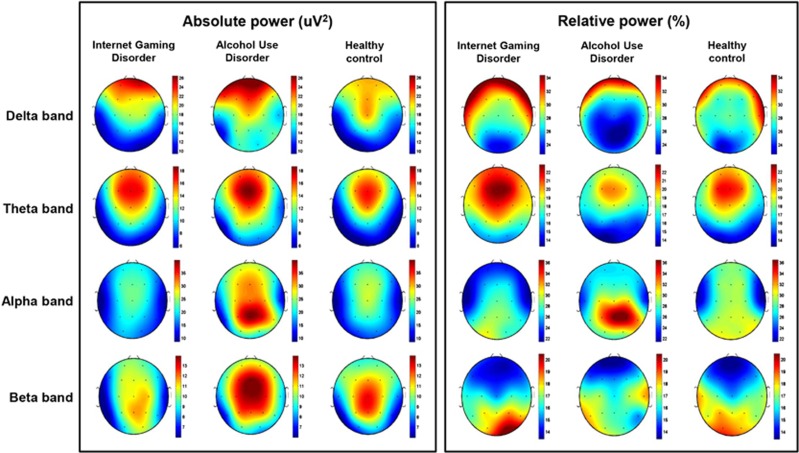
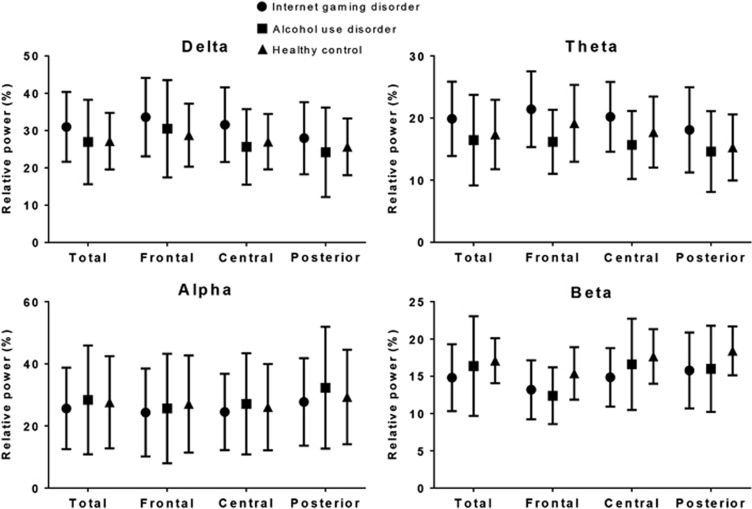
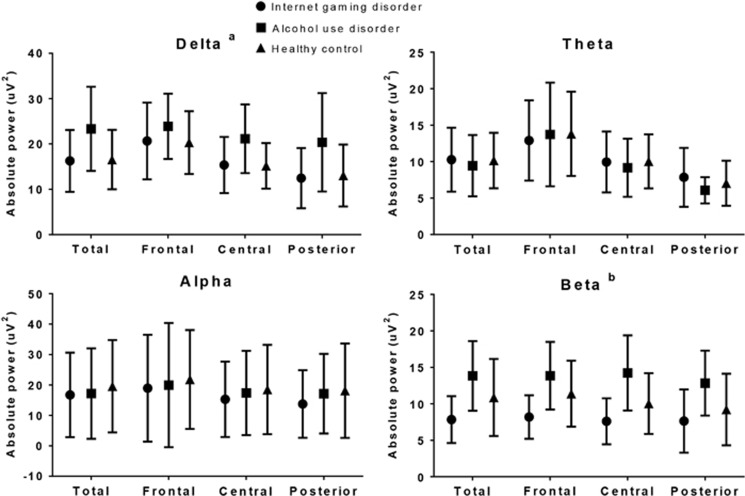
Despite that Internet gaming disorder (IGD) shares clinical, neuropsychological and personality characteristics with alcohol use disorder (AUD), little is known about the resting-state quantitative electroencephalography (QEEG) patterns associated with IGD and AUD. Therefore, this study compared the QEEG patterns in patients with IGD with those in patients with AUD to identify unique neurophysiological characteristics that can be used as biomarkers of IGD. A total of 76 subjects (34 with IGD, 17 with AUD and 25 healthy controls) participated in this study. Resting-state, eyes-closed QEEGs were recorded, and the absolute and relative power of brains were analyzed. The generalized estimating equation showed that the IGD group had lower absolute beta power than AUD (estimate = 5.319, P < 0.01) and the healthy control group (estimate = 2.612, P = 0.01). The AUD group showed higher absolute delta power than IGD (estimate = 7.516, P < 0.01) and the healthy control group (estimate = 7.179, P < 0.01). We found no significant correlations between the severity of IGD and QEEG activities in patients with IGD. The current findings suggest that lower absolute beta power can be used as a potential trait marker of IGD. Higher absolute power in the delta band may be a susceptibility marker for AUD. This study clarifies the unique characteristics of IGD as a behavioral addiction, which is distinct from AUD, by providing neurophysiological evidence.
尽管网络成瘾障碍(IGD)与酒精使用障碍(AUD)在临床、神经心理学和人格特征方面存在共性,但关于与IGD和AUD相关的静息态定量脑电图(QEEG)模式却知之甚少。因此,本研究比较了IGD患者与AUD患者的QEEG模式,以确定可作为IGD生物标志物的独特神经生理特征。共有76名受试者(34名IGD患者、17名AUD患者和25名健康对照)参与了本研究。记录了静息态闭眼QEEG,并分析了大脑的绝对功率和相对功率。广义估计方程显示,IGD组的绝对β功率低于AUD组(估计值 = 5.319,P < 0.01)和健康对照组(估计值 = 2.612,P = 0.01)。AUD组的绝对δ功率高于IGD组(估计值 = 7.516,P < 0.01)和健康对照组(估计值 = 7.179,P < 0.01)。我们发现IGD患者的IGD严重程度与QEEG活动之间无显著相关性。目前的研究结果表明,较低的绝对β功率可作为IGD的潜在特质标志物。δ波段较高的绝对功率可能是AUD的易感性标志物。本研究通过提供神经生理学证据,阐明了IGD作为一种行为成瘾与AUD不同的独特特征。