Sergentanis Theodoros N, Tsivgoulis Georgios, Perlepe Christina, Ntanasis-Stathopoulos Ioannis, Tzanninis Ioannis-Georgios, Sergentanis Ioannis N, Psaltopoulou Theodora
Department of Hygiene, Epidemiology and Medical Statistics, Medical School, National University of Athens, Athens, Greece.
Second Department of Neurology, "Attikon" University Hospital, Medical School, National University of Athens, Athens, Greece.
PLoS One. 2015 Sep 2;10(9):e0136974. doi: 10.1371/journal.pone.0136974. eCollection 2015.
This meta-analysis aims to examine the association between being overweight/obese and risk of meningiomas and gliomas as well as overall brain/central nervous system (CNS) tumors.
Potentially eligible publications were sought in PubMed up to June 30, 2014. Random-effects meta-analysis and dose-response meta-regression analysis was conducted. Cochran Q statistic, I-squared and tau-squared were used for the assessment of between-study heterogeneity. The analysis was performed using Stata/SE version 13 statistical software.
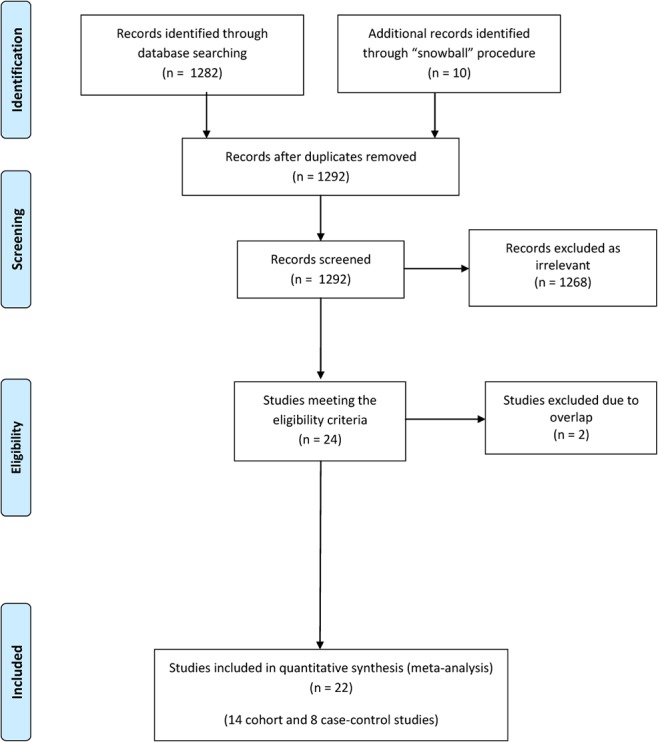
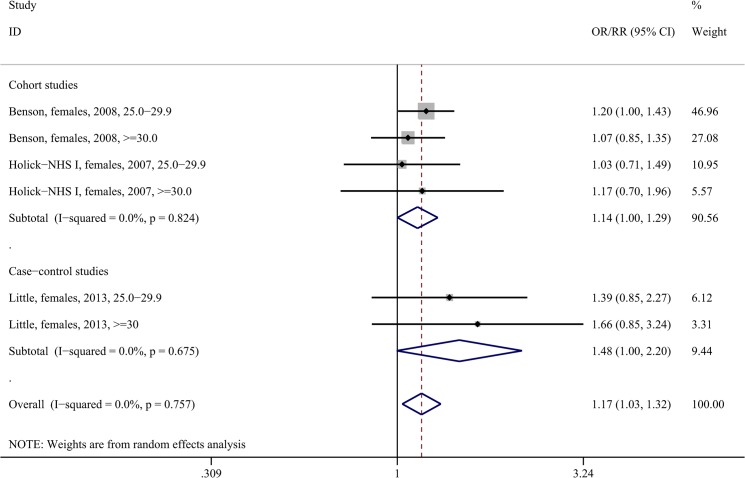
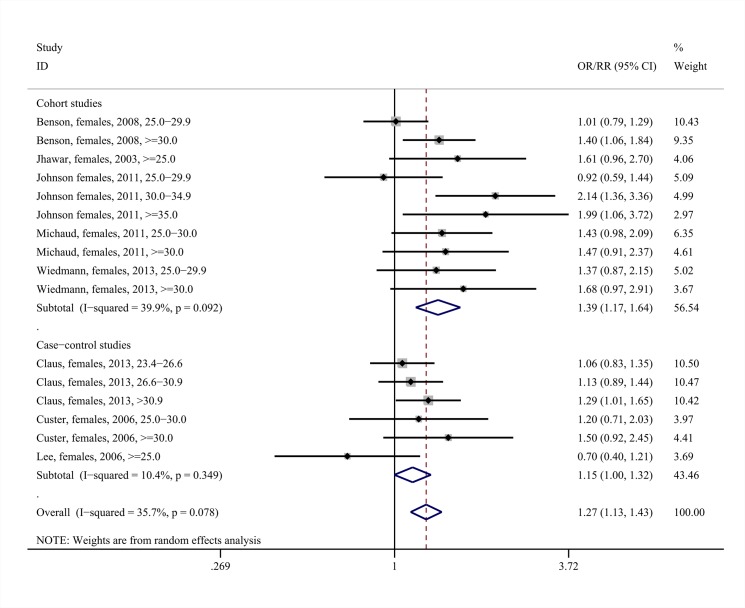
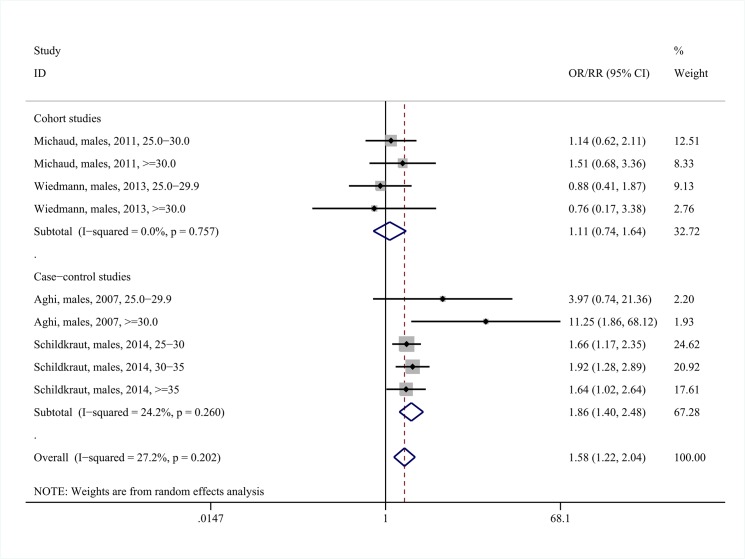
A total of 22 studies were eligible, namely 14 cohort studies (10,219 incident brain/CNS tumor cases, 1,319 meningioma and 2,418 glioma cases in a total cohort size of 10,143,803 subjects) and eight case-control studies (1,009 brain/CNS cases, 1,977 meningioma cases, 1,265 glioma cases and 8,316 controls). In females, overweight status/obesity was associated with increased risk for overall brain/CNS tumors (pooled RR = 1.12, 95%CI: 1.03-1.21, 10 study arms), meningiomas (pooled RR = 1.27, 95%CI: 1.13-1.43, 16 study arms) and gliomas (pooled RR = 1.17, 95%CI: 1.03-1.32, six arms). Obese (BMI>30 kg/m2) females seemed particularly aggravated in terms of brain/CNS tumor (pooled RR = 1.19, 95%CI: 1.05-1.36, six study arms) and meningioma risk (pooled RR = 1.48, 95%CI: 1.28-1.71, seven arms). In males, overweight/obesity status correlated with increased meningioma risk (pooled RR = 1.58, 95%CI: 1.22-2.04, nine study arms), whereas the respective association with overall brain/CNS tumor or glioma risk was not statistically significant. Dose-response meta-regression analysis further validated the findings.
Our findings highlight obesity as a risk factor for overall brain/CNS tumors, meningiomas and gliomas among females, as well as for meningiomas among males.
本荟萃分析旨在研究超重/肥胖与脑膜瘤、神经胶质瘤以及总体脑/中枢神经系统(CNS)肿瘤风险之间的关联。
截至2014年6月30日,在PubMed中检索可能符合条件的出版物。进行随机效应荟萃分析和剂量反应荟萃回归分析。使用Cochran Q统计量、I²和τ²评估研究间的异质性。使用Stata/SE 13版统计软件进行分析。
共有22项研究符合条件,即14项队列研究(10219例新发脑/CNS肿瘤病例,1319例脑膜瘤病例和2418例神经胶质瘤病例,总队列规模为10143803名受试者)和8项病例对照研究(1009例脑/CNS病例,1977例脑膜瘤病例,1265例神经胶质瘤病例和8316例对照)。在女性中,超重/肥胖状态与总体脑/CNS肿瘤风险增加相关(合并相对危险度RR = 1.12,95%可信区间CI:1.03 - 1.21,10个研究组)、脑膜瘤(合并RR = 1.27,95%CI:1.13 - 1.43,16个研究组)和神经胶质瘤(合并RR = 1.17,95%CI:1.03 - 1.32,6个研究组)。肥胖(体重指数BMI>30 kg/m²)女性在脑/CNS肿瘤(合并RR = 1.19,95%CI:1.05 - 1.36,6个研究组)和脑膜瘤风险方面似乎尤其严重(合并RR = 1.48,95%CI:1.28 - 1.71,7个研究组)。在男性中,超重/肥胖状态与脑膜瘤风险增加相关(合并RR = 1.58,95%CI:1.22 - 2.04,9个研究组),而与总体脑/CNS肿瘤或神经胶质瘤风险的相应关联无统计学意义。剂量反应荟萃回归分析进一步验证了这些发现。
我们的研究结果突出了肥胖是女性总体脑/CNS肿瘤、脑膜瘤和神经胶质瘤以及男性脑膜瘤的一个风险因素。