Crémet Lise, Broquet Alexis, Brulin Bénédicte, Jacqueline Cédric, Dauvergne Sandie, Brion Régis, Asehnoune Karim, Corvec Stéphane, Heymann Dominique, Caroff Nathalie
UPRES EA3826, Laboratory of Clinical and Experimental Therapeutics of Infections., Medicine Faculty, University of Nantes, 1, rue G. Veil, F-44000 Nantes, France Department of Bacteriology-Hygiene, Nantes University Hospital, F-44000 Nantes, France.
UPRES EA3826, Laboratory of Clinical and Experimental Therapeutics of Infections., Medicine Faculty, University of Nantes, 1, rue G. Veil, F-44000 Nantes, France.
Pathog Dis. 2015 Nov;73(8):ftv065. doi: 10.1093/femspd/ftv065. Epub 2015 Sep 1.
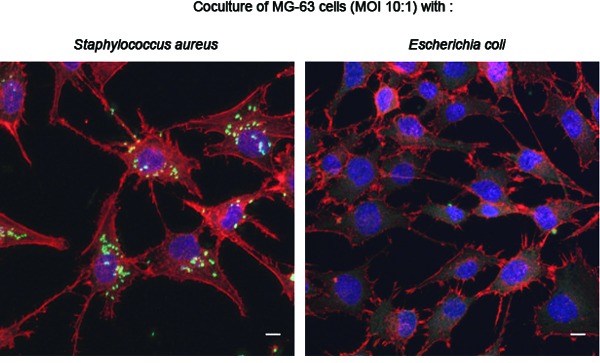
Escherichia coli is one of the first causes of Gram-negative orthopedic implant infections (OII), but little is known about the pathogenicity of this species in such infections that are increasing due to the ageing of the population. We report how this pathogen interacts with human osteoblastic MG-63 cells in vitro, by comparing 20 OII E. coli strains to two Staphylococcus aureus and two Pseudomonas aeruginosa strains. LDH release assay revealed that 6/20 (30%) OII E. coli induced MG-63 cell lysis whereas none of the four control strains was cytotoxic after 4 h of coculture. This high cytotoxicity was associated with hemolytic properties and linked to hlyA gene expression. We further showed by gentamicin protection assay and confocal microscopy that the non-cytotoxic E. coli were not able to invade MG-63 cells unlike S. aureus strains (internalization rate <0.01% for the non-cytotoxic E. coli versus 8.88 ± 2.31% and 4.60 ± 0.42% for both S. aureus). The non-cytotoxic E. coli also demonstrated low adherence rates (<7%), the most adherent E. coli eliciting higher IL-6 and TNF-α mRNA expression in the osteoblastic cells. Either highly cytotoxic or slightly invasive OII E. coli do not show the same infection strategies as S. aureus towards osteoblasts.
大肠杆菌是革兰氏阴性骨科植入物感染(OII)的首要病因之一,但对于该菌种在这类因人口老龄化而日益增多的感染中的致病性,人们了解甚少。我们通过将20株OII大肠杆菌菌株与两株金黄色葡萄球菌和两株铜绿假单胞菌菌株进行比较,报告了这种病原体在体外与人成骨MG-63细胞的相互作用。乳酸脱氢酶释放试验显示,6/20(30%)的OII大肠杆菌诱导MG-63细胞裂解,而在共培养4小时后,四种对照菌株均无细胞毒性。这种高细胞毒性与溶血特性相关,并与hlyA基因表达有关。我们通过庆大霉素保护试验和共聚焦显微镜进一步表明,与金黄色葡萄球菌菌株不同,无细胞毒性的大肠杆菌无法侵入MG-63细胞(无细胞毒性的大肠杆菌内化率<0.01%,而两株金黄色葡萄球菌的内化率分别为8.88±2.31%和4.60±0.42%)。无细胞毒性的大肠杆菌的黏附率也很低(<7%),黏附性最强的大肠杆菌在成骨细胞中引发更高的白细胞介素-6和肿瘤坏死因子-α mRNA表达。高细胞毒性或轻度侵袭性的OII大肠杆菌对成骨细胞的感染策略与金黄色葡萄球菌不同。