Xu Min, Yang Shi-Long, Peng Wei, Liu Yu-Jie, Xie Da-Shuai, Li Xin-Yi, Wu Chun-Jie
College of Pharmacy, Chengdu University of Traditional Chinese Medicine, No. 1166, Liutai Road, Wenjiang District, Chengdu 611137, China.
College of Pharmacy, Chengdu University of Traditional Chinese Medicine, No. 1166, Liutai Road, Wenjiang District, Chengdu 611137, China ; The Key Laboratory of Technology of Chinese Medicine Processing, State Administration of Traditional Chinese Medicine, No. 1166, Liutai Road, Wenjiang District, Chengdu 611137, China.
Evid Based Complement Alternat Med. 2015;2015:753942. doi: 10.1155/2015/753942. Epub 2015 Aug 26.
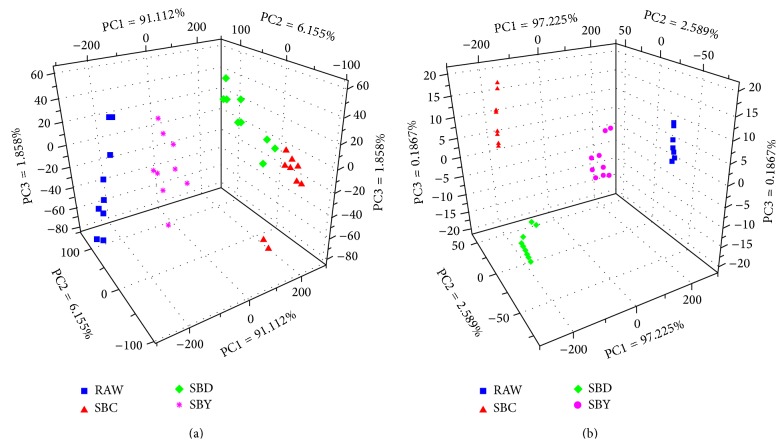
Areca nut, commonly known locally as Semen Arecae (SA) in China, has been used as an important Chinese herbal medicine for thousands of years. The raw SA (RAW) is commonly processed by stir-baking to yellow (SBY), stir-baking to dark brown (SBD), and stir-baking to carbon dark (SBC) for different clinical uses. In our present investigation, intelligent sensory technologies consisting of computer vision (CV), electronic nose (E-nose), and electronic tongue (E-tongue) were employed in order to develop a novel and accurate method for discrimination of SA and its processed products. Firstly, the color parameters and electronic sensory responses of E-nose and E-tongue of the samples were determined, respectively. Then, indicative components including 5-hydroxymethyl furfural (5-HMF) and arecoline (ARE) were determined by HPLC. Finally, principal component analysis (PCA) and discriminant factor analysis (DFA) were performed. The results demonstrated that these three instruments can effectively discriminate SA and its processed products. 5-HMF and ARE can reflect the stir-baking degree of SA. Interestingly, the two components showed close correlations to the color parameters and sensory responses of E-nose and E-tongue. In conclusion, this novel method based on CV, E-nose, and E-tongue can be successfully used to discriminate SA and its processed products.
槟榔在中国当地通常被称为槟榔(SA),数千年来一直被用作重要的中药材。生槟榔(RAW)通常经过炒黄(SBY)、炒焦(SBD)和炒炭(SBC)等不同炮制方法以用于不同的临床用途。在我们目前的研究中,采用了由计算机视觉(CV)、电子鼻(E-nose)和电子舌(E-tongue)组成的智能感官技术,以开发一种新颖且准确的方法来鉴别槟榔及其炮制产品。首先,分别测定了样品的颜色参数以及电子鼻和电子舌的电子感官响应。然后,通过高效液相色谱法测定了包括5-羟甲基糠醛(5-HMF)和槟榔碱(ARE)在内的标志性成分。最后,进行了主成分分析(PCA)和判别因子分析(DFA)。结果表明,这三种仪器能够有效鉴别槟榔及其炮制产品。5-HMF和ARE可以反映槟榔的炮制程度。有趣的是,这两种成分与电子鼻和电子舌的颜色参数及感官响应密切相关。总之,这种基于CV、E-nose和E-tongue的新方法可成功用于鉴别槟榔及其炮制产品。