Alonso Eva, Lopez-Etxaniz Idoia, Hurtado Ana, Liendo Paloma, Urbaneja Felix, Aspiritxaga Inmaculada, Olaizola Jose Ignacio, Piñero Alvaro, Arrazola Iñaki, Barandika Jesús F, Hernáez Silvia, Muniozguren Nerea, García-Pérez Ana L
Department of Epidemiology, Subdirección de Salud Pública de Bizkaia, Gobierno Vasco, Bilbao, Bizkaia, Spain.
Department of Epidemiology, OSALAN- Instituto Vasco de Seguridad y Salud Laborales, Barakaldo, Bizkaia, Spain.
PLoS One. 2015 Sep 23;10(9):e0138817. doi: 10.1371/journal.pone.0138817. eCollection 2015.
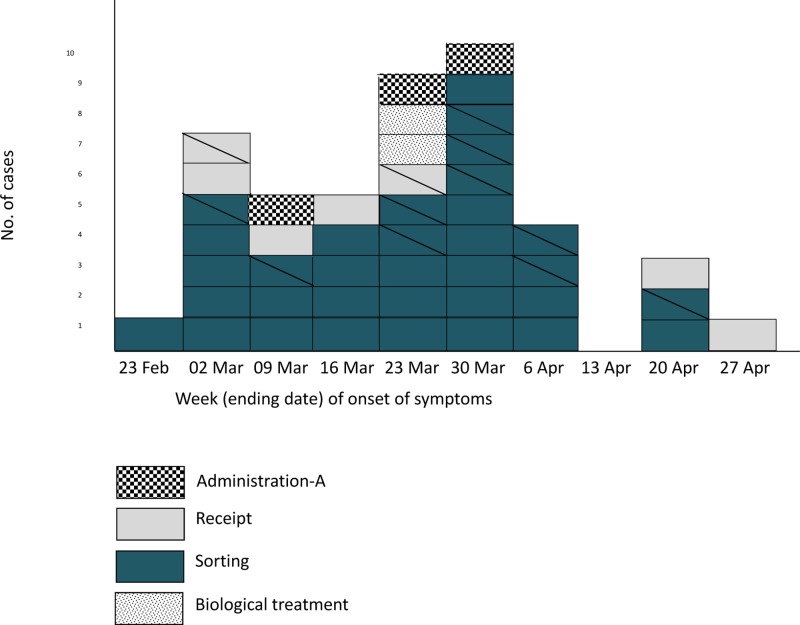
An outbreak of Q fever occurred in February-April 2014 among workers at a waste-sorting plant in Bilbao (Spain). The outbreak affected 58.5% of investigated employees, 47.2% as confirmed cases (PCR and/or serology) and 11.3% as probable cases (symptoms without laboratory confirmation). Only employees who had no-access to the waste processing areas of the plant were not affected and incidence of infection was significantly higher among workers not using respiratory protection masks. Detection by qPCR of Coxiella burnetii in dust collected from surfaces of the plant facilities confirmed exposure of workers inside the plant. Animal remains sporadically detected among the residues received for waste-sorting were the most probable source of infection. After cleaning and disinfection, all environmental samples tested negative. Personal protection measures were reinforced and made compulsory for the staff and actions were taken to raise farmers' awareness of the biological risk of discharging animal carcasses as urban waste.
2014年2月至4月,西班牙毕尔巴鄂一家垃圾分类厂的工人中爆发了Q热疫情。此次疫情影响了58.5%接受调查的员工,其中47.2%为确诊病例(通过PCR和/或血清学检测确诊),11.3%为疑似病例(有症状但未经实验室确诊)。只有无法进入工厂废物处理区域的员工未受影响,未佩戴呼吸防护口罩的工人感染率显著更高。通过qPCR检测工厂设施表面收集的灰尘中的伯氏考克斯体,证实工厂内工人受到了感染。在垃圾分类接收的残渣中偶尔检测到的动物遗骸是最可能的感染源。清洁和消毒后,所有环境样本检测均为阴性。加强了个人防护措施并强制员工执行,同时采取行动提高农民对将动物尸体作为城市垃圾排放的生物风险的认识。