Dalton Michelle, Hollingworth Sophie, Blundell John, Finlayson Graham
Appetite Control & Energy Balance Research, School of Psychology, Faculty of Medicine and Health, University of Leeds, Leeds LS2 9JT, UK.
Nutrients. 2015 Sep 4;7(9):7421-36. doi: 10.3390/nu7095345.
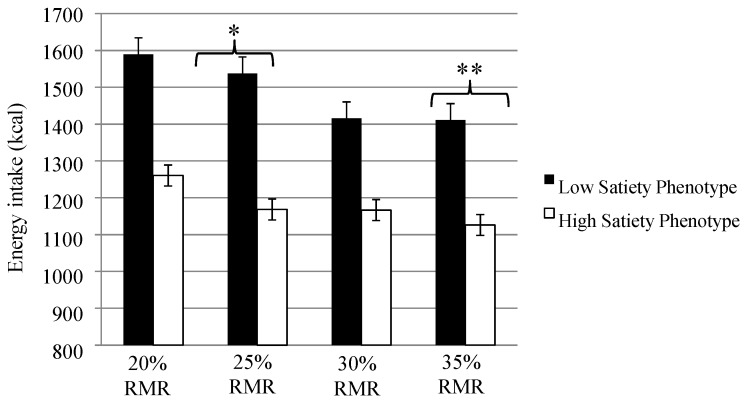
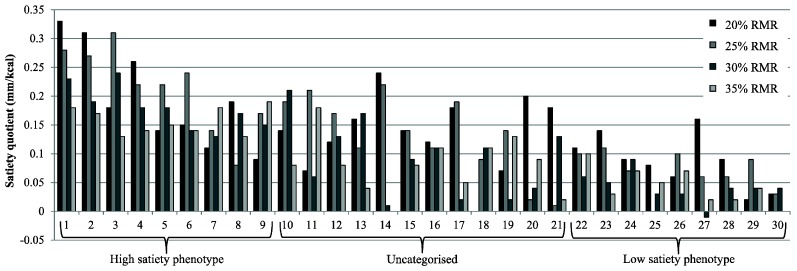
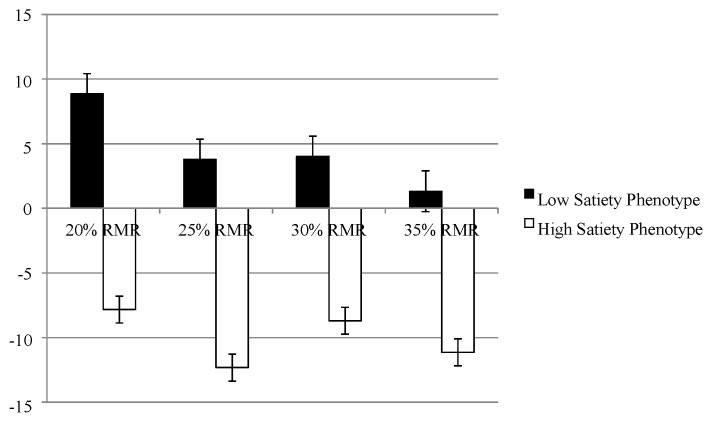
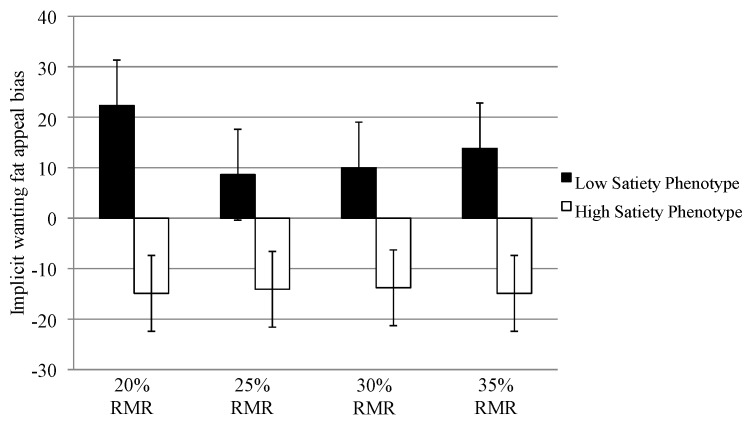
Some individuals exhibit a weak satiety response to food and may be susceptible to overconsumption. The current study identified women showing consistently low or high satiety responses to standardised servings of food across four separate days and compared them on behavioural, psychological and physiological risk factors for overeating and future weight gain. In a crossover design, 30 female participants (age: 28.0 ± 10.6; body mass index (BMI): 23.1 ± 3.0) recorded sensations of hunger in the post-prandial period following four graded energy level breakfasts. Satiety quotients were calculated to compare individuals on satiety responsiveness across conditions. Body composition, resting metabolic rate (RMR), energy intake, food reward and craving, and eating behaviour traits were assessed under controlled laboratory conditions. A distinct low satiety phenotype (LSP) was identified with good consistency across separate study days. These individuals had a higher RMR, greater levels of disinhibition and reported feeling lower control over food cravings. Further, they consumed more energy and exhibited greater wanting for high-fat food. The inverse pattern of characteristics was observed in those exhibiting a consistently high satiety phenotype (HSP). Weak satiety responsiveness is a reliable trait identifiable using the satiety quotient. The LSP was characterised by distinct behavioural and psychological characteristics indicating a risk for overeating, compared to HSP.
一些人对食物的饱腹感反应较弱,可能容易过度进食。当前的研究识别出在四天里对标准化食物分量始终表现出低饱腹感或高饱腹感反应的女性,并比较了她们在暴饮暴食和未来体重增加方面的行为、心理和生理风险因素。在交叉设计中,30名女性参与者(年龄:28.0±10.6;体重指数(BMI):23.1±3.0)记录了在四种不同能量水平早餐后的餐后饥饿感。计算饱腹感商数以比较不同条件下个体的饱腹感反应能力。在受控实验室条件下评估身体成分、静息代谢率(RMR)、能量摄入、食物奖励与渴望以及饮食行为特征。在不同的研究日中一致地识别出了一种明显的低饱腹感表型(LSP)。这些个体的静息代谢率较高,去抑制水平较高,并且报告称对食物渴望的控制感较低。此外,他们消耗了更多能量,并且对高脂肪食物表现出更强烈的欲望。在那些始终表现出高饱腹感表型(HSP)的个体中观察到了相反的特征模式。弱饱腹感反应能力是一种可以通过饱腹感商数识别的可靠特征。与高饱腹感表型相比,低饱腹感表型具有明显的行为和心理特征,表明存在暴饮暴食的风险。