• 文献检索
  • 文档翻译
  • 深度研究
  • 学术资讯
  • Suppr Zotero 插件Zotero 插件
  • 邀请有礼
  • 套餐&价格
  • 历史记录
应用&插件
Suppr Zotero 插件Zotero 插件浏览器插件Mac 客户端Windows 客户端微信小程序
定价
高级版会员购买积分包购买API积分包
服务
文献检索文档翻译深度研究API 文档MCP 服务
关于我们
关于 Suppr公司介绍联系我们用户协议隐私条款
关注我们

Suppr 超能文献

核心技术专利:CN118964589B侵权必究
粤ICP备2023148730 号-1Suppr @ 2026

文献检索

告别复杂PubMed语法,用中文像聊天一样搜索,搜遍4000万医学文献。AI智能推荐,让科研检索更轻松。

立即免费搜索

文件翻译

保留排版,准确专业,支持PDF/Word/PPT等文件格式,支持 12+语言互译。

免费翻译文档

深度研究

AI帮你快速写综述,25分钟生成高质量综述,智能提取关键信息,辅助科研写作。

立即免费体验

The limitations of using risk factors to screen for blunt cerebrovascular injuries: the harder you look, the more you find.

作者信息

Jacobson Lewis E, Ziemba-Davis Mary, Herrera Argenis J

机构信息

Department of Surgery, St. Vincent Indianapolis Hospital, 2001 West 86th Street, Indianapolis, IN 46260 USA.

St. Vincent Neuroscience Institute, 8333 Naab Road, Indianapolis, IN 46260 USA.

出版信息

World J Emerg Surg. 2015 Sep 26;10:46. doi: 10.1186/s13017-015-0040-7. eCollection 2015.

DOI:10.1186/s13017-015-0040-7
PMID:26413148
原文链接:https://pmc.ncbi.nlm.nih.gov/articles/PMC4583749/
Abstract

INTRODUCTION

Blunt cerebrovascular injury (BCVI) is reported to occur in 1-2 % of blunt trauma patients. Clinical and radiologic risk factors for BCVI have been described to help identify patients that require screening for these injuries. However, recent studies have suggested that BCVI frequently occurs even in the absence of these risk factors. The purpose of this study was to determine the incidence of BCVI in blunt trauma patients without risk factors and whether these patients could be identified by a more liberal CTA screening protocol.

METHODS

We conducted a retrospective cohort study of all blunt trauma patients seen between November 2010 and May 2014. In May 2012, a clinical practice guideline for CTA screening for BCVI was implemented. The records of all patients with BCVI were reviewed for the presence of risk factors for BCVI previously described in the literature.

RESULTS

During the 43 month study period, 6,602 blunt trauma patients were evaluated, 2,374 prior to, and 4,228 after implementation of the clinical practice guideline. Nineteen percent of all blunt trauma patients underwent CTA of the neck after protocol implementation compared to only 1.5 % prior to protocol implementation (p = 0.001). As a result, a 5-fold increase in the identification of BCVI was observed (p = 0.00003). Thirty-seven percent of patients with BCVI identified with the enhanced CT screening protocol had none of the signs, symptoms, or risk factors usually associated with these injuries.

CONCLUSIONS

Our findings demonstrate that reliance on clinical or radiologic risk factors alone as indications for screening for BCVI is inadequate. We recommend routine CTA screening for BCVI in all patients who have sustained a mechanism of injury sufficient to warrant either a CT of the cervical spine or a CTA of the chest.
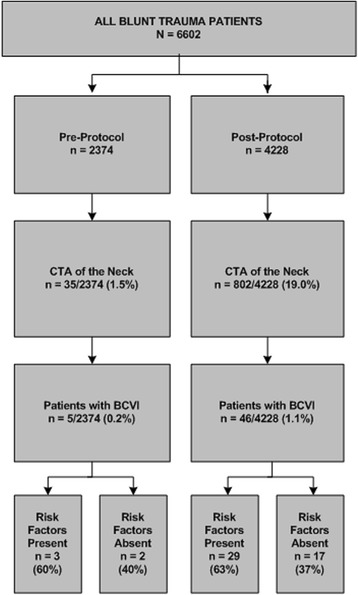
摘要
https://cdn.ncbi.nlm.nih.gov/pmc/blobs/a084/4583749/c4f240a413e6/13017_2015_40_Fig1_HTML.jpg

相似文献

1
The limitations of using risk factors to screen for blunt cerebrovascular injuries: the harder you look, the more you find.
World J Emerg Surg. 2015 Sep 26;10:46. doi: 10.1186/s13017-015-0040-7. eCollection 2015.
2
Routine CTA screening identifies blunt cerebrovascular injuries missed by clinical risk factors.常规CT血管造影筛查可发现临床危险因素遗漏的钝性脑血管损伤。
Trauma Surg Acute Care Open. 2022 Aug 26;7(1):e000924. doi: 10.1136/tsaco-2022-000924. eCollection 2022.
3
Risk factors for traumatic blunt cerebrovascular injury diagnosed by computed tomography angiography in the pediatric population: a retrospective cohort study.计算机断层血管造影诊断儿童创伤性钝性脑血管损伤的危险因素:一项回顾性队列研究。
J Neurosurg Pediatr. 2015 Jun;15(6):599-606. doi: 10.3171/2014.11.PEDS14397. Epub 2015 Mar 6.
4
Association between cervical fracture patterns and blunt cerebrovascular injury when screened with computed tomographic angiography.颈椎骨折类型与计算机断层血管造影筛查出的钝性脑血管损伤之间的相关性。
Spine J. 2024 Feb;24(2):310-316. doi: 10.1016/j.spinee.2023.09.010. Epub 2023 Sep 20.
5
Sixteen-slice computed tomographic angiography is a reliable noninvasive screening test for clinically significant blunt cerebrovascular injuries.16层计算机断层血管造影术是一种用于筛查具有临床意义的钝性脑血管损伤的可靠无创检查方法。
J Trauma. 2006 Apr;60(4):745-51; discussion 751-2. doi: 10.1097/01.ta.0000204034.94034.c4.
6
Initial screening test for blunt cerebrovascular injury: Validity assessment of whole-body computed tomography.钝性脑血管损伤的初始筛查试验:全身计算机断层扫描的有效性评估
Surgery. 2015 Sep;158(3):627-35. doi: 10.1016/j.surg.2015.03.063. Epub 2015 Jun 9.
7
Prospective screening for blunt cerebrovascular injuries: analysis of diagnostic modalities and outcomes.钝性脑血管损伤的前瞻性筛查:诊断方式及结果分析
Ann Surg. 2002 Sep;236(3):386-93; discussion 393-5. doi: 10.1097/01.SLA.0000027174.01008.A0.
8
Blunt cerebrovascular injuries: does treatment always matter?钝性脑血管损伤:治疗是否总是至关重要?
J Trauma. 2009 Jan;66(1):132-43; discussion 143-4. doi: 10.1097/TA.0b013e318142d146.
9
Blunt cerebrovascular injury screening guidelines: what are we willing to miss?钝性脑血管损伤筛查指南:我们愿意遗漏什么?
J Trauma Acute Care Surg. 2014 Mar;76(3):691-5. doi: 10.1097/TA.0b013e3182ab1b4d.
10
Limitations of multidetector computed tomography angiography for the diagnosis of blunt cerebrovascular injury.多排螺旋 CT 血管造影诊断钝性脑血管损伤的局限性。
J Neurosurg. 2018 Jun;128(6):1642-1647. doi: 10.3171/2017.2.JNS163264. Epub 2017 Aug 11.

引用本文的文献

1
Traumatic Vertebral Artery Injury: Diagnosis, Natural History, and Key Considerations for Management.创伤性椎动脉损伤:诊断、自然病程及管理的关键考量因素
J Clin Med. 2025 May 2;14(9):3159. doi: 10.3390/jcm14093159.
2
Blunt Cerebrovascular Injury: Are We Overscreening Low-Mechanism Trauma?钝性脑血管损伤:我们是否过度筛查低机制创伤?
AJNR Am J Neuroradiol. 2023 Nov;44(11):1296-1301. doi: 10.3174/ajnr.A8004. Epub 2023 Oct 12.
3
Routine CTA screening identifies blunt cerebrovascular injuries missed by clinical risk factors.常规CT血管造影筛查可发现临床危险因素遗漏的钝性脑血管损伤。

本文引用的文献

1
Endovascular stenting is rarely necessary for the management of blunt cerebrovascular injuries.血管内支架置入术很少用于治疗钝性脑血管损伤。
J Am Coll Surg. 2014 May;218(5):1012-7. doi: 10.1016/j.jamcollsurg.2014.01.042. Epub 2014 Feb 3.
2
Blunt cerebrovascular injury screening guidelines: what are we willing to miss?钝性脑血管损伤筛查指南:我们愿意遗漏什么?
J Trauma Acute Care Surg. 2014 Mar;76(3):691-5. doi: 10.1097/TA.0b013e3182ab1b4d.
3
Incidence and trends in the diagnosis of traumatic extracranial cerebrovascular injury in the nationwide inpatient sample database, 2003-2010.
Trauma Surg Acute Care Open. 2022 Aug 26;7(1):e000924. doi: 10.1136/tsaco-2022-000924. eCollection 2022.
4
Atypical hangman's fracture with concomitant subaxial fracture-dislocation treated with circumferential fusion of C2-C5-a case report.颈椎 C2-C5 环形融合治疗伴有下颈椎骨折脱位的不典型绞刑骨折:病例报告。
Spinal Cord Ser Cases. 2020 Dec 2;6(1):108. doi: 10.1038/s41394-020-00365-3.
5
Cerebral infarct secondary to traumatic internal carotid artery dissection.外伤性颈内动脉夹层继发脑梗死
World J Clin Cases. 2020 Oct 26;8(20):4773-4784. doi: 10.12998/wjcc.v8.i20.4773.
6
Blunt cerebrovascular injury: incidence and long-term follow-up.钝性脑血管损伤:发生率及长期随访。
Eur J Trauma Emerg Surg. 2021 Feb;47(1):161-170. doi: 10.1007/s00068-019-01171-9. Epub 2019 Jun 13.
7
Augmenting Denver criteria yields increased BCVI detection, with screening showing markedly increased risk for subsequent ischemic stroke.强化丹佛标准可提高钝性脑血管损伤(BCVI)的检测率,筛查显示后续缺血性卒中风险显著增加。
Emerg Radiol. 2019 Aug;26(4):365-372. doi: 10.1007/s10140-019-01677-0. Epub 2019 Feb 12.
8
Management of Blunt Cerebrovascular Injury.钝性脑血管损伤的处理。
Curr Neurol Neurosci Rep. 2018 Oct 23;18(12):98. doi: 10.1007/s11910-018-0906-7.
9
Blunt traumatic vascular injuries of the head and neck in the ED.急诊科中头颈部钝性创伤性血管损伤
Emerg Radiol. 2019 Feb;26(1):75-85. doi: 10.1007/s10140-018-1630-y. Epub 2018 Aug 10.
10
Blunt cerebrovascular injury in elderly fall patients: are we screening enough?老年跌倒患者的钝性脑血管损伤:我们的筛查足够吗?
World J Emerg Surg. 2018 Jul 4;13:30. doi: 10.1186/s13017-018-0188-z. eCollection 2018.
J Neurotrauma. 2014 Jun 1;31(11):1056-62. doi: 10.1089/neu.2013.3309. Epub 2014 Apr 11.
4
Blunt cerebrovascular injury screening with 64-channel multidetector computed tomography: more slices finally cut it.64 层多排 CT 对钝性脑血管损伤的筛查作用:多层扫描终于派上用场了。
J Trauma Acute Care Surg. 2014 Feb;76(2):279-83; discussion 284-5. doi: 10.1097/TA.0000000000000101.
5
Review of multidetector computed tomography angiography as a screening modality in the assessment of blunt vascular neck injuries.多排螺旋 CT 血管造影在钝性颈部血管损伤评估中的筛查作用评价。
Can Assoc Radiol J. 2013 May;64(2):130-9. doi: 10.1016/j.carj.2013.02.002. Epub 2013 Mar 28.
6
Blunt cerebrovascular injuries: redefining screening criteria in the era of noninvasive diagnosis.钝性脑血管损伤:在无创诊断时代重新定义筛选标准。
J Trauma Acute Care Surg. 2012 Feb;72(2):330-5; discussion 336-7, quiz 539. doi: 10.1097/TA.0b013e31823de8a0.
7
A systematic review and meta-analysis of diagnostic screening criteria for blunt cerebrovascular injuries.一项关于钝性脑血管损伤诊断筛查标准的系统评价和荟萃分析。
J Am Coll Surg. 2012 Mar;214(3):313-27. doi: 10.1016/j.jamcollsurg.2011.11.012. Epub 2012 Jan 11.
8
Improving the screening criteria for blunt cerebrovascular injury: the appropriate role for computed tomography angiography.改进钝性脑血管损伤的筛查标准:计算机断层血管造影的恰当作用。
J Trauma. 2011 May;70(5):1058-63; discussion 1063-5. doi: 10.1097/TA.0b013e318213f849.
9
Management of blunt extracranial traumatic cerebrovascular injury: a multidisciplinary survey of current practice.钝性颅脑创伤性脑血管损伤的治疗:当前实践的多学科调查。
World J Emerg Surg. 2011 Apr 8;6:11. doi: 10.1186/1749-7922-6-11.
10
Blunt cerebrovascular injury screening with 32-channel multidetector computed tomography: more slices still don't cut it.32 层多排 CT 筛查钝性脑血管损伤:更多层面仍不适用。
Ann Surg. 2011 Mar;253(3):444-50. doi: 10.1097/SLA.0b013e31820d946b.