Emdin Connor A, Anderson Simon G, Callender Thomas, Conrad Nathalie, Salimi-Khorshidi Gholamreza, Mohseni Hamid, Woodward Mark, Rahimi Kazem
The George Institute for Global Health, Oxford Martin School, University of Oxford, Oxford OX1 3DB, UK.
The George Institute for Global Health, University of Sydney, Sydney, Australia Department of Epidemiology, Johns Hopkins University, Baltimore, MD, USA.
BMJ. 2015 Sep 29;351:h4865. doi: 10.1136/bmj.h4865.
To determine the subgroup specific associations between usual blood pressure and risk of peripheral arterial disease, and to examine the relation between peripheral arterial disease and a range of other types of vascular disease in a large contemporary cohort.
Cohort study.
Linked electronic health records from 1990 to 2013 in the United Kingdom.
4,222,459 people aged 30-90 years, registered at a primary care practice for at least one year and with a blood pressure measurement.
Time to first diagnosis of new onset peripheral arterial disease and time to first diagnosis of 12 different vascular events.
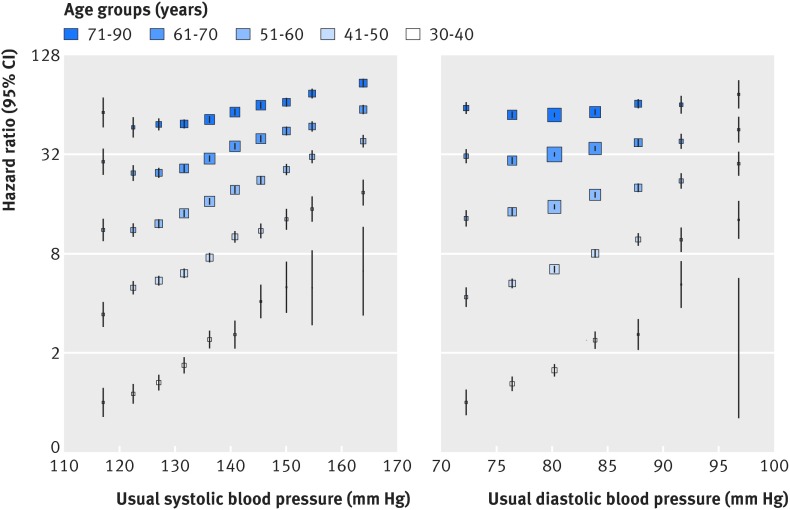
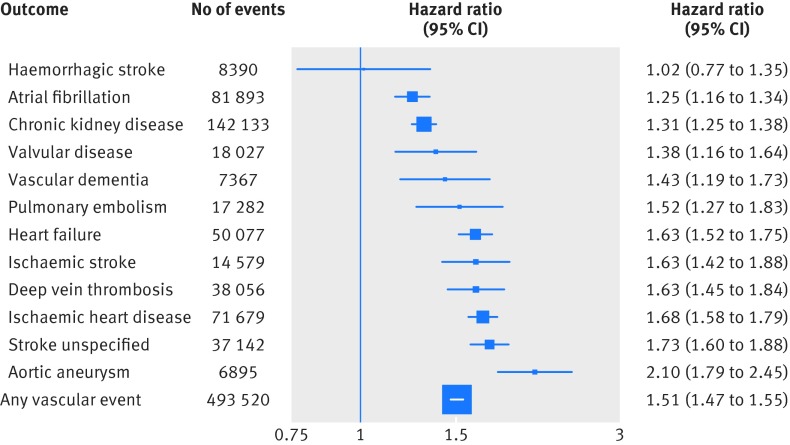
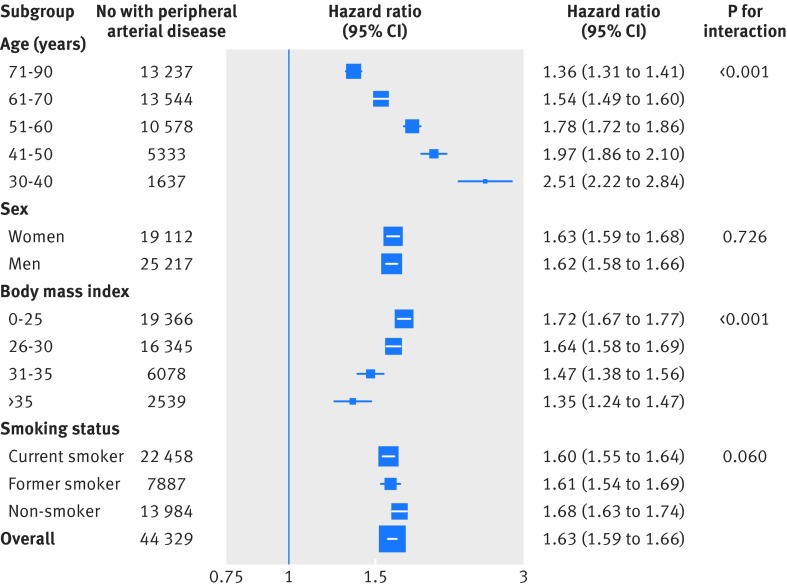
A 20 mm Hg higher than usual systolic blood pressure was associated with a 63% higher risk of peripheral arterial disease (hazard ratio 1.63, 95% confidence interval 1.59 to 1.66). The strength of the association declined with increasing age and body mass index (P<0.001 for interaction) but was not modified by sex or smoking status. Peripheral arterial disease was associated with an increased risk of 11 different vascular events, including ischaemic heart disease (1.68, 1.58 to 1.79), heart failure (1.63, 1.52 to 1.75), aortic aneurysm (2.10, 1.79 to 2.45), and chronic kidney disease (1.31, 1.25 to 1.38), but not haemorrhagic stroke. The most common initial vascular event among those with peripheral arterial disease was chronic kidney disease (24.4% of initial events), followed by ischaemic heart disease (18.5% of initial events), heart failure (14.7%), and atrial fibrillation (13.2%). Overall estimates from this cohort were consistent with those derived from traditional studies when we pooled the findings in two meta-analyses.
Raised blood pressure is a strong risk factor for peripheral arterial disease in a range of patient subgroups. Furthermore, clinicians should be aware that those with established peripheral arterial disease are at an increased risk of a range of other vascular events, including chronic kidney disease, ischaemic heart disease, heart failure, atrial fibrillation, and stroke.
确定正常血压与外周动脉疾病风险之间的亚组特异性关联,并在一个大型当代队列中研究外周动脉疾病与一系列其他类型血管疾病之间的关系。
队列研究。
1990年至2013年英国的关联电子健康记录。
4222459名年龄在30 - 90岁之间的人,在初级保健机构注册至少一年且有血压测量值。
首次诊断新发外周动脉疾病的时间以及首次诊断12种不同血管事件的时间。
收缩压比正常水平高20 mmHg与外周动脉疾病风险高63%相关(风险比1.63,95%置信区间1.59至1.66)。这种关联的强度随年龄和体重指数的增加而下降(交互作用P<0.001),但不受性别或吸烟状况的影响。外周动脉疾病与11种不同血管事件的风险增加相关,包括缺血性心脏病(1.68,1.58至1.79)、心力衰竭(1.63,1.52至1.75)、主动脉瘤(2.10,1.79至2.45)和慢性肾病(1.31,1.25至1.38),但与出血性中风无关。外周动脉疾病患者中最常见的初始血管事件是慢性肾病(初始事件的24.4%),其次是缺血性心脏病(初始事件的18.5%)、心力衰竭(14.7%)和心房颤动(13.2%)。当我们在两项荟萃分析中汇总研究结果时,该队列的总体估计与传统研究得出的结果一致。
血压升高是一系列患者亚组中外周动脉疾病的强危险因素。此外,临床医生应意识到,已确诊外周动脉疾病的患者发生一系列其他血管事件的风险增加,包括慢性肾病、缺血性心脏病、心力衰竭、心房颤动和中风。