Hughes John, Kabir Zubair, Bennett Kathleen, Hotchkiss Joel W, Kee Frank, Leyland Alastair H, Davies Carolyn, Bandosz Piotr, Guzman-Castillo Maria, O'Flaherty Martin, Capewell Simon, Critchley Julia
UKCRC Centre of Excellence for Public Health, Queen's University, Belfast, United Kingdom.
Department of Epidemiology &Public Health University College Cork, Cork, Ireland.
PLoS One. 2015 Sep 30;10(9):e0138044. doi: 10.1371/journal.pone.0138044. eCollection 2015.
Despite rapid declines over the last two decades, coronary heart disease (CHD) mortality rates in the British Isles are still amongst the highest in Europe. This study uses a modelling approach to compare the potential impact of future risk factor scenarios relating to smoking and physical activity levels, dietary salt and saturated fat intakes on future CHD mortality in three countries: Northern Ireland (NI), Republic of Ireland (RoI) and Scotland.
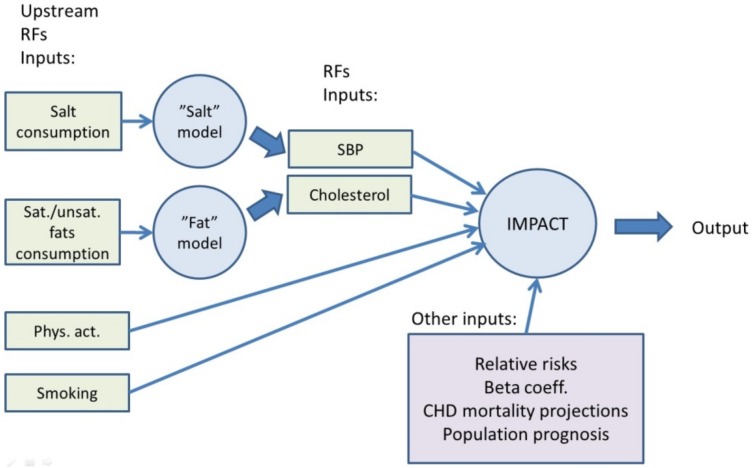
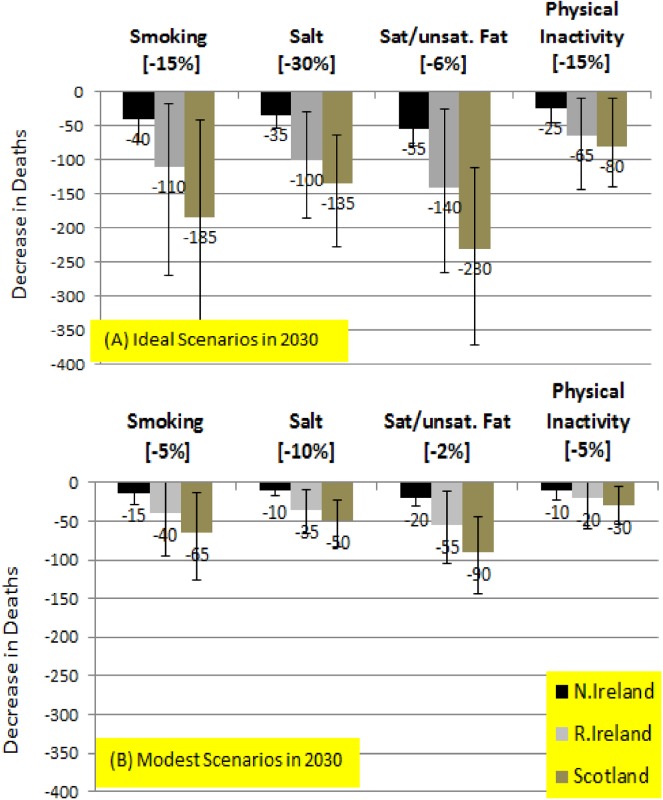
CHD mortality models previously developed and validated in each country were extended to predict potential reductions in CHD mortality from 2010 (baseline year) to 2030. Risk factor trends data from recent surveys at baseline were used to model alternative future risk factor scenarios: Absolute decreases in (i) smoking prevalence and (ii) physical inactivity rates of up to 15% by 2030; relative decreases in (iii) dietary salt intake of up to 30% by 2030 and (iv) dietary saturated fat of up to 6% by 2030. Probabilistic sensitivity analyses were then conducted.
Projected populations in 2030 were 1.3, 3.4 and 3.9 million in NI, RoI and Scotland respectively (adults aged 25-84). In 2030: assuming recent declining mortality trends continue: 15% absolute reductions in smoking could decrease CHD deaths by 5.8-7.2%. 15% absolute reductions in physical inactivity levels could decrease CHD deaths by 3.1-3.6%. Relative reductions in salt intake of 30% could decrease CHD deaths by 5.2-5.6% and a 6% reduction in saturated fat intake might decrease CHD deaths by some 7.8-9.0%. These projections remained stable under a wide range of sensitivity analyses.
Feasible reductions in four cardiovascular risk factors (already achieved elsewhere) could substantially reduce future coronary deaths. More aggressive polices are therefore needed in the British Isles to control tobacco, promote healthy food and increase physical activity.
尽管在过去二十年中冠心病(CHD)死亡率迅速下降,但不列颠群岛的冠心病死亡率仍位居欧洲最高之列。本研究采用建模方法,比较未来与吸烟、身体活动水平、饮食中盐和饱和脂肪摄入量相关的风险因素情景对北爱尔兰(NI)、爱尔兰共和国(RoI)和苏格兰这三个国家未来冠心病死亡率的潜在影响。
先前在每个国家开发并验证的冠心病死亡率模型被扩展,以预测2010年(基准年)至2030年冠心病死亡率的潜在降低情况。使用基准年近期调查中的风险因素趋势数据来模拟未来不同的风险因素情景:到2030年,(i)吸烟率绝对下降高达15%,(ii)身体不活动率绝对下降高达15%;到2030年,(iii)饮食中盐摄入量相对下降高达30%,(iv)饮食中饱和脂肪相对下降高达6%。然后进行概率敏感性分析。
预计到2030年,北爱尔兰、爱尔兰共和国和苏格兰的人口分别为130万、340万和390万(25 - 84岁成年人)。到2030年:假设近期死亡率下降趋势持续:吸烟率绝对下降15%可使冠心病死亡人数减少5.8 - 7.2%。身体不活动水平绝对下降15%可使冠心病死亡人数减少3.1 - 3.6%。盐摄入量相对减少30%可使冠心病死亡人数减少5.2 - 5.6%,饱和脂肪摄入量减少6%可能使冠心病死亡人数减少约7.8 - 9.0%。在广泛的敏感性分析下,这些预测结果保持稳定。
在四个心血管风险因素方面实现可行的降低(其他地方已实现)可大幅减少未来的冠心病死亡人数。因此,不列颠群岛需要更积极的政策来控制烟草、推广健康食品并增加身体活动。