Saadeh Danielle, Salameh Pascale, Caillaud Denis, Charpin Denis, De Blay Frédéric, Kopferschmitt Christine, Lavaud François, Annesi-Maesano Isabella, Baldi Isabelle, Raherison Chantal
Clinical and Epidemiological Research Laboratory, Lebanese University, Hadath, Lebanon.
INSERM U897, Institut de Santé Publique d'Epidémiologie et de Développement, Laboratoire Santé Travail Environnement, Université de Bordeaux, Bordeaux, France.
BMC Public Health. 2015 Sep 30;15:993. doi: 10.1186/s12889-015-2320-2.
The prevalence of asthma and allergy has recently risen among children. This increase in prevalence might be related to various factors, particularly diet. The aim of this study is to assess the prevalence and association of asthma and allergic sensitization with dietary factors in the French Six Cities Study.
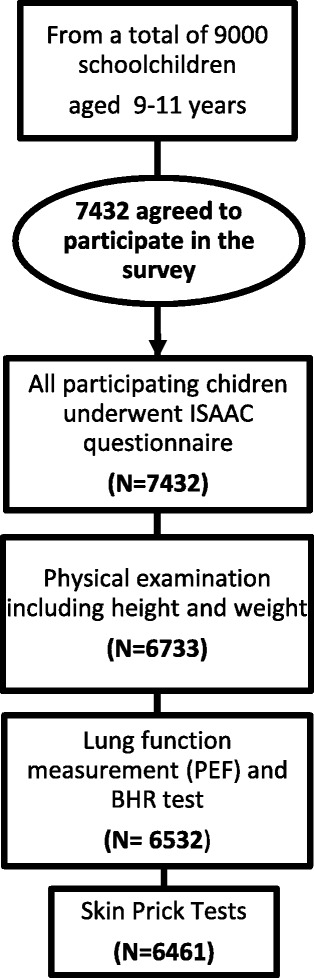
Cross-sectional studies were performed among 7432 schoolchildren aged 9-11 years in Bordeaux, Clermont-Ferrand, Créteil, Marseille, Reims, and Strasbourg. Parental questionnaires, based on the International Study on Asthma and Allergies in Childhood (ISAAC), were used to collect information on allergic diseases and potential exposure factors including a food frequency questionnaire to evaluate dietary habits. Skin prick testing to common allergens for allergic sensitization and bronchial hyper-responsiveness (BHR) testing to exercise were performed. Confounders control was performed with multiple logistic regressions.
Asthma symptoms, asthma and allergic sensitization were more prevalent in boys than in girls and were more prevalent in the South than in the North of France. After adjustment for confounders, fruit juice intake was associated with a low prevalence of lifetime asthma (ORa [95 % CI]; 0.73 [0.56-0.97]), butter intake was positively associated with atopic wheeze (1.48 [1.07-2.05]) and having lunch at the canteen 1-2 times/week compared to never or occasionally was associated with a lower prevalence of past year wheeze (0.71 [0.52-0.96]), lifetime asthma (0.76 [0.60-0.96]) and allergic sensitization (0.80 [0.67-0.95]). Meat intake was inversely related to past year wheeze among atopic children (0.68 [0.50-0.98]) while fast food consumption and butter intake were associated with an increase prevalence of asthma (2.39 [1.47-3.93] and 1.51 [1.17-2.00] respectively). Fish intake was associated with a lower prevalence of asthma among non-atopic children (0.61 [0.43-0.87]. None of the dietary factors was associated with BHR.
Diet is associated with wheeze, asthma and allergic sensitization but not with BHR in children. These results provide further evidence that adherence to a healthy diet including fruits, meat and fish seems to have a protective effect on asthma and allergy in childhood. However, prospective and experimental studies are needed to provide causal evidence concerning the effect of diet on asthma and atopy.
哮喘和过敏症在儿童中的患病率最近有所上升。患病率的增加可能与多种因素有关,尤其是饮食。本研究的目的是在法国六城市研究中评估哮喘和过敏致敏与饮食因素的患病率及相关性。
对波尔多、克莱蒙费朗、克雷泰伊、马赛、兰斯和斯特拉斯堡的7432名9至11岁学童进行了横断面研究。基于儿童哮喘和过敏国际研究(ISAAC)的家长问卷,用于收集有关过敏性疾病和潜在暴露因素的信息,包括一份食物频率问卷以评估饮食习惯。对常见变应原进行皮肤点刺试验以检测过敏致敏情况,并对运动进行支气管高反应性(BHR)测试。通过多元逻辑回归进行混杂因素控制。
哮喘症状、哮喘和过敏致敏在男孩中比在女孩中更普遍,在法国南部比在北部更普遍。在对混杂因素进行调整后,果汁摄入量与终生哮喘患病率较低相关(ORa[95%CI];0.73[0.56 - 0.97]),黄油摄入量与特应性喘息呈正相关(1.48[1.07 - 2.05]),与从不或偶尔在食堂吃午餐相比,每周在食堂吃午餐1 - 2次与过去一年喘息患病率较低相关(0.71[0.52 - 0.96])、终生哮喘患病率较低相关(0.76[0.60 - 0.96])以及过敏致敏患病率较低相关(0.80[0.67 - 0.95])。肉类摄入量与特应性儿童过去一年喘息呈负相关(0.68[0.50 - 0.98]),而快餐消费和黄油摄入量与哮喘患病率增加相关(分别为2.39[1.47 - 3.93]和1.51[1.17 - 2.00])。鱼类摄入量与非特应性儿童哮喘患病率较低相关(0.61[0.43 - 0.87])。没有任何饮食因素与BHR相关。
饮食与儿童的喘息、哮喘和过敏致敏相关,但与BHR无关。这些结果进一步证明,坚持包括水果、肉类和鱼类在内的健康饮食似乎对儿童哮喘和过敏有保护作用。然而,需要前瞻性和实验性研究来提供关于饮食对哮喘和特应性影响的因果证据。