Liu Yuanbao, Hu Ying, Deng Xiuying, Wang Zhiguo, Lu Peishan, Ma Fubao, Zhou Minghao, Liu Pei, Min Jie
Department of Expanded Programme on Immunization, Jiangsu Provincial Center for Disease Control and Prevention, Nanjing, Jiangsu province, 210009, China.
Department of Biostatistics and Epidemiology, School of Public Health, Southeast University, Nanjing, Jiangsu province, 210009, China.
Sci Rep. 2015 Oct 1;5:14660. doi: 10.1038/srep14660.
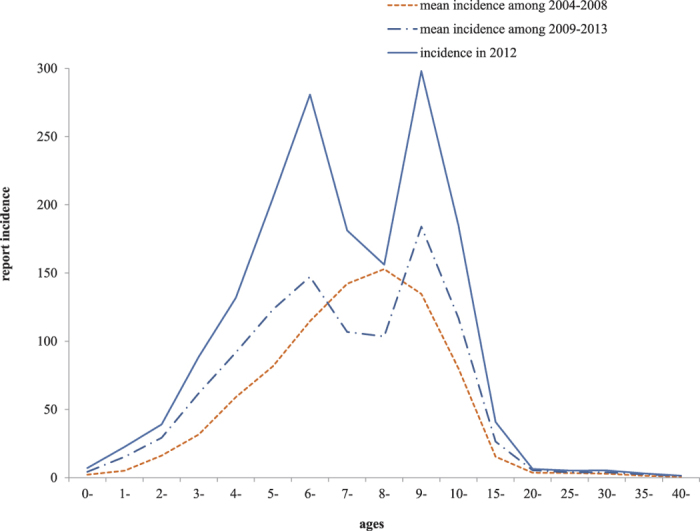
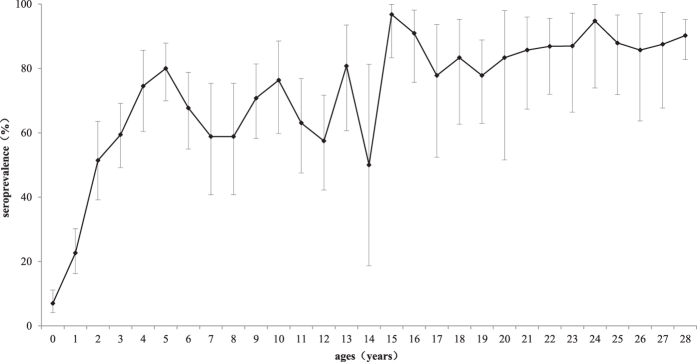
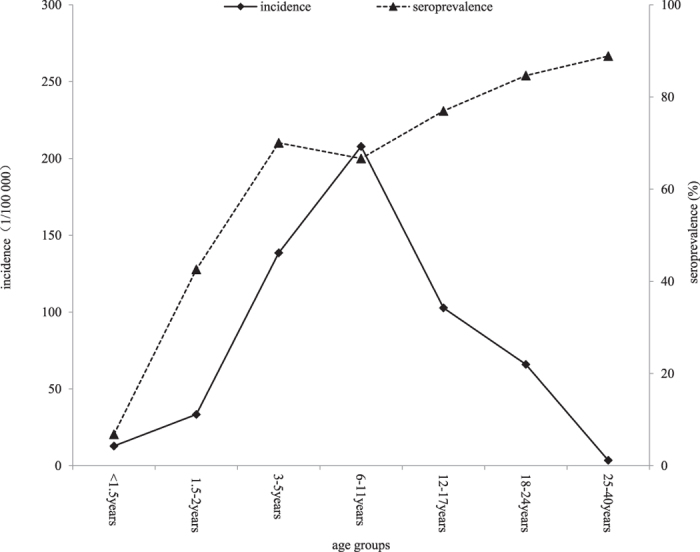
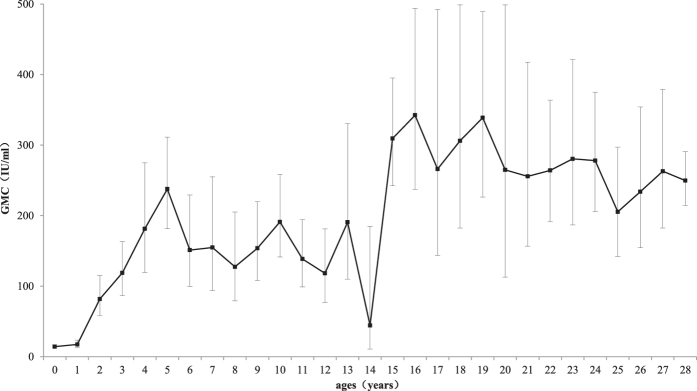
The mumps surveillance data from 2004 to 2011 showed that the incidence of mumps remained high after the one-dose measles-mumps-rubella (MMR) vaccine was introduced in China in 2008. A cross-sectional survey of mumps IgG in the general population of Jiangsu province was conducted in 2012 to gain comprehensive information on the immunity profile of the general population. The mean incidence was 15.2 per 100 000 individuals in Jiangsu province from 2004-2013. Two mumps incidence peaks were observed each year after introduction of the one-dose MMR vaccine. The seroprevalence did not significantly differ by region or sex, while the GMC significantly differed by region and sex. The overall GMC in Jiangsu province was 99.1 IU/ml (95% CI: 90.1-108.2), while the seroprevalence was only 59.1% (95% CI: 56.5-61.6). The seroprevalences for the 2 age groups that received the one-dose MMR vaccine, with reported coverage exceeding 95%, were 42.6% and 70.0%, respectively. The data on the incidence, MMR coverage, and seroprevalence in children younger than 6 years of age indicate that a two-dose MMR strategy should be considered. Mumps surveillance should be strengthened in children aged 6-11 and in those aged 12-17 because of their high contact rates and relatively low seroprevalences.
2004年至2011年的腮腺炎监测数据显示,2008年中国引入一剂次麻疹-腮腺炎-风疹(MMR)疫苗后,腮腺炎发病率仍居高不下。2012年对江苏省普通人群进行了腮腺炎IgG横断面调查,以全面了解普通人群的免疫状况。2004 - 2013年江苏省的平均发病率为每10万人15.2例。引入一剂次MMR疫苗后,每年观察到两个腮腺炎发病高峰。血清阳性率在地区或性别上无显著差异,而几何平均浓度(GMC)在地区和性别上有显著差异。江苏省的总体GMC为99.1 IU/ml(95%可信区间:90.1 - 108.2),而血清阳性率仅为59.1%(95%可信区间:56.5 - 61.6)。接种一剂次MMR疫苗且报告接种率超过95%的两个年龄组的血清阳性率分别为42.6%和70.0%。6岁以下儿童的发病率、MMR接种率和血清阳性率数据表明应考虑采用两剂次MMR策略。由于6 - 11岁和12 - 17岁儿童的接触率高且血清阳性率相对较低,应加强对这些儿童的腮腺炎监测。