Ibuka Yoko, Ohkusa Yasushi, Sugawara Tamie, Chapman Gretchen B, Yamin Dan, Atkins Katherine E, Taniguchi Kiyosu, Okabe Nobuhiko, Galvani Alison P
Graduate School of Economics and Management, Tohoku University, Sendai, Japan.
Infectious Disease Surveillance Center, National Institute of Infectious Diseases, Tokyo, Japan.
J Epidemiol Community Health. 2016 Feb;70(2):162-7. doi: 10.1136/jech-2015-205777. Epub 2015 Sep 30.
Contact patterns and vaccination decisions are fundamental to transmission dynamics of infectious diseases. We report on age-specific contact patterns in Japan and their effect on influenza vaccination behaviour.
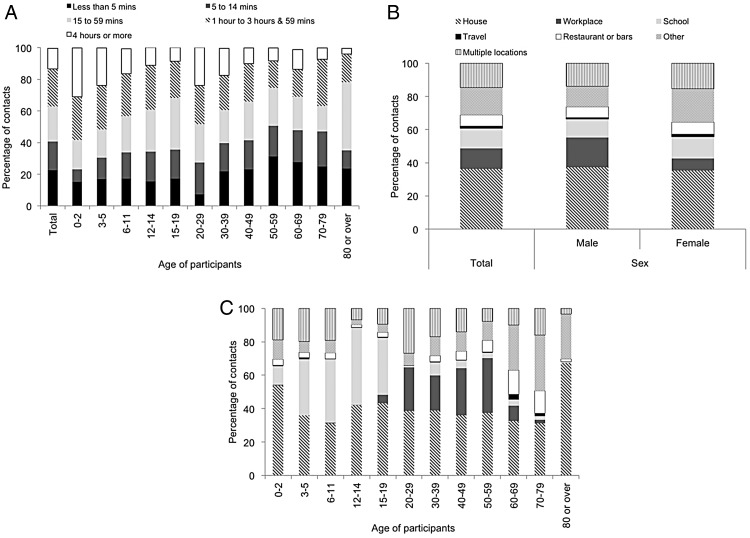
Japanese adults (N=3146) were surveyed in Spring 2011 to assess the number of their social contacts within a 24 h period, defined as face-to-face conversations within 2 m, and gain insight into their influenza-related behaviour. We analysed the duration and location of contacts according to age. Additionally, we analysed the probability of vaccination and influenza infection in relation to the number of contacts controlling for individual's characteristics.
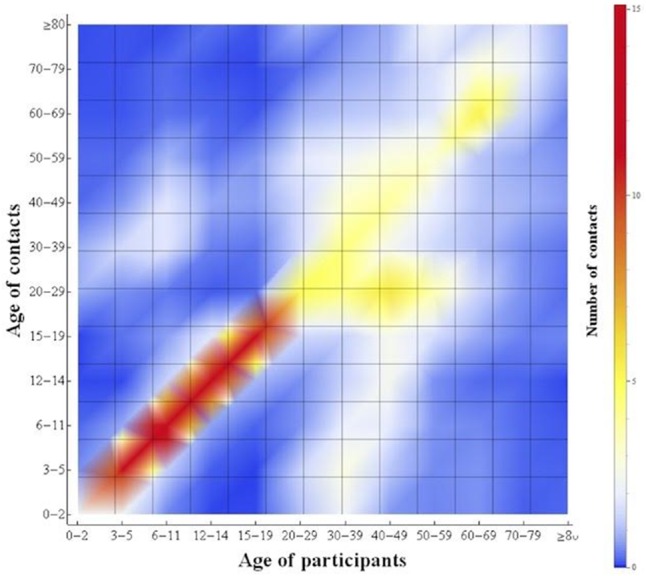
The mean and median reported numbers of daily contacts were 15.3 and 12.0, respectively. School-aged children and young adults reported the greatest number of daily contacts, and individuals had the most contacts with those in the same age group. The age-specific contact patterns were different between men and women, and differed between weekdays and weekends. Children had fewer contacts between the same age groups during weekends than during weekdays, due to reduced contacts at school. The probability of vaccination increased with the number of contacts, controlling for age and household size. Influenza infection among unvaccinated individuals was higher than for those vaccinated, and increased with the number of contacts.
Contact patterns in Japan are age and gender specific. These contact patterns, as well as their interplay with vaccination decisions and infection risks, can help inform the parameterisation of mathematical models of disease transmission and the design of public health policies, to control disease transmission.
接触模式和疫苗接种决策是传染病传播动态的基础。我们报告了日本特定年龄的接触模式及其对流感疫苗接种行为的影响。
2011年春季对3146名日本成年人进行了调查,以评估他们在24小时内的社交接触次数(定义为在2米内的面对面交谈),并深入了解他们与流感相关的行为。我们根据年龄分析了接触的持续时间和地点。此外,我们分析了在控制个体特征的情况下,接种疫苗和感染流感的概率与接触次数的关系。
报告的每日接触次数的均值和中位数分别为15.3和12.0。学龄儿童和年轻人报告的每日接触次数最多,并且个体与同年龄组的人接触最多。特定年龄的接触模式在男性和女性之间以及工作日和周末之间有所不同。由于学校接触减少,儿童在周末同年龄组之间的接触比工作日少。在控制年龄和家庭规模的情况下,接种疫苗的概率随着接触次数的增加而增加。未接种疫苗个体的流感感染率高于接种疫苗者,并且随着接触次数的增加而上升。
日本的接触模式具有年龄和性别特异性。这些接触模式,以及它们与疫苗接种决策和感染风险的相互作用,有助于为疾病传播数学模型的参数化和公共卫生政策的设计提供信息,以控制疾病传播。