Leroy Jef L, Ruel Marie, Habicht Jean-Pierre, Frongillo Edward A
Poverty, Health, and Nutrition Division, International Food Policy Research Institute, 2033 K Street NW, Washington, DC, 20006, USA.
Division of Nutritional Sciences, Cornell University, Savage Hall, Ithaca, NY, USA.
BMC Pediatr. 2015 Oct 6;15:145. doi: 10.1186/s12887-015-0458-9.
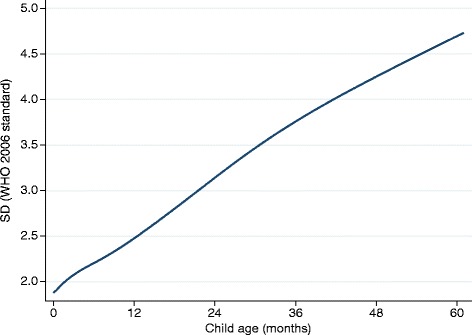
Evidence from studies conducted in nutritionally deprived children in low- and middle-income countries (LIMC) in past decades showed little or no population-level catch-up in linear growth (mostly defined as reductions in the absolute height deficit) after 2 years of age. Recent studies, however, have reported population-level catch-up growth in children, defined as positive changes in mean height-for-age z-scores (HAZ). The aim of this paper was to assess whether population-level catch-up in linear growth is found when height-for-age difference (HAD: child's height compared to standard, expressed in centimeters) is used instead of HAZ. Our premise is that HAZ is inappropriate to measure changes in linear growth over time because they are constructed using standard deviations from cross-sectional data.
We compare changes in growth in populations of children between 2 and 5 years using HAD vs. HAZ using cross-sectional data from 6 Demographic and Health Surveys (DHS) and longitudinal data from the Young Lives and the Consortium on Health-Orientated Research in Transitional Societies (COHORTS) studies.
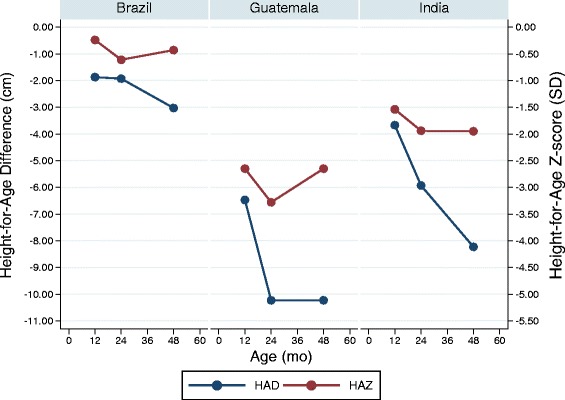
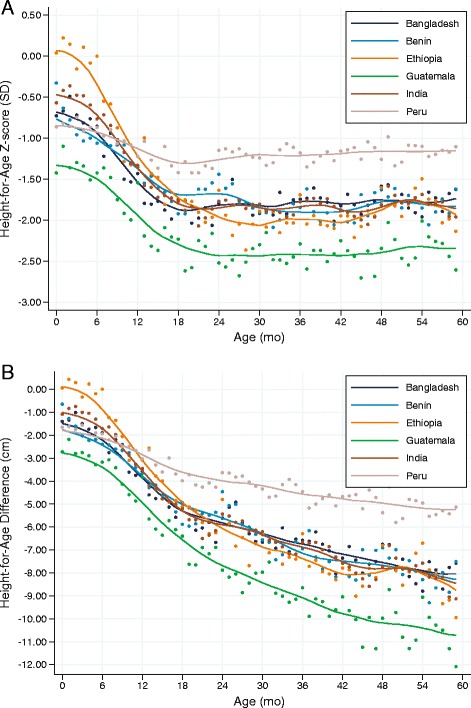
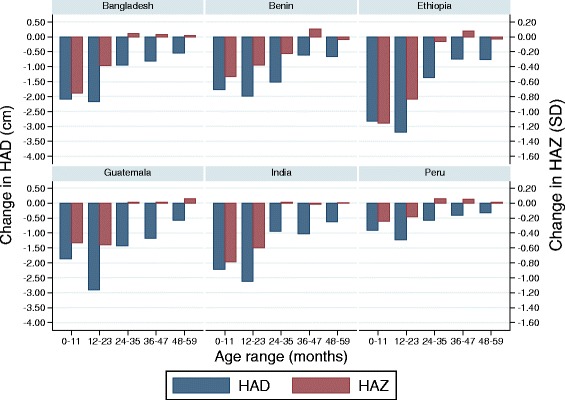
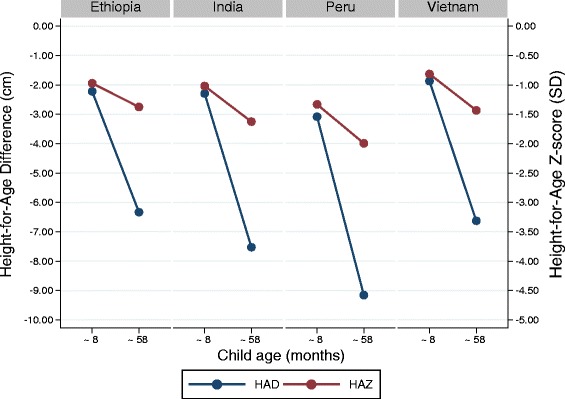
Using HAD, we find not only an absence of population-level catch-up in linear growth, but a continued deterioration reflected in a decrease in mean HAD between 2 and 5 years; by contrast, HAZ shows either no change (DHS surveys) or an improvement in mean HAZ (some of the longitudinal data). Population-level growth velocity was also lower than expected (based on standards) in all four Young Lives data sets, confirming the absence of catch-up growth in height.
We show no evidence of population-level catch-up in linear growth in children between 2 to 5 years of age when using HAD (a measure more appropriate than HAZ to document changes as populations of children age), but a continued deterioration reflected in a decrease in mean HAD.
The continued widening of the absolute height deficit after 2 years of age does not challenge the critical importance of investing in improving nutrition during the first 1000 days (i.e., from conception to 2 years of age), but raises a number of research questions including how to prevent continued deterioration and what is the potential of children to benefit from nutrition interventions after 2 years of age. Preventing, rather than reversing linear growth retardation remains the priority for reducing the global burden of malnutritionworldwide.
过去几十年在低收入和中等收入国家(LIMC)对营养缺乏儿童进行的研究证据表明,两岁之后几乎没有或不存在线性生长方面的人群水平的追赶生长(大多定义为绝对身高缺陷的减少)。然而,近期研究报告了儿童的人群水平的追赶生长,定义为年龄别身高z评分(HAZ)的正向变化。本文的目的是评估当使用年龄别身高差异(HAD:儿童身高与标准身高相比,以厘米表示)而非HAZ时,是否能发现线性生长方面的人群水平的追赶生长。我们的前提是,HAZ不适用于衡量随时间的线性生长变化,因为它们是根据横断面数据的标准差构建的。
我们使用来自6次人口与健康调查(DHS)的横断面数据以及“年轻生命”研究和转型社会健康导向研究联盟(COHORTS)研究的纵向数据,比较2至5岁儿童群体中使用HAD与HAZ时的生长变化。
使用HAD时,我们发现不仅不存在线性生长方面的人群水平的追赶生长,而且在2至5岁之间平均HAD的下降反映出持续恶化;相比之下,HAZ要么没有变化(DHS调查),要么平均HAZ有所改善(部分纵向数据)。在所有四个“年轻生命”数据集中,人群水平的生长速度也低于预期(基于标准),证实不存在身高方面的追赶生长。
我们表明,当使用HAD时(一种比HAZ更适合记录儿童群体随年龄增长的变化的指标),没有证据表明2至5岁儿童存在线性生长方面的人群水平的追赶生长,而是平均HAD的下降反映出持续恶化。
两岁之后绝对身高缺陷的持续扩大并不质疑在生命最初1000天(即从受孕到两岁)投资改善营养的至关重要性,但引发了一些研究问题,包括如何防止持续恶化以及两岁之后儿童从营养干预中受益的潜力如何。预防而非扭转线性生长迟缓仍然是减轻全球营养不良负担的首要任务。