Nayak Seema, Goel Madhu Mati, Makker Annu, Bhatia Vikram, Chandra Saumya, Kumar Sandeep, Agarwal S P
Department of Pathology, King George's Medical University, Lucknow, U.P. - 226003, India.
All India Institute of Medical Sciences Bhopal, M.P. - 462026, India.
PLoS One. 2015 Oct 14;10(10):e0138801. doi: 10.1371/journal.pone.0138801. eCollection 2015.
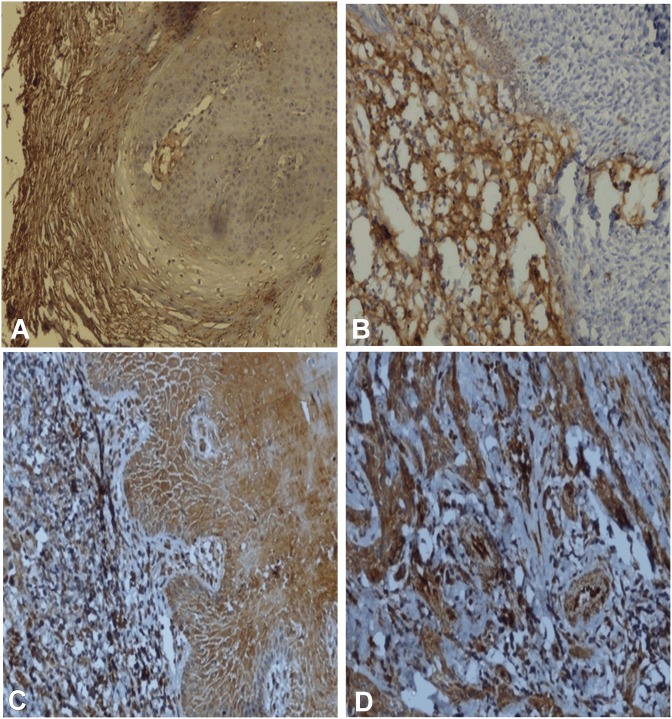
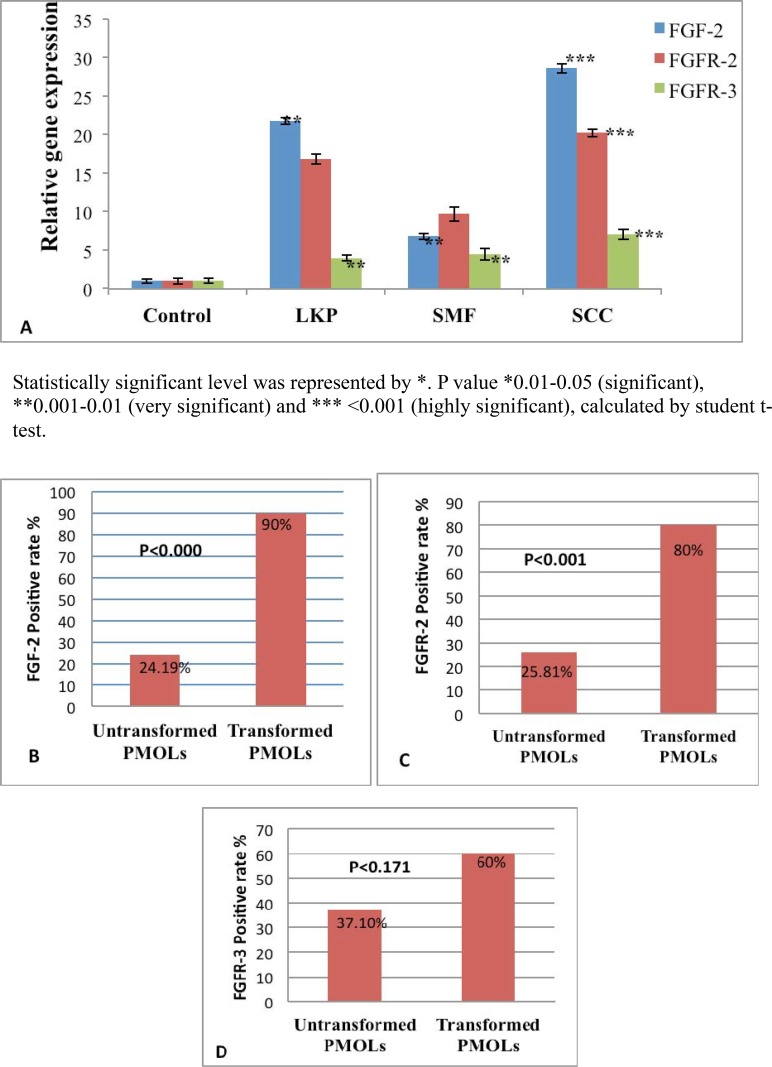
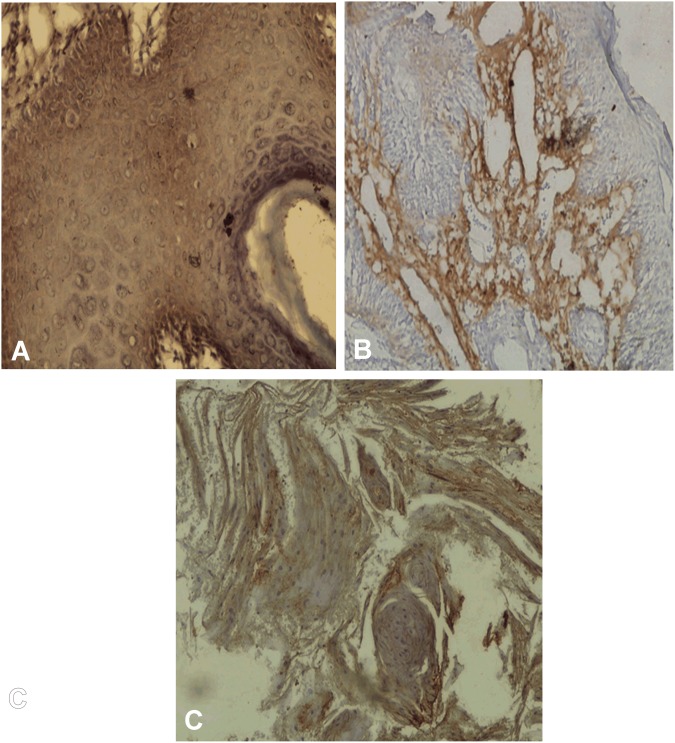
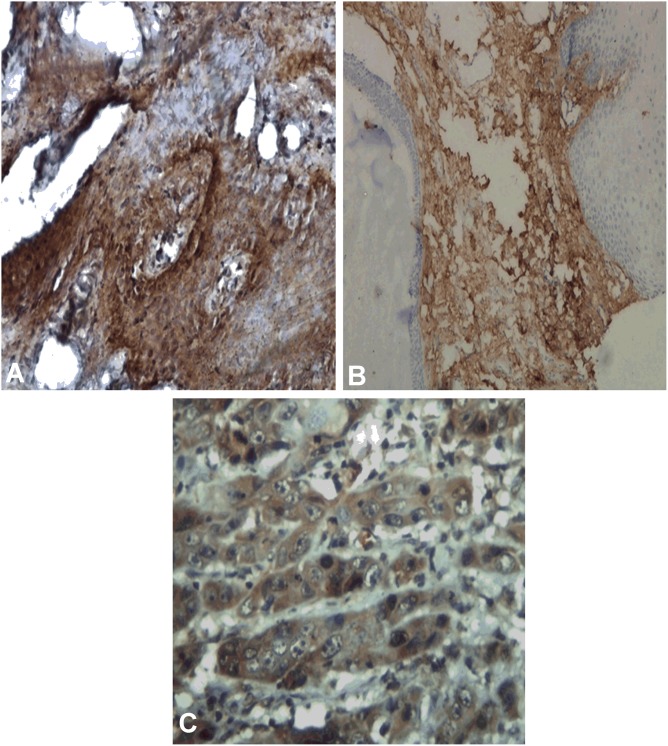
There are several factors like angiogenesis, lymphangiogenesis, genetic alterations, mutational factors that are involved in malignant transformation of potentially malignant oral lesions (PMOLs) to oral squamous cell carcinoma (OSCC). Fibroblast growth factor-2 (FGF-2) is one of the prototypes of the large family of growth factors that bind heparin. FGF-2 induces angiogenesis and its receptors may play a role in synthesis of collagen. FGFs are involved in transmission of signals between the epithelium and connective tissue, and influence growth and differentiation of a wide variety of tissue including epithelia. The present study was undertaken to analyze expression of FGF-2 and its receptors FGFR-2 and FGFR-3 in 72 PMOLs, 108 OSCC and 52 healthy controls, and their role in risk assessment for malignant transformation of Leukoplakia (LKP) and Oral submucous fibrosis (OSMF) to OSCC. Immunohistochemistry was performed using antibodies against FGF-2, FGFR-2 and FGFR-3. IHC results were validated by Real Time PCR. Expression of FGF-2, FGFR-2 and FGFR-3 was upregulated from PMOLs to OSCC. While 90% (9/10) of PMOLs which showed malignant transformation (transformed) expressed FGF-2, only 24.19% cases (15/62) of PMOLs which were not transformed (untransformed) to OSCC expressed FGF-2. Similarly, FGFR-2 expression was seen in 16/62 (25.81%) of untransformed PMOLs and 8/10 (80%) cases of transformed PMOLs. FGFR-3 expression was observed in 23/62 (37.10%) cases of untransformed PMOLs and 6/10 (60%) cases of transformed PMOLs. A significant association of FGF-2 and FGFR-2 expression with malignant transformation from PMOLs to OSCC was observed both at phenotypic and molecular level. The results suggest that FGF-2 and FGFR-2 may be useful as biomarkers of malignant transformation in patients with OSMF and LKP.
有几个因素参与了潜在恶性口腔病变(PMOLs)向口腔鳞状细胞癌(OSCC)的恶性转化,如血管生成、淋巴管生成、基因改变、突变因素等。成纤维细胞生长因子-2(FGF-2)是与肝素结合的生长因子大家族的原型之一。FGF-2诱导血管生成,其受体可能在胶原蛋白合成中发挥作用。FGFs参与上皮细胞与结缔组织之间的信号传递,并影响包括上皮细胞在内的多种组织的生长和分化。本研究旨在分析72例PMOLs、108例OSCC和52例健康对照中FGF-2及其受体FGFR-2和FGFR-3的表达情况,以及它们在白斑(LKP)和口腔黏膜下纤维化(OSMF)向OSCC恶性转化风险评估中的作用。使用抗FGF-2、FGFR-2和FGFR-3的抗体进行免疫组织化学检测。免疫组化结果通过实时荧光定量PCR进行验证。从PMOLs到OSCC,FGF-2、FGFR-2和FGFR-3的表达均上调。在发生恶性转化(已转化)的PMOLs中,90%(9/10)表达FGF-2,而未转化为OSCC的PMOLs中只有24.19%(15/62)的病例表达FGF-2。同样,在未转化的PMOLs中有16/62(25.81%)表达FGFR-2,在已转化的PMOLs中有8/10(80%)的病例表达FGFR-2。在未转化的PMOLs中有23/62(37.10%)的病例表达FGFR-3,在已转化的PMOLs中有6/10(60%)的病例表达FGFR-3。在表型和分子水平上均观察到FGF-2和FGFR-2表达与PMOLs向OSCC的恶性转化之间存在显著关联。结果表明,FGF-2和FGFR-2可能作为OSMF和LKP患者恶性转化的生物标志物。