Weatherup Robert S, D'Arsié Lorenzo, Cabrero-Vilatela Andrea, Caneva Sabina, Blume Raoul, Robertson John, Schloegl Robert, Hofmann Stephan
Department of Engineering, University of Cambridge , Cambridge CB3 0FA, United Kingdom.
Materials Sciences Division, Lawrence Berkeley National Laboratory , Berkeley, California 94720, United States.
J Am Chem Soc. 2015 Nov 18;137(45):14358-66. doi: 10.1021/jacs.5b08729. Epub 2015 Nov 9.
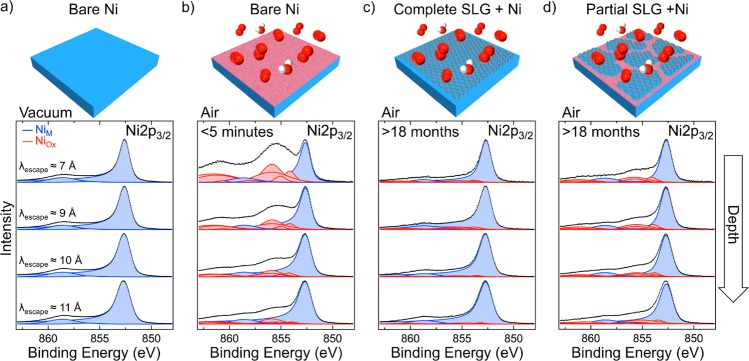
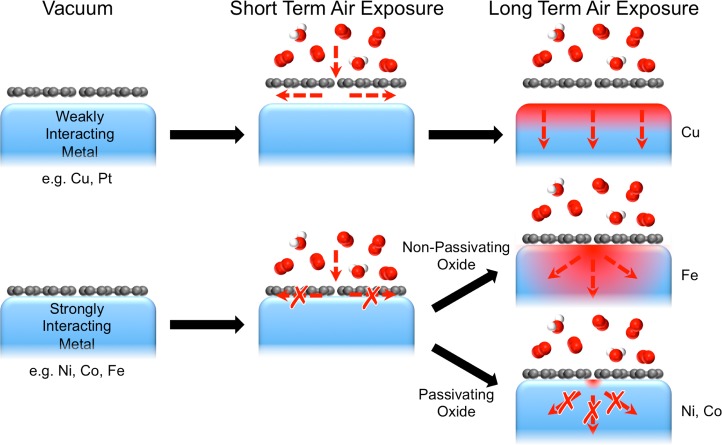
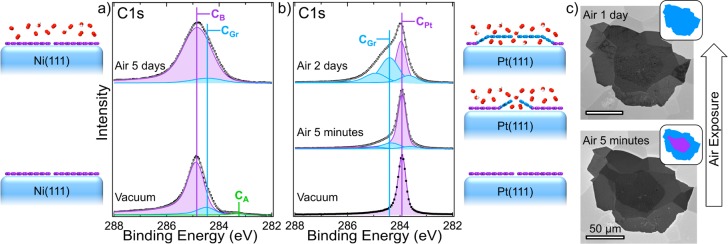
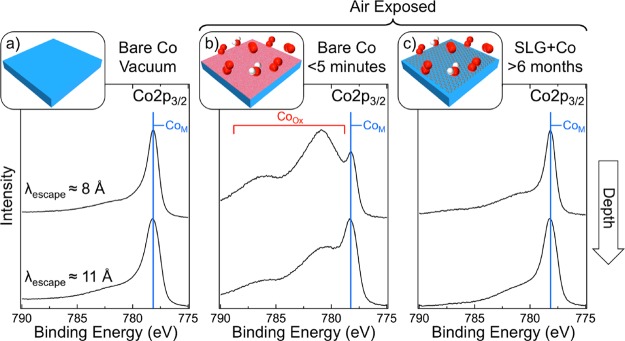
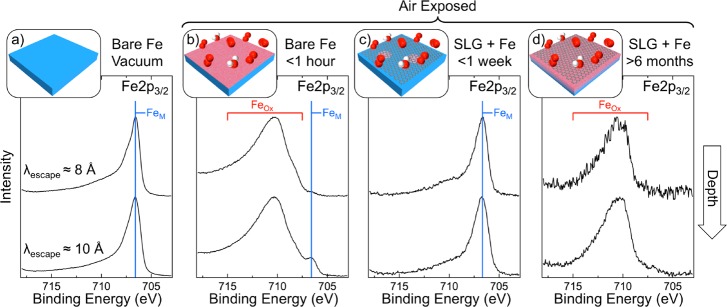
The long-term (>18 months) protection of Ni surfaces against oxidation under atmospheric conditions is demonstrated by coverage with single-layer graphene, formed by chemical vapor deposition. In situ, depth-resolved X-ray photoelectron spectroscopy of various graphene-coated transition metals reveals that a strong graphene-metal interaction is of key importance in achieving this long-term protection. This strong interaction prevents the rapid intercalation of oxidizing species at the graphene-metal interface and thus suppresses oxidation of the substrate surface. Furthermore, the ability of the substrate to locally form a passivating oxide close to defects or damaged regions in the graphene overlayer is critical in plugging these defects and preventing oxidation from proceeding through the bulk of the substrate. We thus provide a clear rationale for understanding the extent to which two-dimensional materials can protect different substrates and highlight the key implications for applications of these materials as barrier layers to prevent oxidation.
通过化学气相沉积形成的单层石墨烯覆盖,展示了镍表面在大气条件下的长期(>18个月)抗氧化性能。对各种石墨烯包覆的过渡金属进行原位深度分辨X射线光电子能谱分析表明,强石墨烯-金属相互作用对于实现这种长期保护至关重要。这种强相互作用可防止氧化物种在石墨烯-金属界面快速嵌入,从而抑制基底表面的氧化。此外,基底在靠近石墨烯覆盖层中的缺陷或受损区域局部形成钝化氧化物的能力,对于堵塞这些缺陷并防止氧化通过基底主体进行至关重要。因此,我们为理解二维材料能够保护不同基底的程度提供了清晰的理论依据,并突出了这些材料作为防止氧化的阻挡层应用的关键意义。