Aitchison Laurence, Bang Dan, Bahrami Bahador, Latham Peter E
Gatsby Computational Neuroscience Unit, University College London, London, United Kingdom.
Department of Experimental Psychology, University of Oxford, Oxford, United Kingdom; Calleva Research Centre for Evolution and Human Sciences, Magdalen College, University of Oxford, Oxford, United Kingdom; Interacting Minds Centre, Aarhus University, Aarhus, Denmark.
PLoS Comput Biol. 2015 Oct 30;11(10):e1004519. doi: 10.1371/journal.pcbi.1004519. eCollection 2015 Oct.
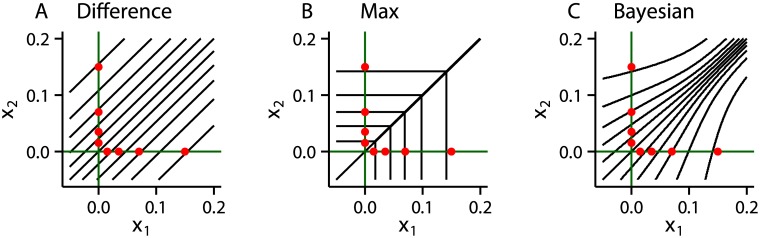
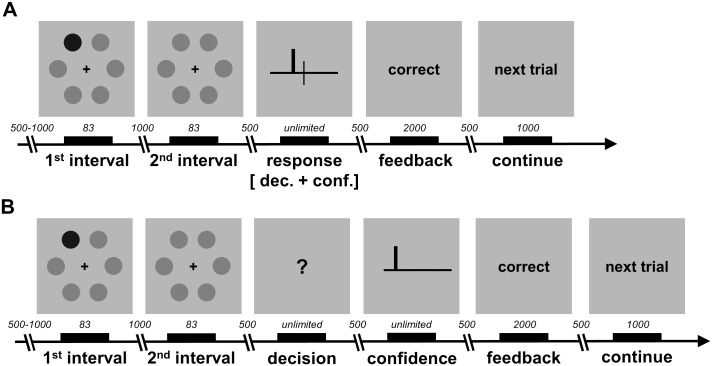
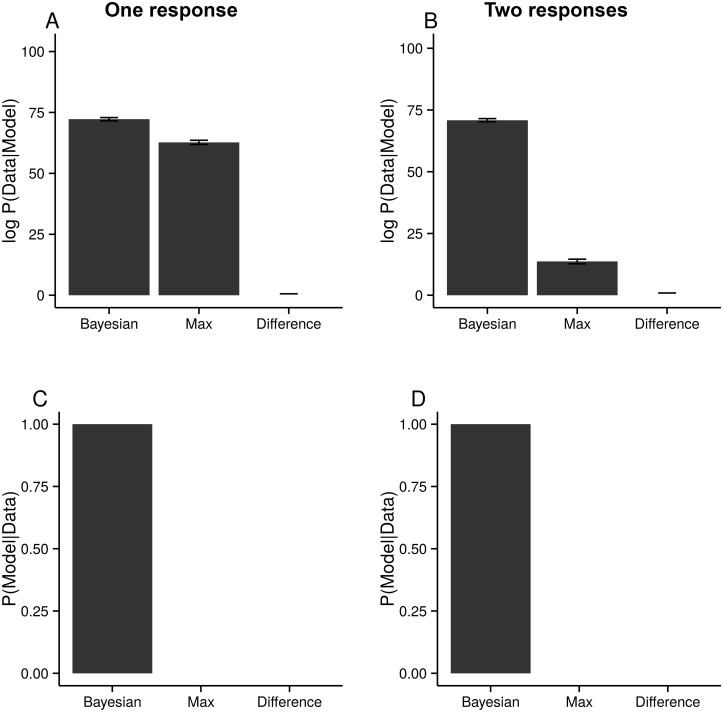
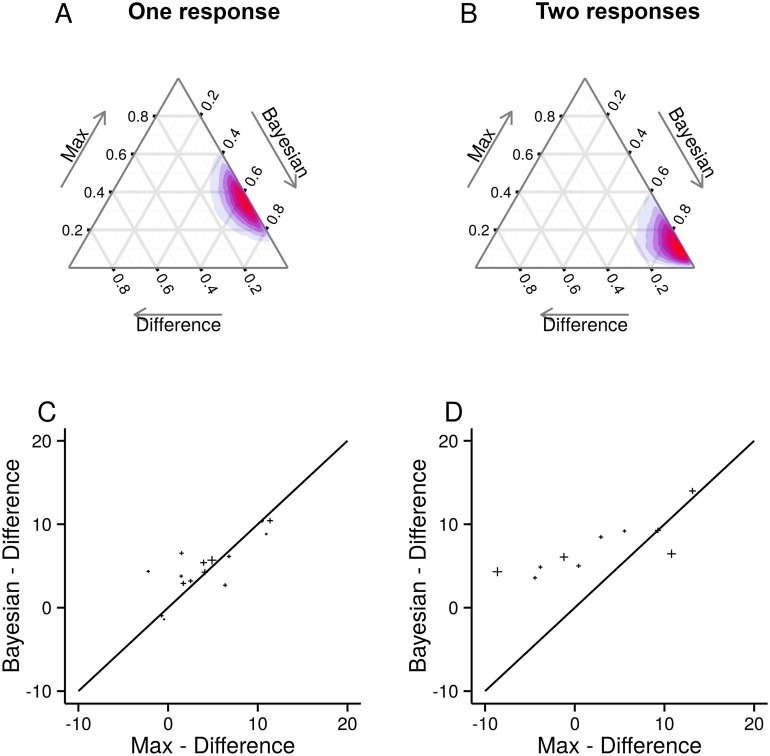
Humans stand out from other animals in that they are able to explicitly report on the reliability of their internal operations. This ability, which is known as metacognition, is typically studied by asking people to report their confidence in the correctness of some decision. However, the computations underlying confidence reports remain unclear. In this paper, we present a fully Bayesian method for directly comparing models of confidence. Using a visual two-interval forced-choice task, we tested whether confidence reports reflect heuristic computations (e.g. the magnitude of sensory data) or Bayes optimal ones (i.e. how likely a decision is to be correct given the sensory data). In a standard design in which subjects were first asked to make a decision, and only then gave their confidence, subjects were mostly Bayes optimal. In contrast, in a less-commonly used design in which subjects indicated their confidence and decision simultaneously, they were roughly equally likely to use the Bayes optimal strategy or to use a heuristic but suboptimal strategy. Our results suggest that, while people's confidence reports can reflect Bayes optimal computations, even a small unusual twist or additional element of complexity can prevent optimality.
人类与其他动物的不同之处在于,他们能够明确报告其内部运作的可靠性。这种能力被称为元认知,通常通过要求人们报告他们对某个决策正确性的信心来进行研究。然而,信心报告背后的计算过程仍不清楚。在本文中,我们提出了一种完全贝叶斯方法,用于直接比较信心模型。使用视觉双间隔强制选择任务,我们测试了信心报告是反映启发式计算(例如感官数据的大小)还是贝叶斯最优计算(即给定感官数据时决策正确的可能性)。在标准设计中,受试者首先被要求做出决策,然后才给出他们的信心,受试者大多是贝叶斯最优的。相比之下,在一种较少使用的设计中,受试者同时表明他们的信心和决策,他们使用贝叶斯最优策略或使用启发式但次优策略的可能性大致相同。我们的结果表明,虽然人们的信心报告可以反映贝叶斯最优计算,但即使是一个小的异常转折或额外的复杂性因素也可能阻止最优性。