Maka Daniel Ethe, Chiabi Andreas, Ndikum Valentine, Achu Dorothy, Mah Evelyn, Nguefack Séraphin, Nana Pamela, Njoumemi Zakariaou, Mbacham Wilfred, Mbonda Elie
Department of Paediatrics, Faculty of Medicine and Biomedical Sciences, University of Yaounde I, Yaounde, Cameroon.
Paediatric Unit, Yaounde Gynaeco-Obstetric and Paediatric Hospital, Yaounde, Cameroon.
Malar J. 2015 Oct 31;14:429. doi: 10.1186/s12936-015-0948-0.
Severe malaria is a medical emergency with high mortality in children below 5 years of age especially in sub-Saharan Africa. Recently, quinine has been replaced by artesunate as the first-line drug in the treatment of severe malaria in Cameroon. No local data are yet available on the efficacy of artesunate with respect to the different quinine regimens used in this setting. This study was undertaken at the Ebolowa Regional Hospital (ERH), which is located in a region of perennial transmission of malaria.
This was a randomized, open-label trial in children aged 3 months to 15 years, admitted in the hospital with severe malaria due to Plasmodium falciparum confirmed on microscopy after informed parental consent. Patients were randomized into four groups. Group 1 (ARTES) received parenteral artesunate at 2.4 mg/kg at H0, H12, H24 and then once daily; Group 2 (QLD) received a loading dose of quinine base at 16.6 mg/kg followed 8 hours later by an eight-hourly maintenance dose of 8.3 mg/kg quinine base; Group 3 (QNLD3) received 8.3 mg/kg quinine base every 8 hours; and, Group 4 (QNLD2) received 12.5 mg/kg quinine base every 12 h. All patients invariably received a minimum of 24 h parenteral treatment, then, oral drugs were prescribed. The endpoints were fever clearance time, time to sit unsupported, time to eat, parasite clearance time, and parasitaemia reduction rate at H24. Survival analysis was used to compare the outcomes.
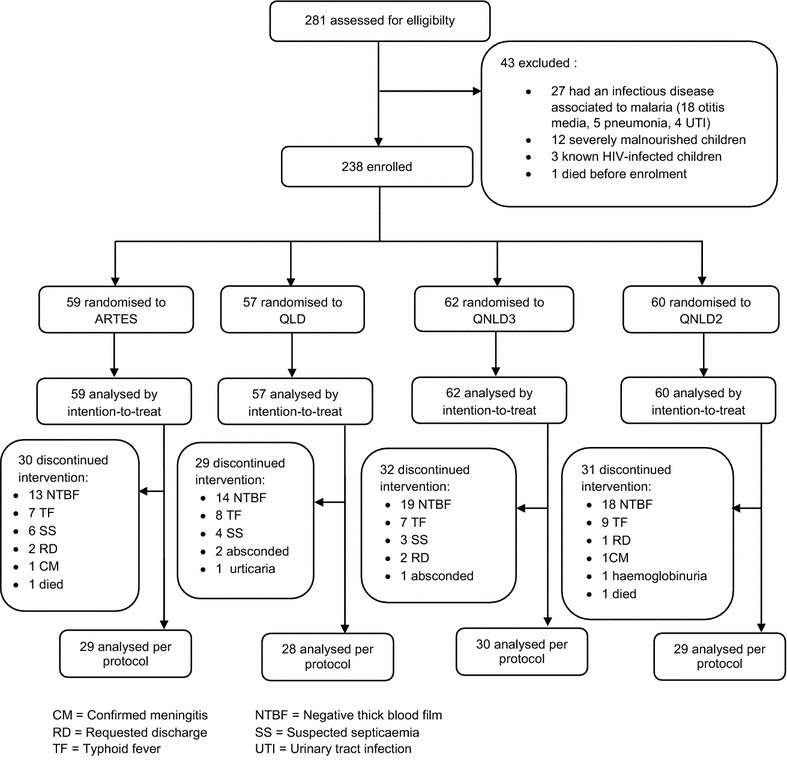
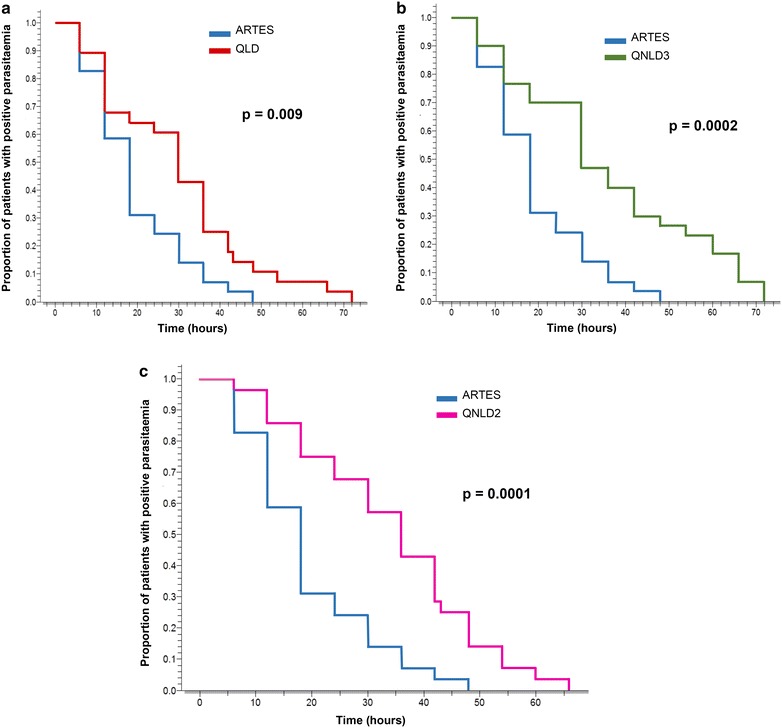
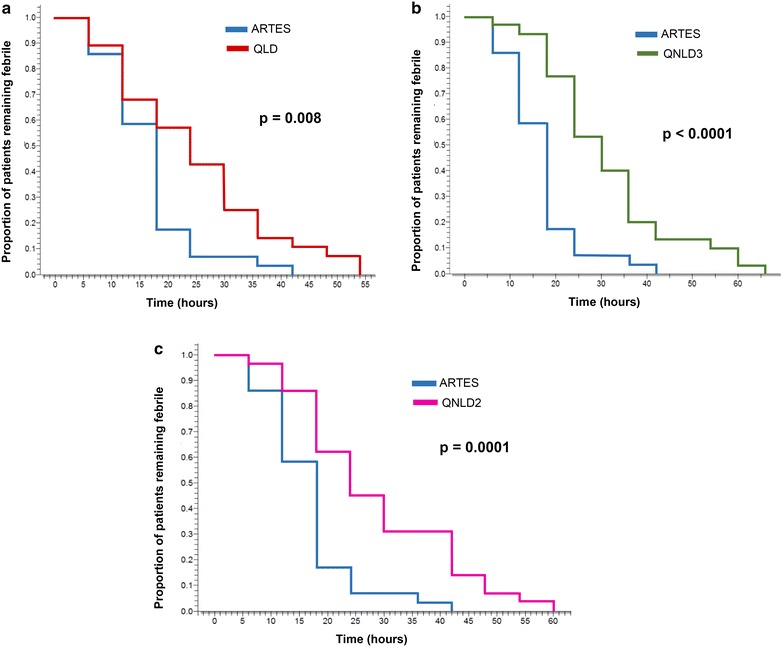
One-hundred and sixteen patients completed the study: 29 in ARTES arm, 28 in QLD arm, 30 in QNLD3 arm, and 29 in QNLD2 arm. There was no major differences in baseline characteristics in the treatment groups. On analysis of endpoints, fever clearance time and parasite clearance time were significantly shorter for artesunate-treated patients than for quinine-treated patients. Parasitaemia reduction rate at H24 was also significantly higher for artesunate. Time to sit unsupported and time to eat were shorter with artesunate, but the difference was not statistically significant.
Artesunate is more effective than quinine in the treatment of severe malaria in Cameroonian children.
重症疟疾是一种医疗急症,在5岁以下儿童中死亡率很高,尤其是在撒哈拉以南非洲地区。最近,在喀麦隆,青蒿琥酯已取代奎宁成为治疗重症疟疾的一线药物。目前尚无关于青蒿琥酯在该环境中相对于不同奎宁治疗方案疗效的本地数据。本研究在位于疟疾常年传播地区的埃博洛瓦地区医院(ERH)进行。
这是一项针对3个月至15岁儿童的随机、开放标签试验,这些儿童因恶性疟原虫导致的重症疟疾入院,经显微镜检查确诊,且获得了家长的知情同意。患者被随机分为四组。第1组(ARTES)在H0、H12、H24时接受2.4mg/kg的青蒿琥酯静脉注射,然后每日一次;第2组(QLD)接受16.6mg/kg的奎宁碱负荷剂量,8小时后接着每8小时接受8.3mg/kg奎宁碱的维持剂量;第3组(QNLD3)每8小时接受8.3mg/kg奎宁碱;第4组(QNLD2)每12小时接受12.5mg/kg奎宁碱。所有患者均接受至少24小时的静脉治疗,然后开具口服药物。观察终点为发热消退时间、无支撑坐立时间、进食时间、寄生虫清除时间以及H24时的疟原虫血症降低率。采用生存分析比较结果。
116名患者完成了研究:ARTES组29名,QLD组28名,QNLD3组30名,QNLD2组29名。各治疗组的基线特征无重大差异。在观察终点分析中,青蒿琥酯治疗的患者发热消退时间和寄生虫清除时间明显短于奎宁治疗的患者。青蒿琥酯在H24时的疟原虫血症降低率也显著更高。青蒿琥酯治疗的患者无支撑坐立时间和进食时间较短,但差异无统计学意义。
在喀麦隆儿童重症疟疾治疗中,青蒿琥酯比奎宁更有效。