Hitchcock Caitlin, Hammond Emily, Rees Catrin, Panesar Inderpal, Watson Peter, Werner-Seidler Aliza, Dalgleish Tim
Medical Research Council Cognition and Brain Sciences Unit, Cambridge, UK.
Cambridgeshire and Peterborough National Health Service Foundation Trust (CPFT), Cambridge, UK.
Trials. 2015 Nov 3;16:494. doi: 10.1186/s13063-015-1029-y.
Major depressive disorder (MDD) is associated with chronic biases in the allocation of attention and recollection of personal memories. Impaired flexibility in attention and autobiographical memory retrieval is seen to both maintain current symptoms and predict future depression. Development of innovative interventions to reduce maladaptive cognitive patterns and improve cognitive flexibility in the domain of memory may therefore advance current treatment approaches for depression. Memory specificity training and cognitive bias modification techniques have both shown some promise in improving cognitive flexibility. Here we outline plans for a trial of an innovative memory flexibility training programme, MemFlex, which advances current training techniques with the aim of improving flexibility of autobiographical memory retrieval. This trial seeks to estimate the efficacy of MemFlex, provide data on feasibility, and begin to explore mechanisms of change.
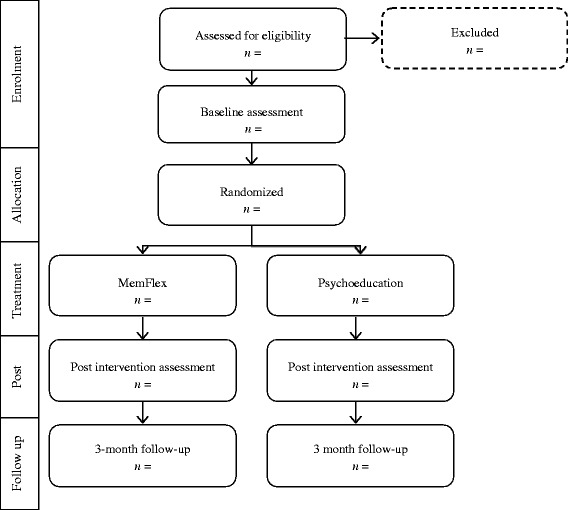
METHODS/DESIGN: We plan a single-blind, randomised, controlled, patient-level trial in which 50 individuals with MDD will complete either psychoeducation (n = 25) or MemFlex (n = 25). After completing pre-treatment measures and an orientation session, participants complete eight workbook-based sessions at home. Participants will then be assessed at post-treatment and at 3 month follow-up. The co-primary outcomes are depressive symptoms and diagnostic status at 3 month follow-up. The secondary outcomes are memory flexibility at post-treatment and number of depression free days at 3 month follow-up. Other process outcomes and mediators of any treatment effects will also be explored.
This trial will establish the efficacy of MemFlex in improving memory flexibility, and reducing depressive symptoms. Any effects on process measures related to relapse may also indicate whether MemFlex may be helpful in reducing vulnerability to future depressive episodes. The low-intensity and workbook-based format of the programme may improve access to psychological therapies, and, if encouraging, the results of this study will provide a platform for later-phase trials.
NCT02371291 (ClinicalTrials.gov), registered 9 February 2015.
重度抑郁症(MDD)与注意力分配和个人记忆回忆方面的慢性偏差有关。注意力和自传体记忆检索的灵活性受损被认为既维持当前症状又预测未来抑郁症。因此,开发创新干预措施以减少适应不良的认知模式并提高记忆领域的认知灵活性,可能会推进当前的抑郁症治疗方法。记忆特异性训练和认知偏差修正技术在提高认知灵活性方面都显示出了一些前景。在此,我们概述了一项创新记忆灵活性训练计划MemFlex的试验计划,该计划改进了当前的训练技术,旨在提高自传体记忆检索的灵活性。该试验旨在评估MemFlex的疗效,提供可行性数据,并开始探索其改变机制。
方法/设计:我们计划进行一项单盲、随机、对照、患者水平的试验,其中50名患有MDD的个体将完成心理教育(n = 25)或MemFlex(n = 25)。在完成预处理措施和一次指导课程后,参与者在家中完成八个基于工作手册的课程。然后,参与者将在治疗后和3个月随访时接受评估。共同主要结局是3个月随访时的抑郁症状和诊断状态。次要结局是治疗后记忆灵活性和3个月随访时无抑郁天数。还将探索其他过程结局和任何治疗效果的调节因素。
该试验将确定MemFlex在提高记忆灵活性和减轻抑郁症状方面的疗效。对与复发相关的过程指标的任何影响也可能表明MemFlex是否有助于降低未来抑郁发作的易感性。该计划的低强度和基于工作手册的形式可能会改善心理治疗的可及性,如果结果令人鼓舞,本研究结果将为后期试验提供一个平台。
NCT02371291(ClinicalTrials.gov),于2015年2月9日注册。