Medical Research Council Cognition and Brain Sciences Unit, University of Cambridge, United Kingdom; Cambridgeshire and Peterborough NHS Foundation Trust, United Kingdom.
Medical Research Council Cognition and Brain Sciences Unit, University of Cambridge, United Kingdom.
Behav Res Ther. 2018 Nov;110:22-30. doi: 10.1016/j.brat.2018.08.008. Epub 2018 Aug 29.
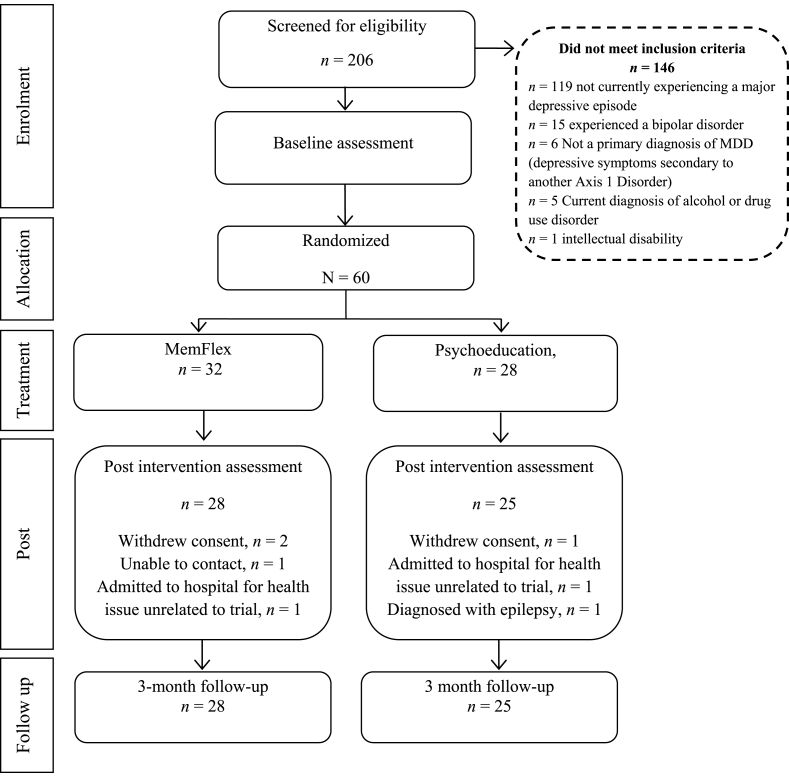
Successful navigation within the autobiographical memory store is integral to daily cognition. Impairment in the flexibility of memory retrieval can thereby have a detrimental impact on mental health. This randomised controlled phase II exploratory trial (N = 60) evaluated the potential of a novel intervention drawn from basic science - an autobiographical Memory Flexibility (MemFlex) training programme - which sought to ameliorate memory difficulties and improve symptoms of Major Depressive Disorder. MemFlex was compared to Psychoeducation (an evidence-based low-intensity intervention) to determine the likely range of effects on a primary cognitive target of memory flexibility at post-intervention, and co-primary clinical targets of self-reported depressive symptoms and diagnostic status at three-month follow-up. These effect sizes could subsequently be used to estimate sample size for a fully-powered trial. Results demonstrated small-moderate, though as expected statistically non-significant, effect sizes in favour of MemFlex for memory flexibility (d = 0.34, p = .20), and loss of diagnosis (OR = 0.65, p = .48), along with the secondary outcome of depression-free days (d = 0.36, p = .18). A smaller effect size was observed for between-group difference in self-reported depressive symptoms (d = 0.24, p = .35). Effect sizes in favour of MemFlex in this early-stage trial suggest that fully-powered evaluation of MemFlex may be warranted as an avenue to improving low-intensity treatment of depression.
ClinicalTrials.gov, Identifier NCT02371291.
成功地在自传体记忆库中进行导航是日常认知的基础。记忆检索的灵活性受损可能会对心理健康产生不利影响。这项随机对照的 II 期探索性试验(N=60)评估了一种新的干预措施的潜力,该干预措施来自基础科学——自传体记忆灵活性(MemFlex)训练计划,旨在改善记忆困难并改善重度抑郁症的症状。MemFlex 与心理教育(一种基于证据的低强度干预措施)进行了比较,以确定干预后对记忆灵活性这一主要认知目标的潜在影响范围,以及自我报告的抑郁症状和三个月随访时的诊断状态这两个共同的主要临床目标。随后,可以使用这些效应大小来估计全功率试验的样本量。结果表明,尽管在统计学上不显著,但与 MemFlex 相比,在记忆灵活性(d=0.34,p=0.20)和诊断丧失(OR=0.65,p=0.48)方面的效应大小为中等,在抑郁无天数(d=0.36,p=0.18)方面的效应大小为中等。在自我报告的抑郁症状方面,观察到组间差异的效应大小较小(d=0.24,p=0.35)。在这项早期试验中,MemFlex 有利的效应大小表明,可能需要对 MemFlex 进行全面评估,作为改善轻度抑郁症治疗的一种途径。
ClinicalTrials.gov,标识符 NCT02371291。