Barthe Béatrice, Tirilly Ghislaine, Gentil Catherine, Toupin Cathy
University of Toulouse, CLLE-LTC, UMR 5263 CNRS, France.
Ind Health. 2016;54(2):157-62. doi: 10.2486/indhealth.2015-0002. Epub 2015 Nov 3.
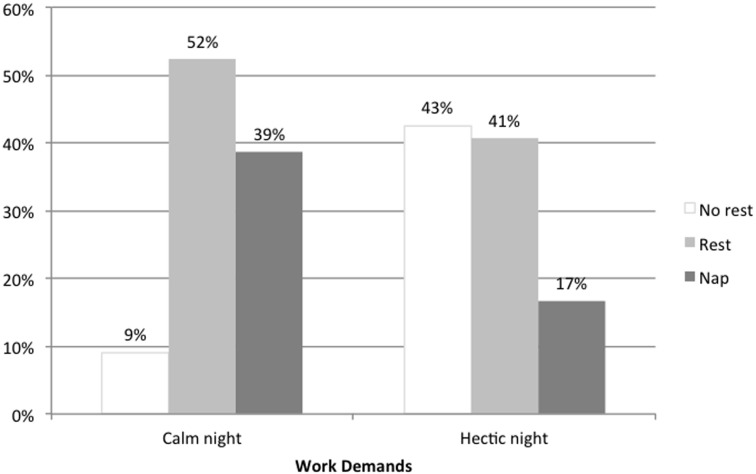
The aim of this field study is to describe night shift resting and napping strategies and to examine their beneficial effects on sleepiness and quality of work. The study was carried out with 16 nurses working in an intensive care unit. Data collected during 20 night shifts were related to job demands (systematic observations), to the duration and timing of rests and naps taken by nurses (systematic observations, sleep diaries), to sleepiness (Karolinska Sleepiness Scale), and to quality of work scores (visual analog scale). The results showed that the number of rests and naps depended on the job demands. Resting and napping lowered the levels of sleepiness at the end of the shift. There was no direct relationship between sleepiness and the quality of work score. Discussions about the choice of indicators for the quality of work are necessary. Suggestions for implementing regulations for prescribed napping during night shifts are presented.
这项实地研究的目的是描述夜班休息和小睡策略,并检验它们对困倦感和工作质量的有益影响。该研究对16名在重症监护病房工作的护士进行。在20个夜班期间收集的数据涉及工作要求(系统观察)、护士休息和小睡的时长及时间安排(系统观察、睡眠日记)、困倦感(卡罗林斯卡嗜睡量表)以及工作质量评分(视觉模拟量表)。结果表明,休息和小睡的次数取决于工作要求。休息和小睡降低了轮班结束时的困倦程度。困倦感与工作质量评分之间没有直接关系。有必要对工作质量指标的选择进行讨论。文中提出了实施夜班规定小睡的建议。