Shen Chongxing, Huang Ying, Yi Shanhong, Fang Zhenqiang, Li Longkun
Department of Urology, Second Affiliated Hospital, Third Military Medical University, Chongqing, China (mainland).
Department of Ultrasound, Second Affiliated Hospital, Third Military Medical University, Chongqing, China (mainland).
Med Sci Monit. 2015 Nov 8;21:3420-6. doi: 10.12659/msm.896018.
Several observational studies suggested that vitamin E intake is related to the risk of kidney cancer; however, the results of published studies are inconsistent.
A meta-analysis was performed to assess the relationship between vitamin E intake and the risk of kidney cancer by searching PubMed and Medline through August 2015. We computed pooled relative risks (RR) and 95%CI of kidney cancer for the highest versus lowest level of vitamin E intake.
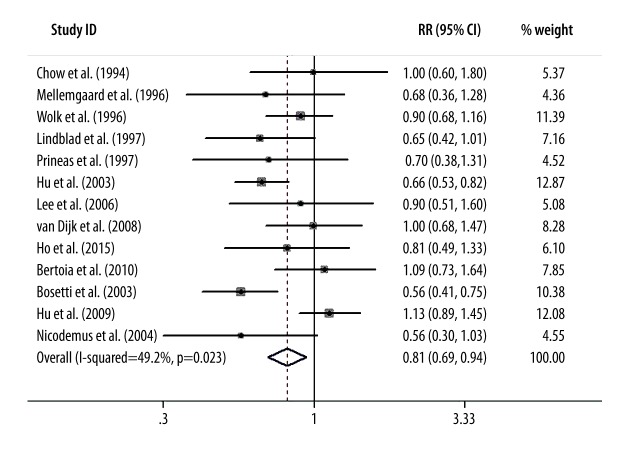
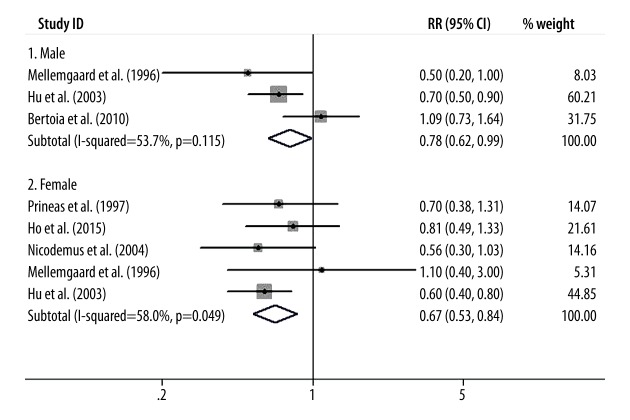
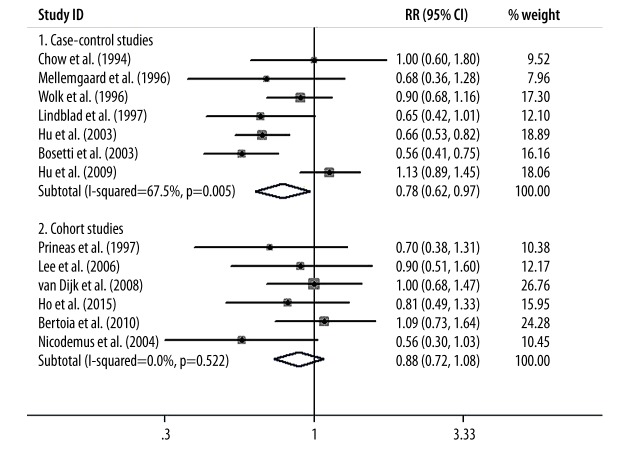
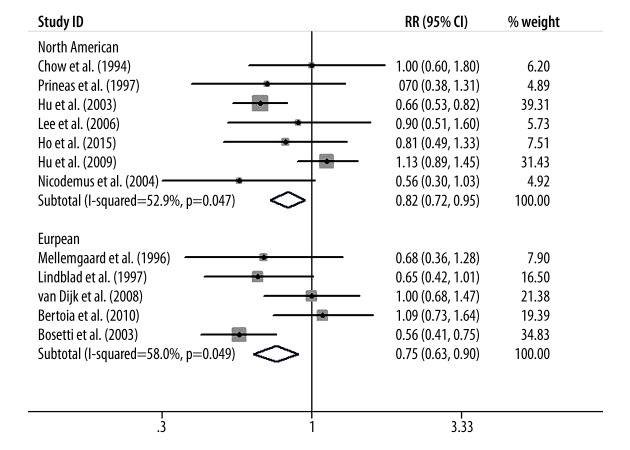
A total of 13 observational studies (7 case-control and 6 cohort) were included. The pooled RR (95%CI) of kidney cancer for the highest vs. the lowest level of vitamin E intake was 0.81 (0.69-0.94). In subgroup-analysis, this study found an inverse relationship between vitamin E intake and kidney cancer risk, which was not significantly modified by study design, study population, or sex distribution except in the cohort studies.
Results of the present study suggest an inverse relationship between vitamin E intake and kidney cancer risk. However, additional well designed cohort studies and randomized controlled trials that focus on the relationship between vitamin E intake and kidney cancer risk are needed.
多项观察性研究表明,维生素E的摄入量与肾癌风险相关;然而,已发表研究的结果并不一致。
通过检索截至2015年8月的PubMed和Medline数据库,进行一项荟萃分析以评估维生素E摄入量与肾癌风险之间的关系。我们计算了维生素E摄入量最高与最低水平时肾癌的合并相对风险(RR)及95%置信区间(CI)。
共纳入13项观察性研究(7项病例对照研究和6项队列研究)。维生素E摄入量最高与最低水平时肾癌的合并RR(95%CI)为0.81(0.69 - 0.94)。在亚组分析中,本研究发现维生素E摄入量与肾癌风险呈负相关,除队列研究外,研究设计、研究人群或性别分布对此关系无显著影响。
本研究结果提示维生素E摄入量与肾癌风险呈负相关。然而,还需要更多精心设计的队列研究和随机对照试验来关注维生素E摄入量与肾癌风险之间的关系。