Korenromp Eline L, Gobet Benjamin, Fazito Erika, Lara Joseph, Bollinger Lori, Stover John
Avenir Health, Geneva, Switzerland/Glastonbury, United States of America.
UNAIDS, Mozambique country office, Maputo, Mozambique.
PLoS One. 2015 Nov 13;10(11):e0142908. doi: 10.1371/journal.pone.0142908. eCollection 2015.
Mozambique continues to face a severe HIV epidemic and high cost for its control, largely born by international donors. We assessed feasible targets, likely impact and costs for the 2015-2019 national strategic HIV/AIDS plan (NSP).
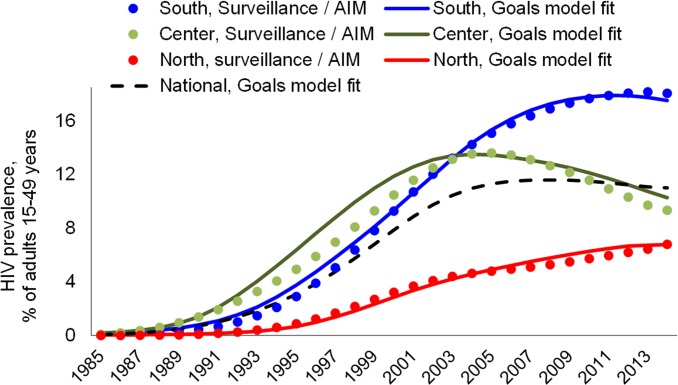
The HIV epidemic and response was modelled in the Spectrum/Goals/Resource Needs dynamical simulation model, separately for North/Center/South regions, fitted to antenatal clinic surveillance data, household and key risk group surveys, program statistics, and financial records. Intervention targets were defined in collaboration with the National AIDS Council, Ministry of Health, technical partners and implementing NGOs, considering existing commitments.
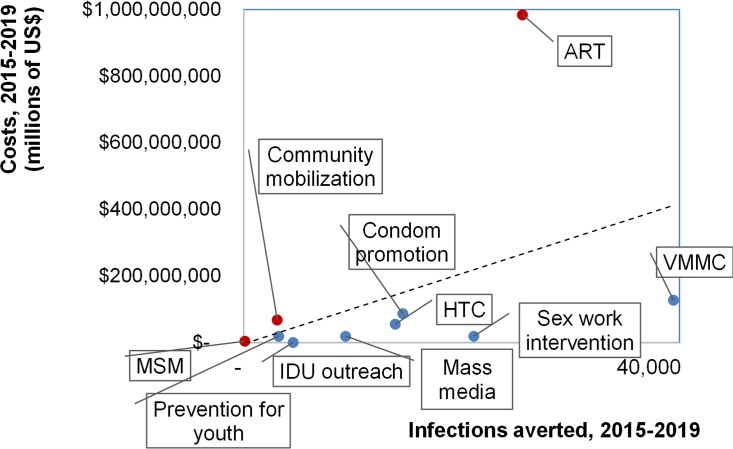
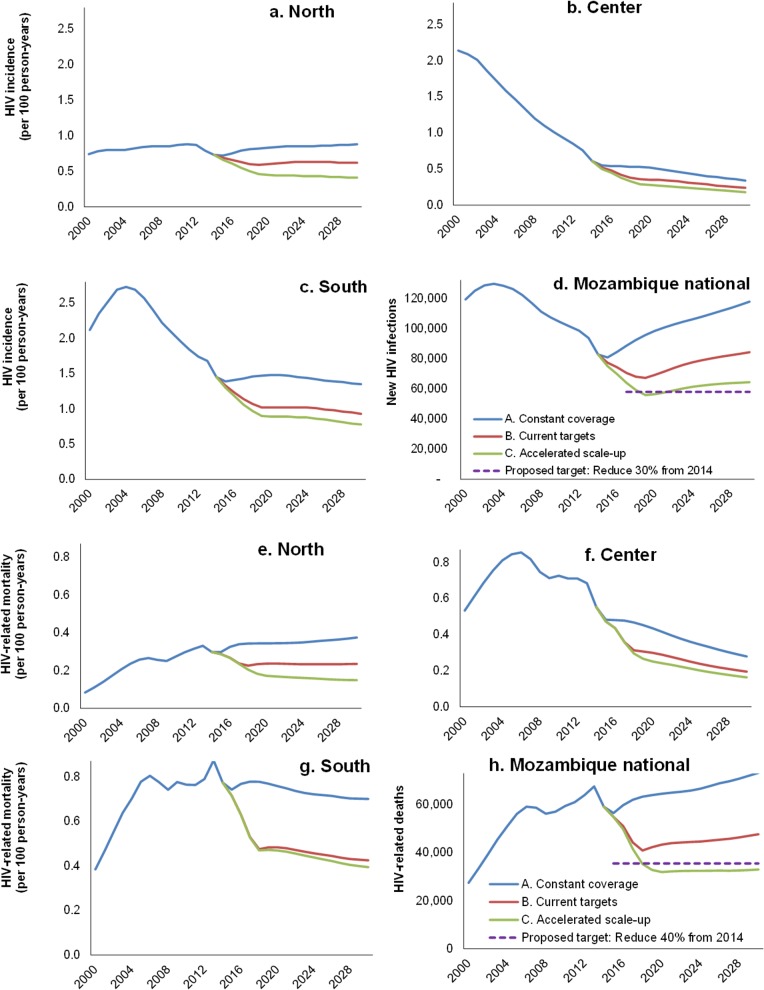
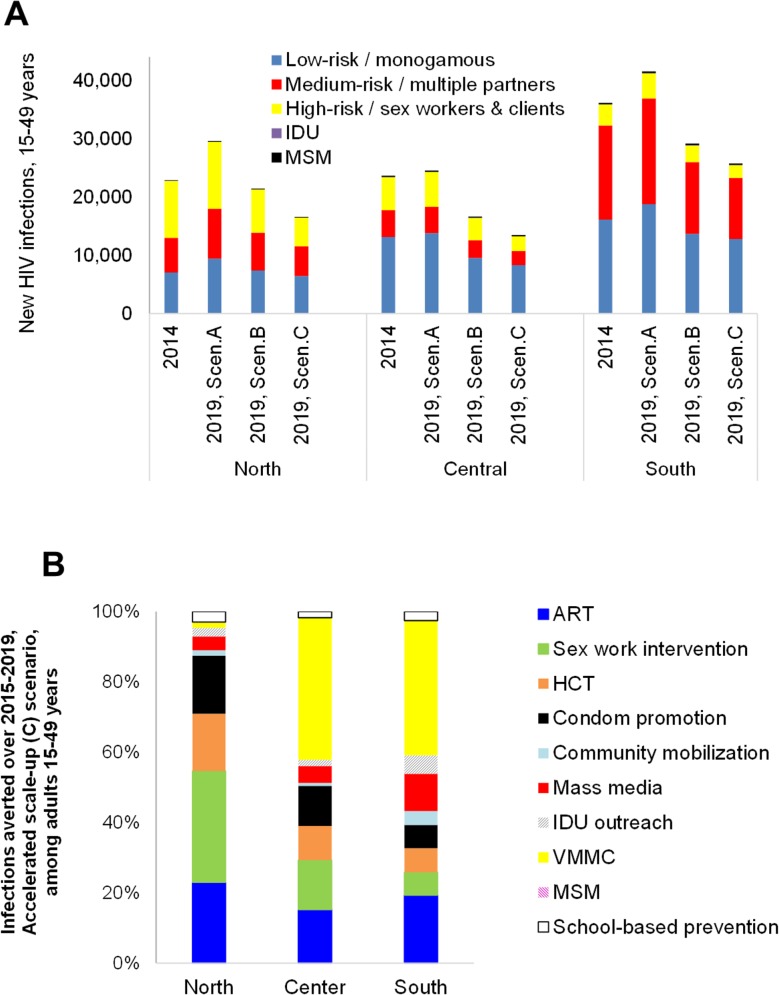
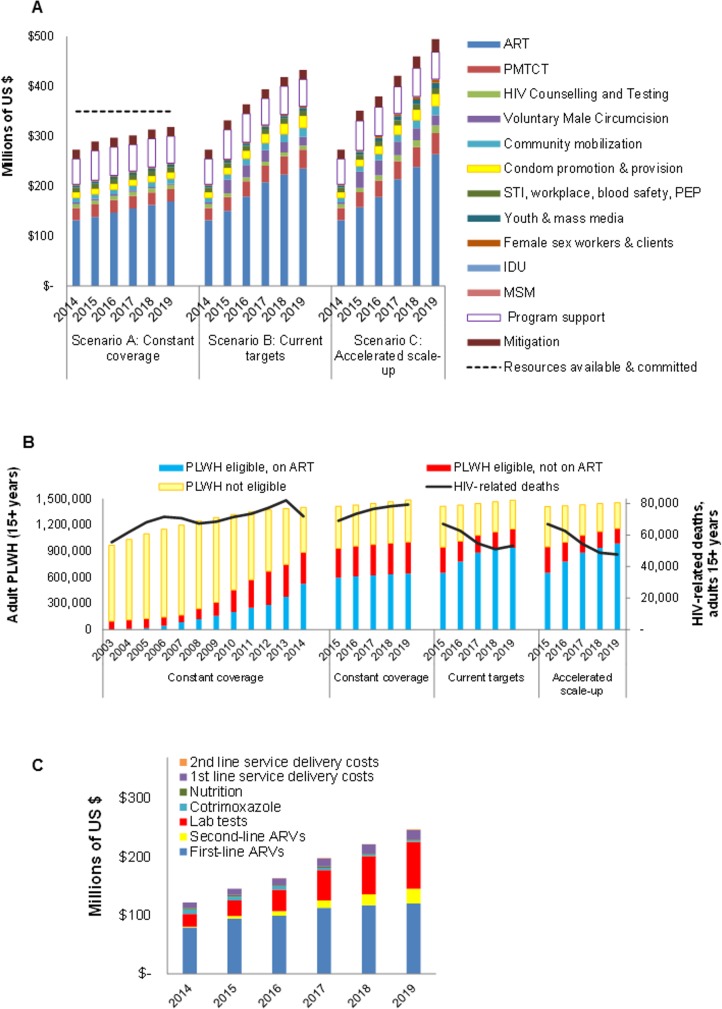
Implementing the NSP to meet existing coverage targets would reduce annual new infections among all ages from 105,000 in 2014 to 78,000 in 2019, and reduce annual HIV/AIDS-related deaths from 80,000 to 56,000. Additional scale-up of prevention interventions targeting high-risk groups, with improved patient retention on ART, could further reduce burden to 65,000 new infections and 51,000 HIV-related deaths in 2019. Program cost would increase from US$ 273 million in 2014, to US$ 433 million in 2019 for 'Current targets', or US$ 495 million in 2019 for 'Accelerated scale-up'. The 'Accelerated scale-up' would lower cost per infection averted, due to an enhanced focus on behavioural prevention for high-risk groups. Cost and mortality impact are driven by ART, which accounts for 53% of resource needs in 2019. Infections averted are driven by scale-up of interventions targeting sex work (North, rising epidemic) and voluntary male circumcision (Center & South, generalized epidemics).
The NSP could aim to reduce annual new HIV infections and deaths by 2019 by 30% and 40%, respectively, from 2014 levels. Achieving incidence and mortality reductions corresponding to UNAIDS' 'Fast track' targets will require increased ART coverage and additional behavioural prevention targeting key risk groups.
莫桑比克继续面临严重的艾滋病毒疫情,且控制成本高昂,这一成本主要由国际捐助者承担。我们评估了2015 - 2019年国家艾滋病毒/艾滋病战略计划(NSP)的可行目标、可能产生的影响及成本。
利用Spectrum/Goals/Resource Needs动态模拟模型对艾滋病毒疫情及应对情况进行建模,分别针对北部/中部/南部地区,模型与产前诊所监测数据、家庭及重点风险群体调查、项目统计数据以及财务记录相匹配。干预目标是与国家艾滋病委员会、卫生部、技术合作伙伴及实施非政府组织合作确定的,同时考虑了现有承诺。
实施国家战略计划以实现现有覆盖目标,将使各年龄段的年度新增感染病例从2014年的105,000例降至2019年的78,000例,并将与艾滋病毒/艾滋病相关的年度死亡人数从80,000例降至56,000例。针对高危群体进一步扩大预防干预措施,并提高接受抗逆转录病毒治疗(ART)的患者留存率,到2019年可进一步将负担减轻至65,000例新增感染病例和51,000例与艾滋病毒相关的死亡病例。项目成本将从2014年的2.73亿美元增至2019年的4.33亿美元(“当前目标”),或增至2019年的4.95亿美元(“加速扩大规模”)。“加速扩大规模”将降低每例避免感染的成本,这是因为更加注重针对高危群体的行为预防。成本和死亡率影响主要由抗逆转录病毒治疗驱动,该治疗在2019年占资源需求的53%。避免感染主要由针对性工作(北部,疫情上升)和自愿男性包皮环切术(中部和南部,普遍流行)的干预措施扩大规模所推动。
国家战略计划的目标可以是到2019年使年度新增艾滋病毒感染病例和死亡人数分别比2014年的水平降低30%和40%。要实现与联合国艾滋病规划署“快车道”目标相应的发病率和死亡率降低,将需要提高抗逆转录病毒治疗的覆盖率,并针对重点风险群体增加行为预防措施。