Mkenda Prisila, Mwanauta Regina, Stevenson Philip C, Ndakidemi Patrick, Mtei Kelvin, Belmain Steven R
Nelson Mandela African Institution of Science and Technology, Arusha, Tanzania.
Jodrell Laboratory, Royal Botanic Gardens, Kew, Richmond, Surrey, United Kingdom.
PLoS One. 2015 Nov 23;10(11):e0143530. doi: 10.1371/journal.pone.0143530. eCollection 2015.
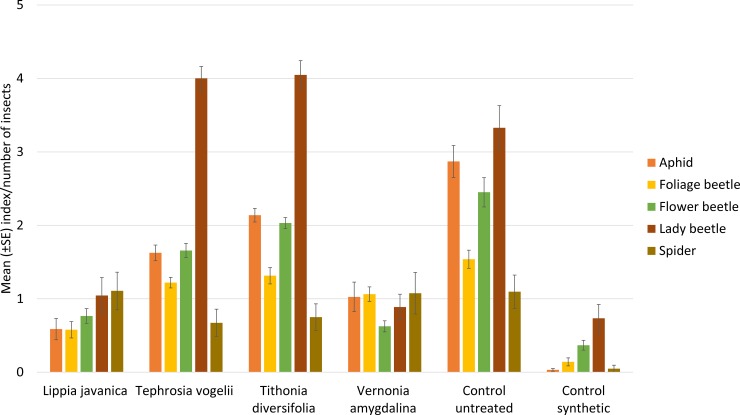
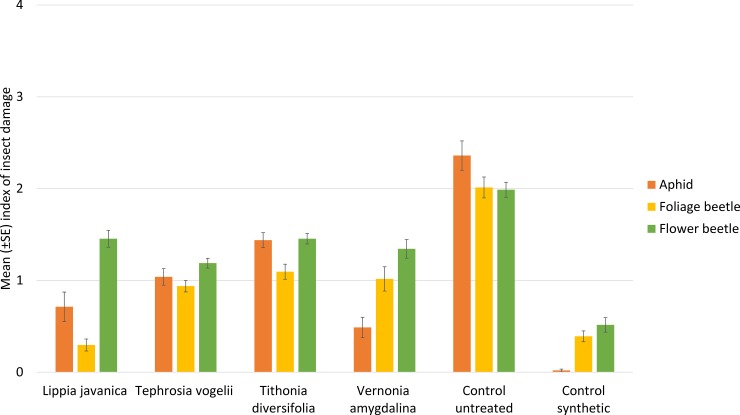
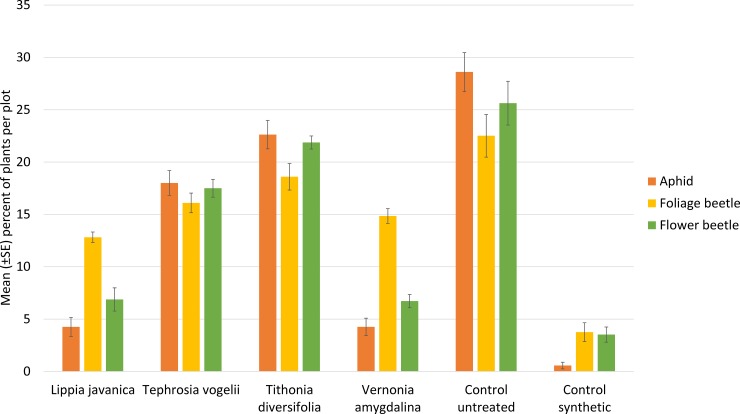
Plants with pesticidal properties have been investigated for decades as alternatives to synthetics, but most progress has been shown in the laboratory. Consequently, research on pesticidal plants is failing to address gaps in our knowledge that constrain their uptake. Some of these gaps are their evaluation of their efficacy under field conditions, their economic viability and impact on beneficial organisms. Extracts made from four abundant weed species found in northern Tanzania, Tithonia diversifolia, Tephrosia vogelii, Vernonia amygdalina and Lippia javanica offered effective control of key pest species on common bean plants (Phaseolus vulgaris) that was comparable to the pyrethroid synthetic, Karate. The plant pesticide treatments had significantly lower effects on natural enemies (lady beetles and spiders). Plant pesticide treatments were more cost effective to use than the synthetic pesticide where the marginal rate of return for the synthetic was no different from the untreated control, around 4USD/ha, compared to a rate of return of around 5.50USD/ha for plant pesticide treatments. Chemical analysis confirmed the presence of known insecticidal compounds in water extracts of T. vogelii (the rotenoid deguelin) and T. diversifolia (the sesquiterpene lactone tagitinin A). Sesquiterpene lactones and the saponin vernonioside C were also identified in organic extracts of V. amygdalina but only the saponin was recorded in water extracts which are similar to those used in the field trial. Pesticidal plants were better able to facilitate ecosystem services whilst effectively managing pests. The labour costs of collecting and processing abundant plants near farm land were less than the cost of purchasing synthetic pesticides.
具有杀虫特性的植物作为合成农药的替代品已被研究了数十年,但大部分进展都体现在实验室中。因此,对杀虫植物的研究未能解决限制其应用的知识空白。其中一些空白包括它们在田间条件下的功效评估、经济可行性以及对有益生物的影响。从坦桑尼亚北部发现的四种常见杂草——肿柄菊、非洲山毛豆、扁桃斑鸠菊和爪哇过江藤中提取的提取物,对菜豆植株(菜豆)上的主要害虫种类提供了有效的控制,效果与拟除虫菊酯类合成农药功夫相当。植物源农药处理对天敌(瓢虫和蜘蛛)的影响显著较低。与合成农药相比,植物源农药处理在使用上更具成本效益,合成农药的边际回报率与未处理对照无异,约为4美元/公顷,而植物源农药处理的回报率约为5.50美元/公顷。化学分析证实,非洲山毛豆的水提取物(鱼藤酮类化合物鱼藤素)和肿柄菊的水提取物(倍半萜内酯tagitinin A)中存在已知杀虫化合物。扁桃斑鸠菊的有机提取物中也鉴定出倍半萜内酯和皂苷vernonioside C,但水提取物中仅记录到皂苷,这与田间试验中使用的提取物相似。杀虫植物在有效防治害虫的同时,更能促进生态系统服务。在农田附近收集和加工常见植物的劳动力成本低于购买合成农药的成本。