Syam Ari Fahrial, Miftahussurur Muhammad, Makmun Dadang, Nusi Iswan Abbas, Zain Lukman Hakim, Akil Fardah, Uswan Willi Brodus, Simanjuntak David, Uchida Tomohisa, Adi Pangestu, Utari Amanda Pitarini, Rezkitha Yudith Annisa Ayu, Subsomwong Phawinee, Suzuki Rumiko, Yamaoka Yoshio
Division of Gastroenterology, Department of Internal Medicine, Faculty of Medicine, University of Indonesia, Jakarta, Indonesia.
Department of Environmental and Preventive Medicine, Oita University Faculty of Medicine, Yufu, Japan.
PLoS One. 2015 Nov 23;10(11):e0140186. doi: 10.1371/journal.pone.0140186. eCollection 2015.
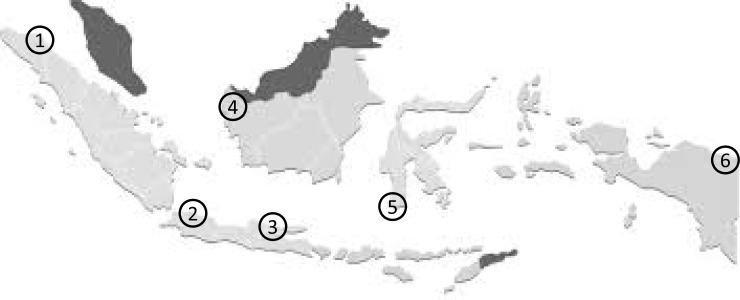
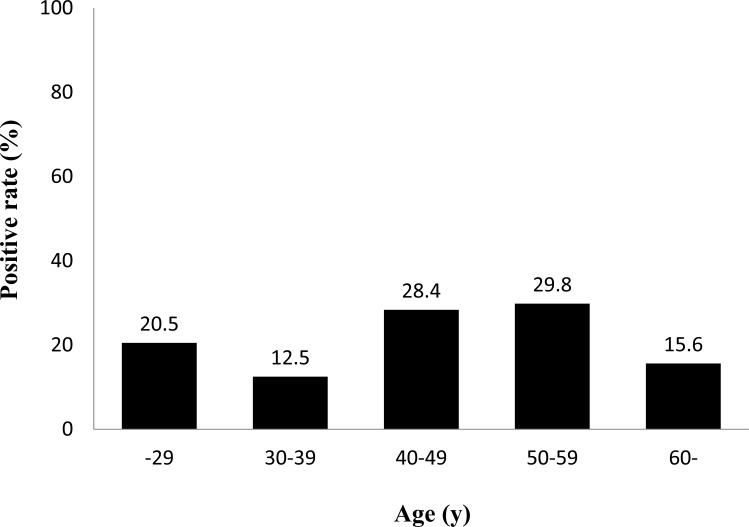
The prevalence of Helicobacter pylori infection in Indonesia is still controversial and mainly investigated in the largest ethnic group, Javanese. We examined the prevalence of H. pylori infection using four different tests including culture, histology confirmed by immunohistochemistry and rapid urease test. We also analyzed risk factors associated with H. pylori infection in five largest islands in Indonesia. From January 2014-February 2015 we consecutively recruited a total of 267 patients with dyspeptic symptoms in Java, Papua, Sulawesi, Borneo and Sumatera Island. Overall, the prevalence of H. pylori infection was 22.1% (59/267). Papuan, Batak and Buginese ethnics had higher risk for H. pylori infection than Javanese, Dayak and Chinese ethnics (OR = 30.57, 6.31, 4.95; OR = 28.39, 5.81, 4.61 and OR = 23.23, 4.76, 3.77, respectively, P <0.05). The sensitivity and specificity for RUT and culture were 90.2%, 92.9% and 80.5%, 98.2%, respectively. The patients aged 50-59 years group had significantly higher H. pylori infection than 30-39 years group (OR 2.98, P = 0.05). Protestant had significantly higher H. pylori infection rate than that among Catholic (OR 4.42, P = 0.008). It was also significantly lower among peoples who used tap water as source of drinking water than from Wells/river (OR 9.67, P = 0.03). However only ethnics as become independent risk factors for H. pylori infection. Although we confirmed low prevalence of H. pylori in Javanese; predominant ethnic in Indonesia, several ethnic groups had higher risk of H. pylori infection. The age, religion and water source may implicate as a risk factor for H. pylori infection in Indonesia.
幽门螺杆菌感染在印度尼西亚的患病率仍存在争议,且主要在最大的族群爪哇族中进行研究。我们使用包括培养、免疫组织化学确诊的组织学检查和快速尿素酶试验在内的四种不同检测方法,对幽门螺杆菌感染的患病率进行了检测。我们还分析了印度尼西亚五个最大岛屿上与幽门螺杆菌感染相关的危险因素。从2014年1月至2015年2月,我们在爪哇岛、巴布亚岛、苏拉威西岛、婆罗洲岛和苏门答腊岛连续招募了总共267例有消化不良症状的患者。总体而言,幽门螺杆菌感染的患病率为22.1%(59/267)。巴布亚族、巴塔克族和布吉斯族感染幽门螺杆菌的风险高于爪哇族、达雅克族和华裔(比值比分别为30.57、6.31、4.95;比值比分别为28.39、5.81、4.61以及比值比分别为23.23、4.76、3.77,P<0.05)。快速尿素酶试验和培养的敏感性及特异性分别为90.2%、92.9%以及80.5%、98.2%。50 - 59岁年龄组的幽门螺杆菌感染率显著高于30 - 39岁年龄组(比值比2.98,P = 0.05)。新教徒的幽门螺杆菌感染率显著高于天主教徒(比值比4.42,P = 0.008)。使用自来水作为饮用水源的人群中的感染率也显著低于使用井水/河水的人群(比值比9.67,P = 0.03)。然而,只有族群是幽门螺杆菌感染的独立危险因素。尽管我们证实印度尼西亚主要族群爪哇族中幽门螺杆菌感染率较低,但几个族群感染幽门螺杆菌的风险较高。年龄、宗教和水源可能是印度尼西亚幽门螺杆菌感染的危险因素。