Luka George, Ahmadi Ali, Najjaran Homayoun, Alocilja Evangelyn, DeRosa Maria, Wolthers Kirsten, Malki Ahmed, Aziz Hassan, Althani Asmaa, Hoorfar Mina
School of Engineering, University of British Columbia, Kelowna, BC V1V 1V7, Canada.
Nano-Biosensors Laboratory, Department of Biosystems and Agricultural Engineering, Michigan State University, 524 S. Shaw Lane, Room 115, East Lansing, MI 48224, USA.
Sensors (Basel). 2015 Dec 1;15(12):30011-31. doi: 10.3390/s151229783.
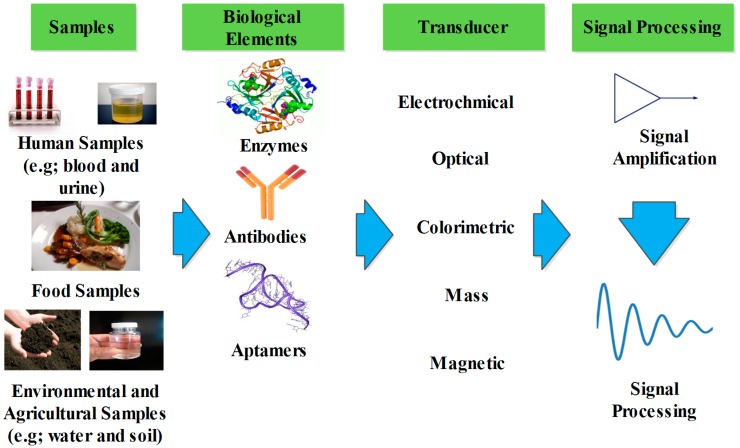
A biosensor can be defined as a compact analytical device or unit incorporating a biological or biologically derived sensitive recognition element immobilized on a physicochemical transducer to measure one or more analytes. Microfluidic systems, on the other hand, provide throughput processing, enhance transport for controlling the flow conditions, increase the mixing rate of different reagents, reduce sample and reagents volume (down to nanoliter), increase sensitivity of detection, and utilize the same platform for both sample preparation and detection. In view of these advantages, the integration of microfluidic and biosensor technologies provides the ability to merge chemical and biological components into a single platform and offers new opportunities for future biosensing applications including portability, disposability, real-time detection, unprecedented accuracies, and simultaneous analysis of different analytes in a single device. This review aims at representing advances and achievements in the field of microfluidic-based biosensing. The review also presents examples extracted from the literature to demonstrate the advantages of merging microfluidic and biosensing technologies and illustrate the versatility that such integration promises in the future biosensing for emerging areas of biological engineering, biomedical studies, point-of-care diagnostics, environmental monitoring, and precision agriculture.
生物传感器可定义为一种紧凑的分析装置或单元,它包含固定在物理化学换能器上的生物或生物衍生的敏感识别元件,用于测量一种或多种分析物。另一方面,微流控系统可实现高通量处理,增强传输以控制流动条件,提高不同试剂的混合速率,减少样品和试剂体积(低至纳升),提高检测灵敏度,并在同一平台上进行样品制备和检测。鉴于这些优点,微流控技术与生物传感器技术的集成能够将化学和生物组件融合到一个单一平台上,并为未来的生物传感应用带来新机遇,包括便携性、一次性使用、实时检测、前所未有的准确性以及在单个设备中同时分析不同分析物。本综述旨在介绍基于微流控的生物传感领域的进展和成就。该综述还列举了从文献中提取的实例,以展示融合微流控技术和生物传感技术的优势,并说明这种集成在未来生物传感中为生物工程、生物医学研究、即时诊断、环境监测和精准农业等新兴领域所带来的多功能性。