Lutz Stefanie, Anesio Alexandre M, Field Katie, Benning Liane G
Cohen Laboratories, School of Earth and Environment, University of Leeds Leeds, UK ; GFZ German Research Centre for Geosciences Potsdam, Germany.
Bristol Glaciology Centre, School of Geographical Sciences, University of Bristol Bristol, UK.
Front Microbiol. 2015 Nov 25;6:1323. doi: 10.3389/fmicb.2015.01323. eCollection 2015.
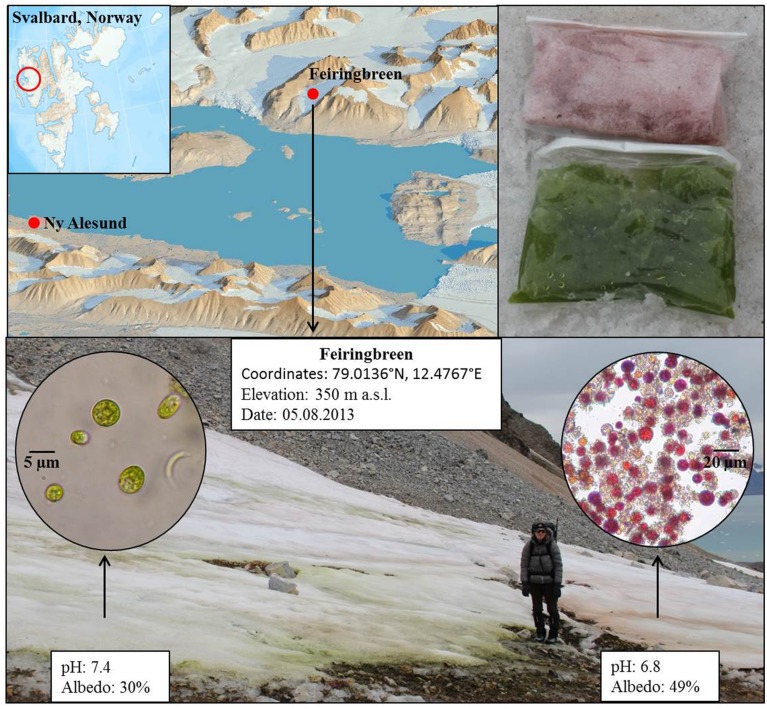
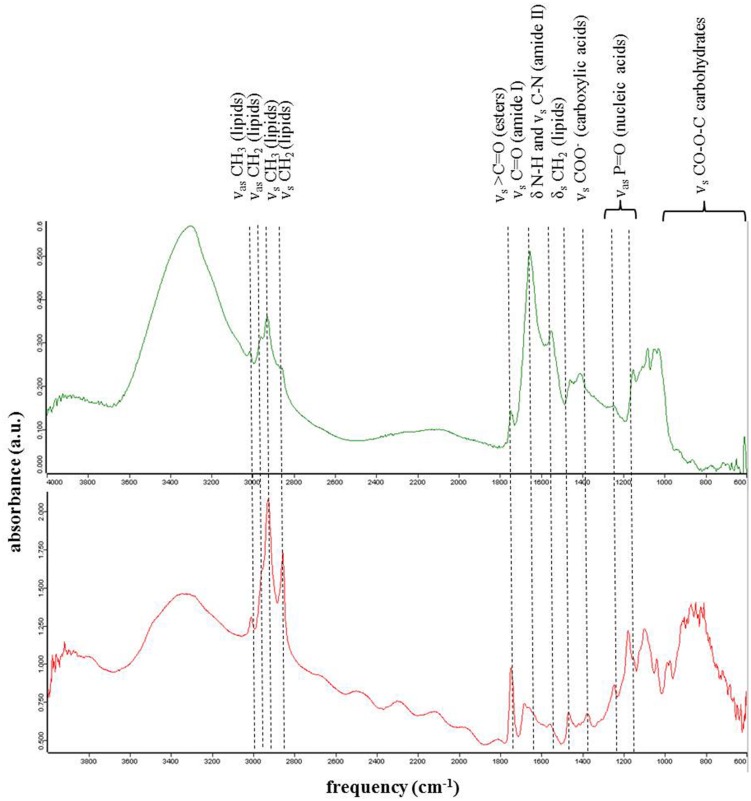
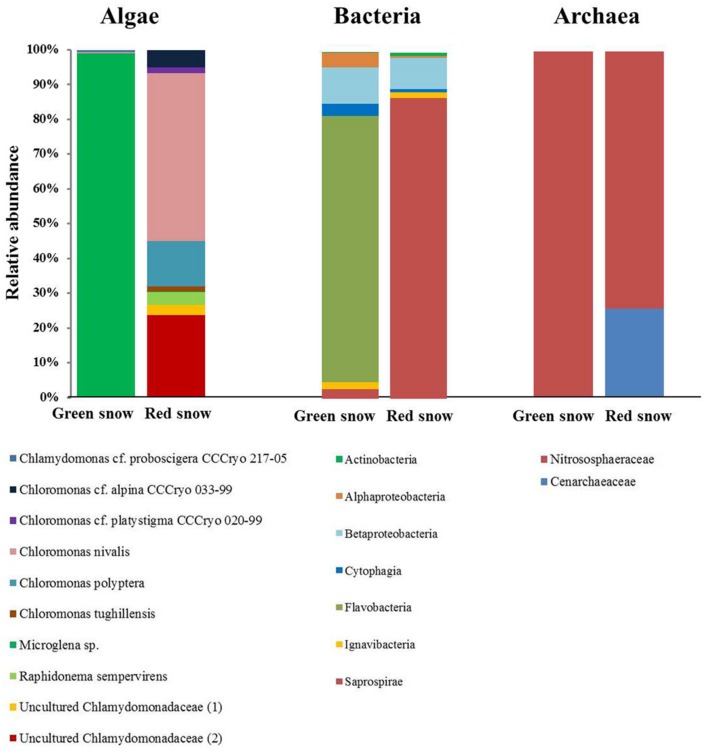
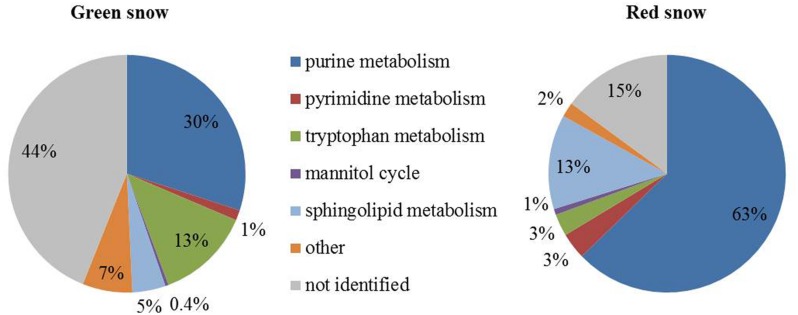
Snow algae are poly-extremophilic microalgae and important primary colonizers and producers on glaciers and snow fields. Depending on their pigmentation they cause green or red mass blooms during the melt season. This decreases surface albedo and thus further enhances snow and ice melting. Although the phenomenon of snow algal blooms has been known for a long time, large aspects of their physiology and ecology sill remain cryptic. This study provides the first in-depth and multi-omics investigation of two very striking adjacent green and red snow fields on a glacier in Svalbard. We have assessed the algal community composition of green and red snow including their associated microbiota, i.e., bacteria and archaea, their metabolic profiles (targeted and non-targeted metabolites) on the bulk and single-cell level, and assessed the feedbacks between the algae and their physico-chemical environment including liquid water content, pH, albedo, and nutrient availability. We demonstrate that green and red snow clearly vary in their physico-chemical environment, their microbial community composition and their metabolic profiles. For the algae this likely reflects both different stages of their life cycles and their adaptation strategies. Green snow represents a wet, carbon and nutrient rich environment and is dominated by the algae Microglena sp. with a metabolic profile that is characterized by key metabolites involved in growth and proliferation. In contrast, the dry and nutrient poor red snow habitat is colonized by various Chloromonas species with a high abundance of storage and reserve metabolites likely to face upcoming severe conditions. Combining a multitude of techniques we demonstrate the power of such complementary approaches in elucidating the function and ecology of extremophiles such as green and red snow algal blooms, which play crucial roles in glacial ecosystems.
雪藻是多极端嗜性微藻,是冰川和雪地上重要的初级定居者和生产者。根据其色素沉着情况,它们在融化季节会引发绿色或红色的大量繁殖。这会降低表面反照率,从而进一步加速冰雪融化。尽管雪藻大量繁殖的现象早已为人所知,但其生理学和生态学的许多方面仍然神秘莫测。本研究首次对斯瓦尔巴群岛一座冰川上相邻的两片非常显著的绿色和红色雪地进行了深入的多组学调查。我们评估了绿色和红色雪地的藻类群落组成,包括其相关的微生物群,即细菌和古菌,在整体和单细胞水平上的代谢谱(靶向和非靶向代谢物),并评估了藻类与其物理化学环境之间的反馈,包括液态水含量、pH值、反照率和养分可用性。我们证明,绿色和红色雪地在其物理化学环境、微生物群落组成和代谢谱方面明显不同。对于藻类来说,这可能反映了它们生命周期的不同阶段及其适应策略。绿色雪地代表了一个湿润、富含碳和养分的环境,主要由微绿藻属藻类主导,其代谢谱的特征是含有参与生长和增殖的关键代谢物。相比之下,干燥且养分匮乏的红色雪地栖息地则被各种绿梭藻属物种占据,这些物种含有大量的储存和储备代谢物,可能是为了应对即将到来的恶劣条件。我们结合多种技术,展示了这种互补方法在阐明极端嗜性生物(如绿色和红色雪藻大量繁殖)的功能和生态学方面的强大作用,这些极端嗜性生物在冰川生态系统中起着至关重要的作用。