Martín-Martín Inés, Jiménez Maribel, González Estela, Eguiluz César, Molina Ricardo
Unidad de Entomología Médica, Servicio de Parasitología, Centro Nacional de Microbiología, Instituto de Salud Carlos III, Ctra. Majadahonda-Pozuelo s/n, Majadahonda, 28220, Madrid, Spain.
Unidad de Veterinaria, Centro Nacional de Microbiología, Instituto de Salud Carlos III, Ctra. Majadahonda-Pozuelo s/n, Majadahonda, 28220, Madrid, Spain.
Vet Res. 2015 Dec 9;46:138. doi: 10.1186/s13567-015-0281-1.
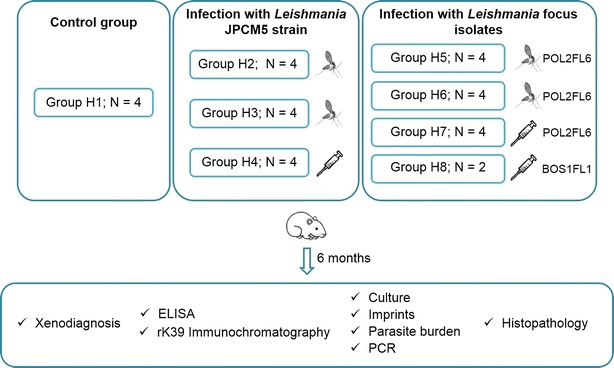
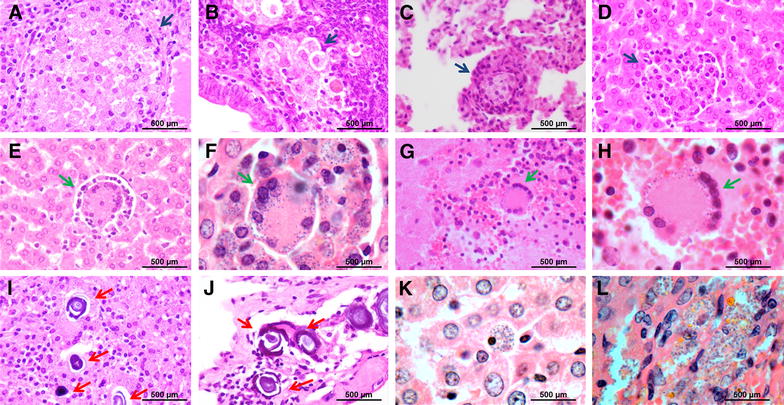
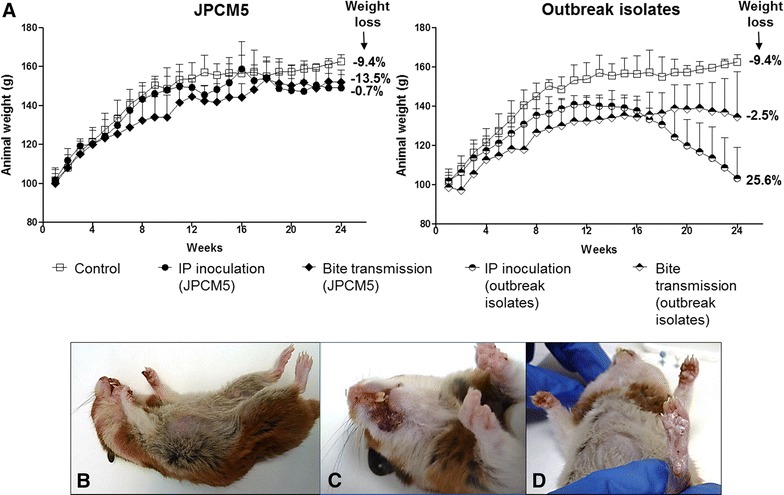
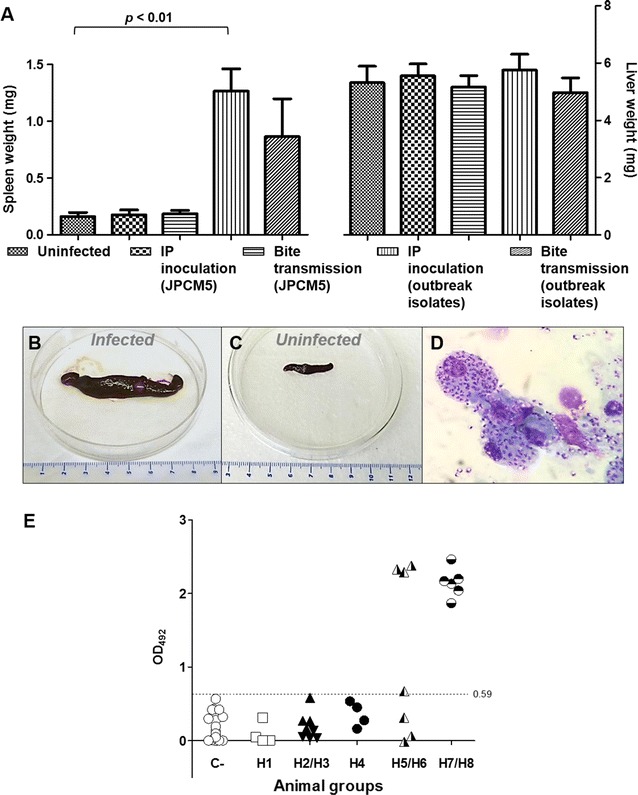
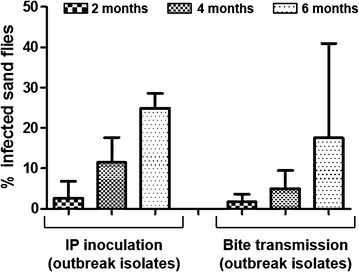
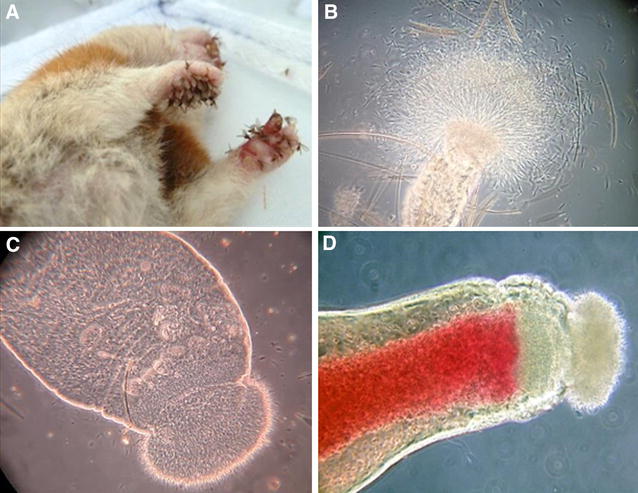
A human leishmaniasis outbreak is occurring in the Madrid region, Spain, with the parasite and vector involved being Leishmania infantum and Phlebotomus perniciosus respectively. The aim of this study was to investigate the virulence of L. infantum isolates from the focus using a natural transmission model. Hamsters were infected by intraperitoneal inoculation (IP) or by bites of sand flies experimentally infected with L. infantum isolates obtained from P. perniciosus collected in the outbreak area (IPER/ES/2012/BOS1FL1 and IPER/ES/2012/POL2FL6) and a well characterized L. infantum strain JPCM5 (MCAN/ES/98/LLM-877). Hamster infections were monitored by clinical examination, serology, culture, parasite burden, Giemsa-stained imprints, PCR, histopathology and xenodiagnostic studies. Establishment of infection of L. infantum was achieved with the JPCM5 strain and outbreak isolates by both P. perniciosus infective bites or IP route. However, high virulence of BOS1FL1 and POL2FL6 isolates was highlighted by the clinical outcome of disease, high parasite detection in spleen and liver, high parasitic loads and positivity of Leishmania serology. Transmission by bite of POL2FL6 infected flies generated a slower progression of clinical disease than IP infection, but both groups were infective to P. perniciosus by xenodiagnosis at 2 months post-infection. Conversely, hamsters inoculated with JPCM5 were not infective to sand flies. Histopathology studies confirmed the wide spread of POL2FL6 parasites to several organs. A visceral leishmaniasis model that mimics the natural transmission in nature allowed us to highlight the high virulence of isolates that are circulating in the focus. These findings contribute to a better understanding of the outbreak epidemiology.
西班牙马德里地区正在发生一起人类利什曼病疫情,涉及的寄生虫和传播媒介分别为婴儿利什曼原虫和白蛉。本研究的目的是使用自然传播模型调查来自疫源地的婴儿利什曼原虫分离株的毒力。通过腹腔接种(IP)或让仓鼠被实验感染了从疫情爆发地区采集的白蛉(IPER/ES/2012/BOS1FL1和IPER/ES/2012/POL2FL6)中获得的婴儿利什曼原虫分离株以及特征明确的婴儿利什曼原虫菌株JPCM5(MCAN/ES/98/LLM-877)的白蛉叮咬来感染仓鼠。通过临床检查、血清学、培养、寄生虫负荷、吉姆萨染色涂片、PCR、组织病理学和异种诊断研究来监测仓鼠感染情况。通过白蛉感染性叮咬或IP途径,JPCM5菌株和疫情分离株均成功建立了婴儿利什曼原虫感染。然而,BOS1FL1和POL2FL6分离株的高毒力体现在疾病的临床结果、脾脏和肝脏中高寄生虫检出率、高寄生虫载量以及利什曼原虫血清学阳性。被POL2FL6感染的白蛉叮咬传播导致临床疾病进展比IP感染慢,但两组在感染后2个月通过异种诊断对白蛉均具有感染性。相反,接种JPCM5的仓鼠对白蛉没有感染性。组织病理学研究证实POL2FL6寄生虫广泛传播至多个器官。一个模拟自然传播的内脏利什曼病模型使我们能够突出疫源地中流行的分离株的高毒力。这些发现有助于更好地理解疫情流行病学。