L'Huillier Arnaud G, Kaiser Laurent, Petty Tom J, Kilowoko Mary, Kyungu Esther, Hongoa Philipina, Vieille Gaël, Turin Lara, Genton Blaise, D'Acremont Valérie, Tapparel Caroline
Geneva University Hospitals and Medical School, 4 rue Gabrielle-Perret-Gentil, 1211 Geneva 14, Switzerland.
Swiss Institute of Bioinformatics, Centre Medical Universitraire, 1 rue Michel-Servet, 1211 Geneva 4, Switzerland.
Viruses. 2015 Dec 8;7(12):6412-23. doi: 10.3390/v7122948.
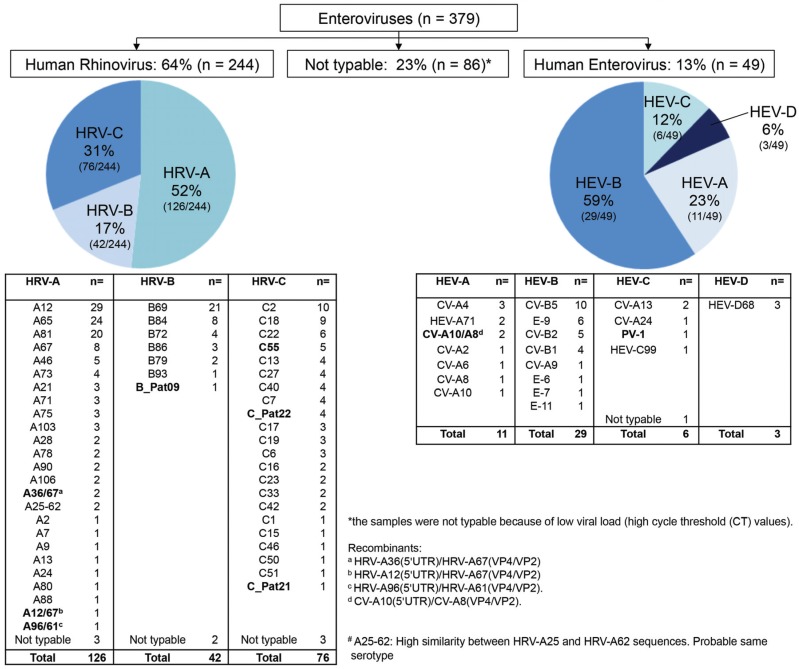
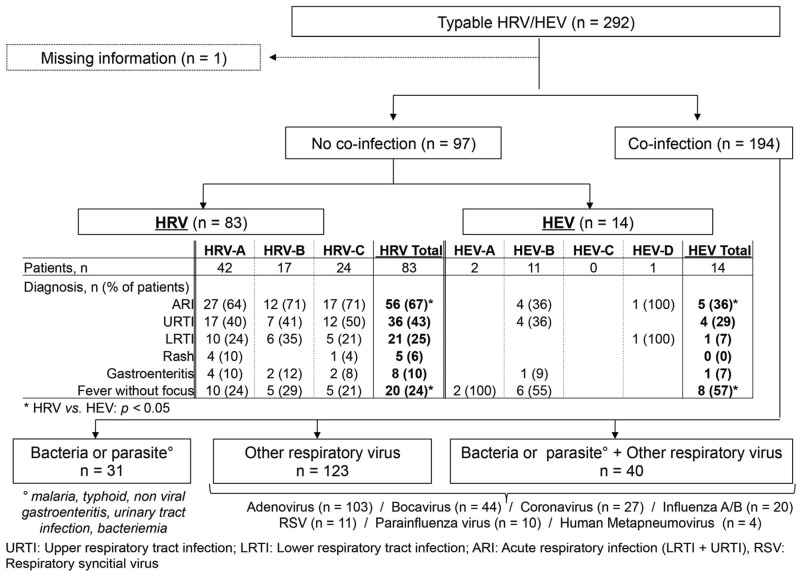
Human rhinoviruses (HRVs) and enteroviruses (HEVs) belong to the Enterovirus genus and are the most frequent cause of infection worldwide, but data on their molecular epidemiology in Africa are scarce. To understand HRV and HEV molecular epidemiology in this setting, we enrolled febrile pediatric patients participating in a large prospective cohort assessing the causes of fever in Tanzanian children. Naso/oropharyngeal swabs were systematically collected and tested by real-time RT-PCR for HRV and HEV. Viruses from positive samples were sequenced and phylogenetic analyses were then applied to highlight the HRV and HEV types as well as recombinant or divergent strains. Thirty-eight percent (378/1005) of the enrolled children harboured an HRV or HEV infection. Although some types were predominant, many distinct types were co-circulating, including a vaccinal poliovirus, HEV-A71 and HEV-D68. Three HRV-A recombinants were identified: HRV-A36/HRV-A67, HRV-A12/HRV-A67 and HRV-A96/HRV-A61. Four divergent HRV strains were also identified: one HRV-B strain and three HRV-C strains. This is the first prospective study focused on HRV and HEV molecular epidemiology in sub-Saharan Africa. This systematic and thorough large screening with careful clinical data management confirms the wide genomic diversity of these viruses, brings new insights about their evolution and provides data about associated symptoms.
人鼻病毒(HRV)和肠道病毒(HEV)属于肠道病毒属,是全球范围内最常见的感染原因,但关于它们在非洲的分子流行病学数据却很匮乏。为了解该地区HRV和HEV的分子流行病学情况,我们招募了参与一项大型前瞻性队列研究的发热儿科患者,该研究旨在评估坦桑尼亚儿童发热的原因。系统性收集鼻/口咽拭子,并通过实时逆转录聚合酶链反应(RT-PCR)检测HRV和HEV。对阳性样本中的病毒进行测序,然后进行系统发育分析,以突出HRV和HEV的类型以及重组或变异株。38%(378/1005)的入组儿童感染了HRV或HEV。尽管某些类型占主导地位,但许多不同类型同时流行,包括疫苗株脊髓灰质炎病毒、HEV-A71和HEV-D68。鉴定出三株HRV-A重组体:HRV-A36/HRV-A67、HRV-A12/HRV-A67和HRV-A96/HRV-A61。还鉴定出四株变异的HRV株:一株HRV-B株和三株HRV-C株。这是撒哈拉以南非洲地区第一项专注于HRV和HEV分子流行病学的前瞻性研究。这项系统、全面的大规模筛查以及细致的临床数据管理证实了这些病毒广泛的基因组多样性,为它们的进化带来了新的见解,并提供了相关症状的数据。