Abrão Fariza, de Araújo Costa Luciana Delfino, Alves Jacqueline Morais, Senedese Juliana Marques, de Castro Pâmela Tinti, Ambrósio Sérgio Ricardo, Veneziani Rodrigo Cássio Sola, Bastos Jairo Kenupp, Tavares Denise Crispim, Martins Carlos Henrique G
Laboratório de Pesquisa em Microbiologia Aplicada, Universidade de Franca, Franca, São Paulo, Brazil.
Laboratório de Mutagênese, Universidade de Franca, Franca, São Paulo, Brazil.
BMC Complement Altern Med. 2015 Dec 21;15:443. doi: 10.1186/s12906-015-0961-4.
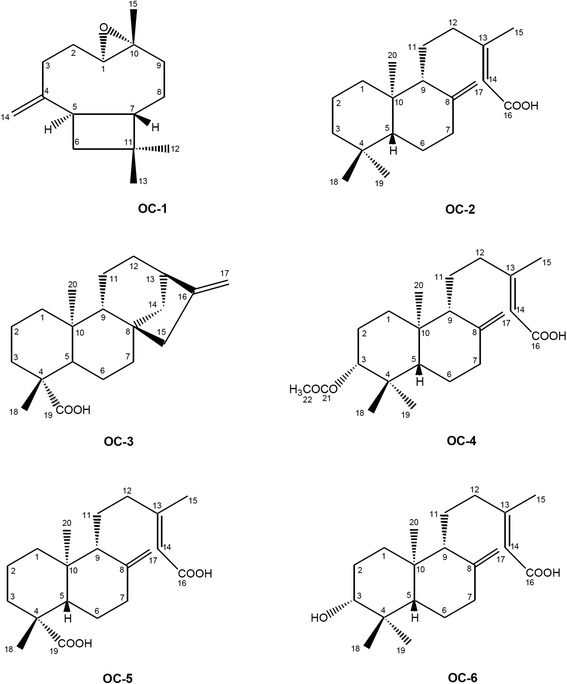
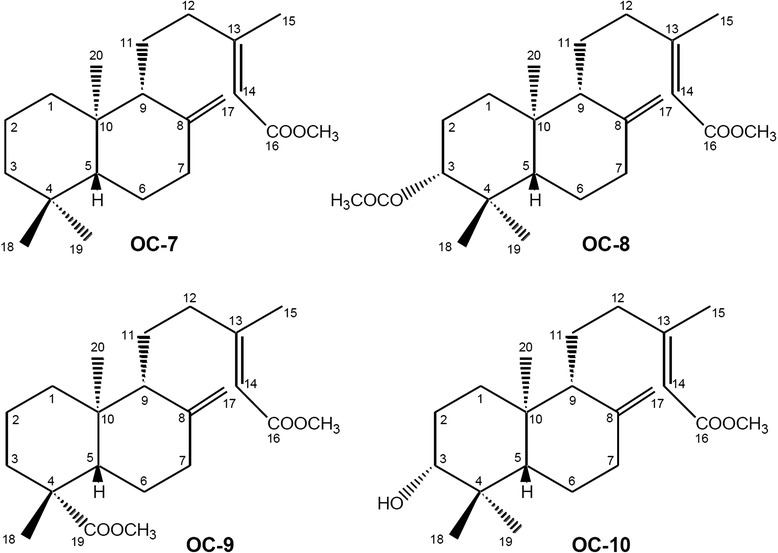
Natural products display numerous therapeutic properties (e.g., antibacterial activity), providing the population with countless benefits. Therefore, the search for novel biologically active, naturally occurring compounds is extremely important. The present paper describes the antibacterial action of the Copaifera langsdorffii oleoresin and ten compounds isolated from this oleoresin against multiresistant bacteria; it also reports the antiproliferative activity of the Copaifera langsdorffii oleoresin and (-)-copalic acid.
MICs and MBCs were used to determine the antibacterial activity. Time-kill curve assays provided the time that was necessary for the bacteria to die. The Minimum Inhbitory Concentration of Biofilm (CIMB50) of the compounds that displayed the best results was calculated. Cytotoxicity was measured by using the XTT assay.
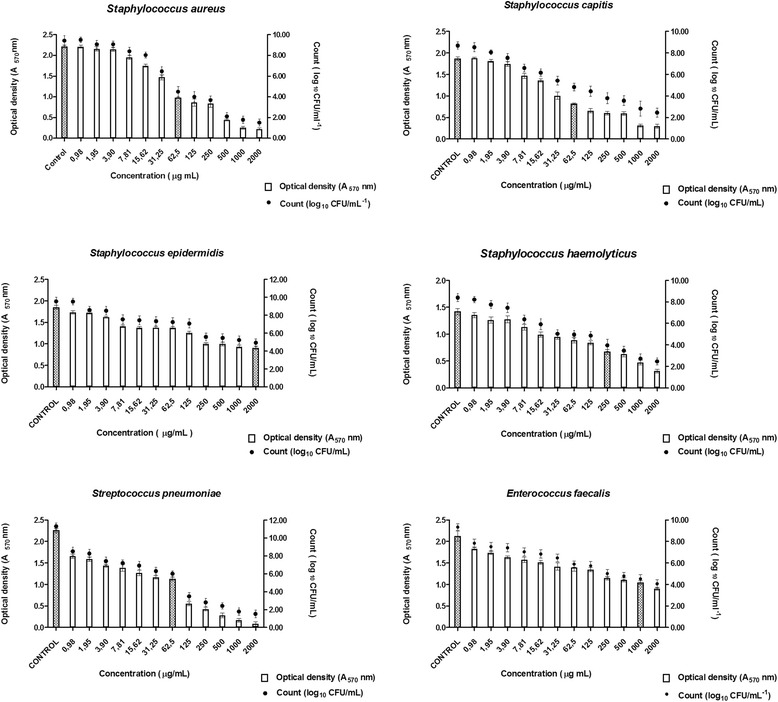
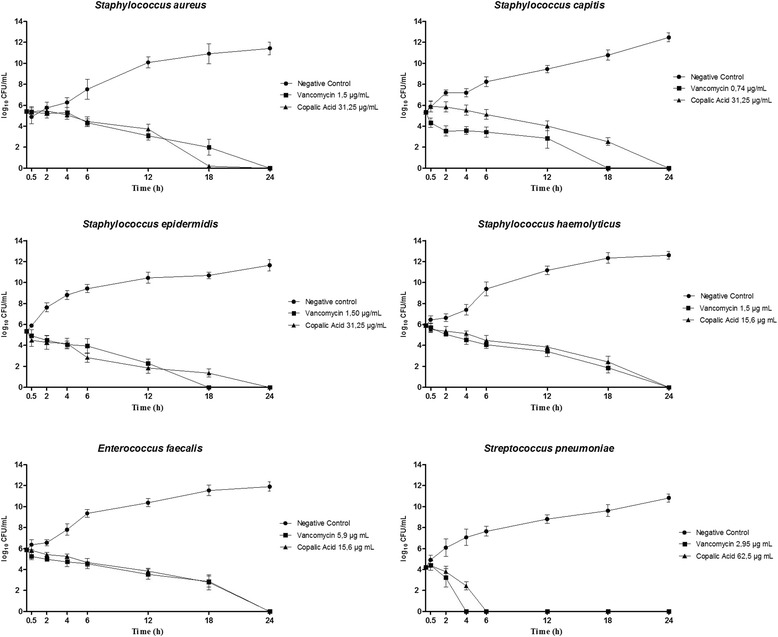
The diterpene (-)-copalic acid was the most active antibacterial and afforded promising Minimum Inhibitory Concentration (MIC) values for most of the tested strains. Determination of the bactericidal kinetics against some bacteria revealed that the bactericidal effect emerged within six hours of incubation for Streptococcus pneumoniae. Concerning the antibiofilm action of this diterpene, its MICB50 was twofold larger than its CBM against S. capitis and S. pneumoniae. The XTT assay helped to evaluate the cytotoxic effect; results are expressed as IC50. The most pronounced antiproliferative effect arose in tumor cell lines treated with (-)-copalic acid; the lowest IC50 value was found for the human glioblastoma cell line.
The diterpene (-)-copalic acid is a potential lead for the development of new selective antimicrobial agents to treat infections caused by Gram-positive multiresistant microorganisms, in both the sessile and planktonic mode. This diterpene is also a good candidate to develop anticancer drugs.
天然产物具有多种治疗特性(如抗菌活性),给人们带来了诸多益处。因此,寻找新型具有生物活性的天然化合物极为重要。本文描述了朗氏南美油楠油树脂及其从该油树脂中分离出的十种化合物对多重耐药菌的抗菌作用;还报告了朗氏南美油楠油树脂和(-)-柯巴酸的抗增殖活性。
采用最低抑菌浓度(MIC)和最低杀菌浓度(MBC)来测定抗菌活性。时间-杀菌曲线分析确定了细菌死亡所需的时间。计算了表现出最佳结果的化合物的生物膜最低抑制浓度(CIMB50)。使用XTT法测量细胞毒性。
二萜类化合物(-)-柯巴酸是最具活性的抗菌剂,对大多数测试菌株都给出了有前景的最低抑菌浓度(MIC)值。对某些细菌的杀菌动力学测定表明,肺炎链球菌在培养6小时内出现杀菌效果。关于这种二萜类化合物的抗生物膜作用,其对头皮葡萄球菌和肺炎链球菌的MICB50比CBM高两倍。XTT法有助于评估细胞毒性作用;结果以IC50表示。在用(-)-柯巴酸处理的肿瘤细胞系中出现了最显著的抗增殖作用;在人胶质母细胞瘤细胞系中发现了最低的IC50值。
二萜类化合物(-)-柯巴酸是开发新型选择性抗菌剂以治疗由革兰氏阳性多重耐药微生物引起的感染的潜在先导化合物,无论是在固着态还是浮游态。这种二萜类化合物也是开发抗癌药物的良好候选物。