Elremaly Wesam, Mohamed Ibrahim, Rouleau Thérèse, Lavoie Jean-Claude
Department of Nutrition, CHU Sainte-Justine, Université de Montréal, Montréal, QC, Canada H3T 1C5.
Department of Pediatrics, CHU Sainte-Justine, Université de Montréal, Montréal, QC, Canada H3T 1C5.
Redox Biol. 2016 Aug;8:18-23. doi: 10.1016/j.redox.2015.12.003. Epub 2015 Dec 17.
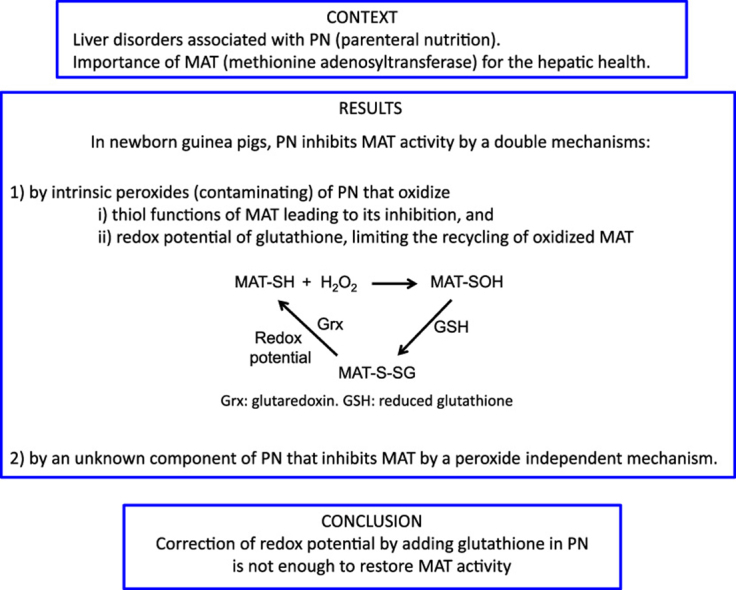
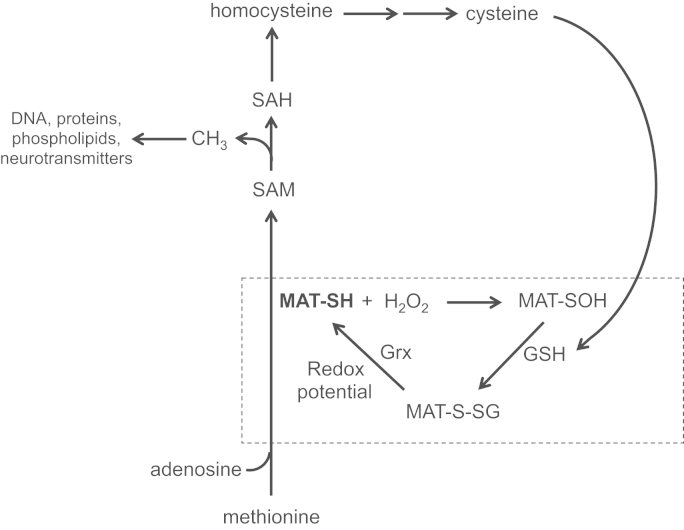
The oxidation of the methionine adenosyltransferase (MAT) by the combined impact of peroxides contaminating parenteral nutrition (PN) and oxidized redox potential of glutathione is suspected to explain its inhibition observed in animals. A modification of MAT activity is suspected to be at origin of the PN-associated liver disease as observed in newborns. We hypothesized that the correction of redox potential of glutathione by adding glutathione in PN protects the MAT activity.
To investigate whether the addition of glutathione to PN can reverse the inhibition of MAT observed in animal on PN.
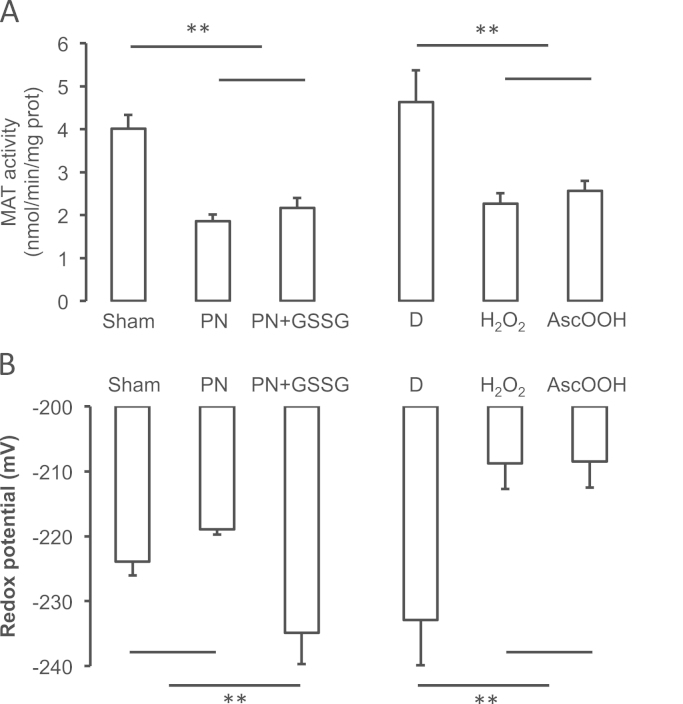
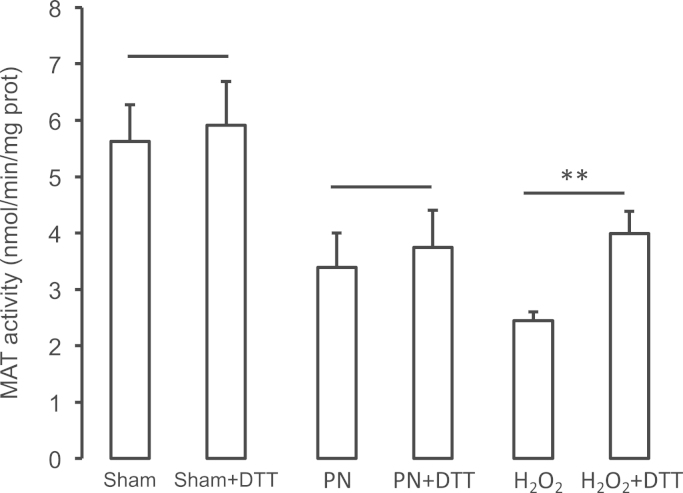
Three days old guinea pigs received through a jugular vein catheter 2 series of solutions. First with methionine supplement, (1) Sham (no infusion); (2) PN: amino acids, dextrose, lipids and vitamins; (3) PN-GSSG: PN+10μM GSSG. Second without methionine, (4) D: dextrose; (5) D+180μM ascorbylperoxide; (6) D+350μM H2O2. Four days later, liver was sampled for determination of redox potential of glutathione and MAT activity in the presence or absence of 1mM DTT. Data were compared by ANOVA, p<0.05.
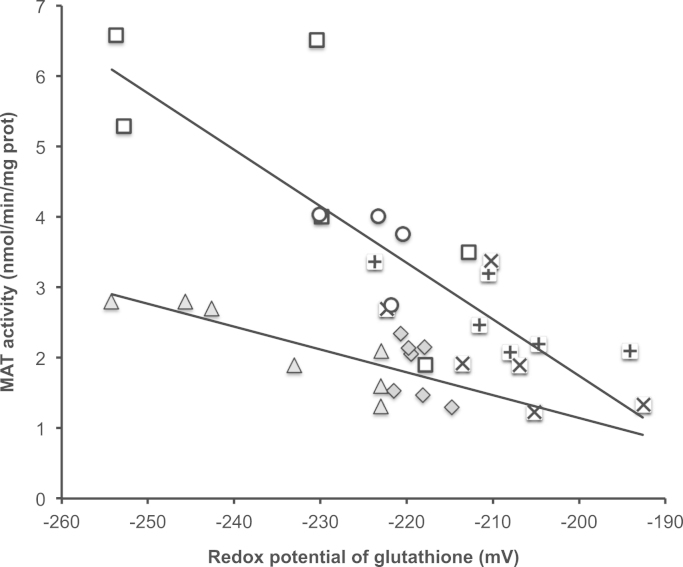
MAT activity was 45±4% lower in animal infused with PN and 23±7% with peroxides generated in PN. The inhibition by peroxides was associated with oxidized redox potential and was reversible by DTT. Correction of redox potential (PN+GSSG) or DTT was without effect on the inhibition of MAT by PN. The slope of the linear relation between MAT activity and redox potential was two fold lower in animal infused with PN than in others groups.
The present study suggests that prevention of peroxide generation in PN and/or correction of the redox potential by adding glutathione in PN are not sufficient, at least in newborn guinea pigs, to restore normal MAT activity.
怀疑肠外营养(PN)中污染的过氧化物与谷胱甘肽氧化还原电位的联合作用导致蛋氨酸腺苷转移酶(MAT)氧化,从而解释在动物中观察到的该酶抑制现象。怀疑MAT活性的改变是新生儿中观察到的PN相关性肝病的根源。我们假设在PN中添加谷胱甘肽纠正谷胱甘肽的氧化还原电位可保护MAT活性。
研究在PN中添加谷胱甘肽是否能逆转在接受PN的动物中观察到的MAT抑制。
3日龄豚鼠通过颈静脉导管接受2组溶液。第一组补充蛋氨酸,(1)假手术组(无输注);(2)PN组:氨基酸、葡萄糖、脂质和维生素;(3)PN-GSSG组:PN+10μM氧化型谷胱甘肽(GSSG)。第二组不补充蛋氨酸,(4)葡萄糖组;(5)葡萄糖+180μM抗坏血酸过氧化物组;(6)葡萄糖+350μM过氧化氢组。4天后,采集肝脏样本,在有或无1mM二硫苏糖醇(DTT)的情况下测定谷胱甘肽的氧化还原电位和MAT活性。数据采用方差分析进行比较,p<0.05。
接受PN输注的动物中MAT活性降低45±4%,接受PN中产生的过氧化物处理的动物中MAT活性降低23±7%。过氧化物的抑制作用与氧化还原电位升高有关,且可被DTT逆转。纠正氧化还原电位(PN+GSSG)或DTT对PN抑制MAT的作用无效。接受PN输注的动物中MAT活性与氧化还原电位之间线性关系的斜率比其他组低两倍。
本研究表明,至少在新生豚鼠中,预防PN中过氧化物的产生和/或通过在PN中添加谷胱甘肽纠正氧化还原电位不足以恢复正常的MAT活性。