Reilly-Harrington Noreen A, Shelton Richard C, Kamali Masoud, Rabideau Dustin J, Shesler Leah W, Trivedi Madhukar H, McElroy Susan L, Sylvia Louisa G, Bowden Charles L, Ketter Terence A, Calabrese Joseph R, Thase Michael E, Bobo William V, Deckersbach Thilo, Tohen Mauricio, McInnis Melvin G, Kocsis James H, Gold Alexandra K, Singh Vivek, Finkelstein Daniel M, Kinrys Gustavo, Nierenberg Andrew A
Department of Psychiatry, Massachusetts General Hospital, Boston, MA, USA; Harvard Medical School, Boston, MA, USA.
Department of Psychiatry, University of Alabama at Birmingham, Birmingham, AL, USA.
J Affect Disord. 2016 Mar 1;192:212-8. doi: 10.1016/j.jad.2015.12.036. Epub 2015 Dec 30.
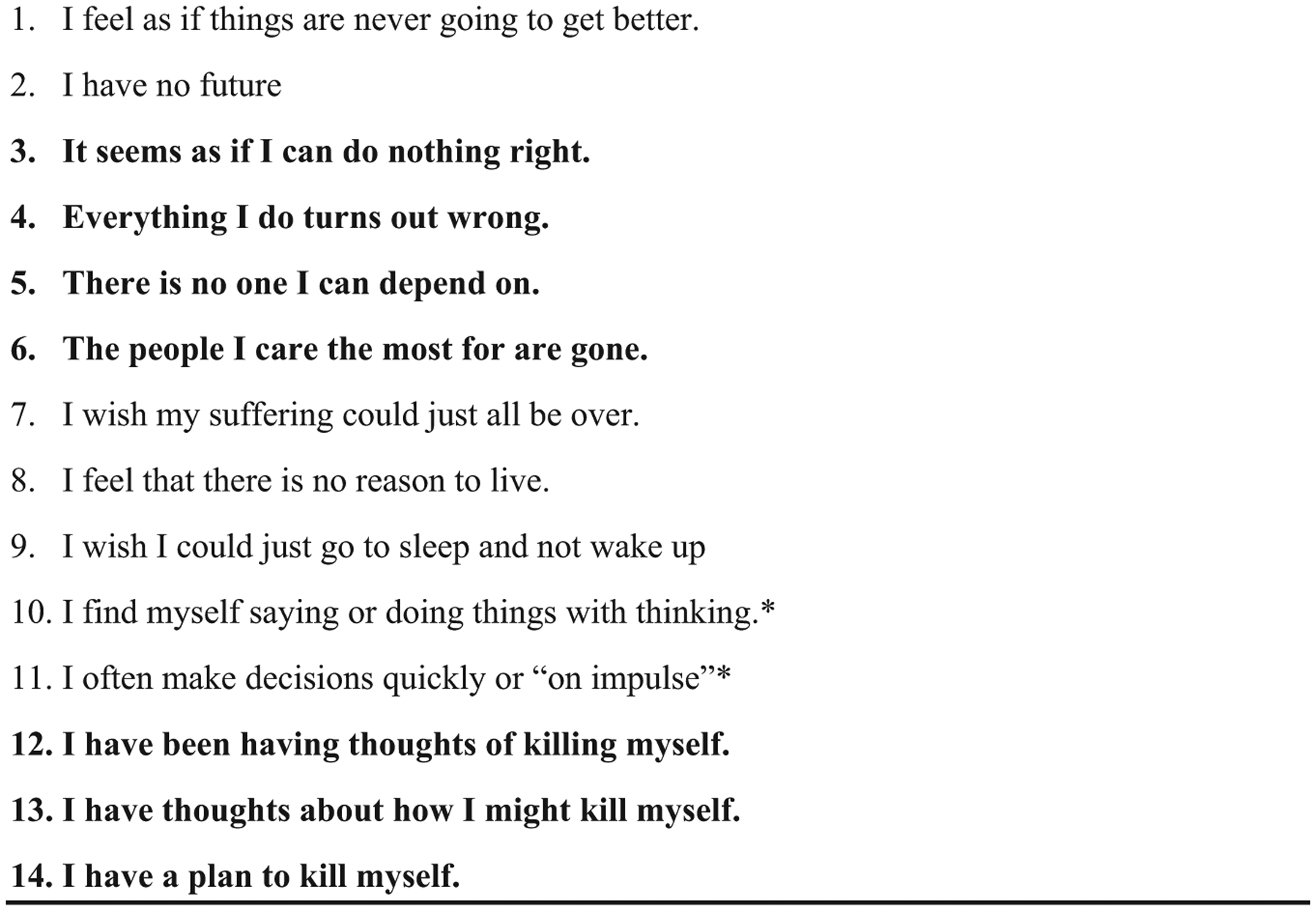
Few brief, self-report measures exist that can reliably predict adverse suicidality outcomes in patients with BD. This study utilized the Concise Health Risk Tracking Self-Report (CHRT) to assess suicidality in patients with BD and examined its psychometric performance, clinical correlates, and prospective value in predicting adverse events related to suicidality.
The CHRT was administered at baseline and follow-up to 482 adult patients in Bipolar CHOICE, a 6-month randomized comparative effectiveness trial. The Columbia Suicide Severity Rating Scale (CSSRS) was used at baseline to assess lifetime history of suicide attempts and related behaviors. Clinician-rated measures of mood (Bipolar Inventory of Symptoms Scale) and bipolar symptoms (Clinical Global Impressions-Bipolar Version) were conducted at baseline and follow-up.
The CHRT showed excellent internal consistency and construct validity and was highly correlated with clinician ratings of depression, anxiety, and overall functioning at baseline and throughout the study. Baseline CHRT scores significantly predicted risk of subsequent suicidality-related Serious Adverse Events (sSAEs), after controlling for mood and comorbidity. Specifically, the hazard of a sSAE increased by 76% for every 10-point increase in baseline CHRT score. Past history of suicide attempts and related behaviors, as assessed by the CSSRS, did not predict subsequent sSAEs.
The CSSRS was used to assess static risk factors in terms of past suicidal behaviors and may have been a more powerful predictor over longer-term follow-up.
The CHRT offers a quick and robust self-report tool for assessing suicidal risk and has important implications for future research and clinical practice.
很少有简短的自我报告测量方法能够可靠地预测双相情感障碍(BD)患者的不良自杀结局。本研究使用简明健康风险追踪自我报告(CHRT)来评估BD患者的自杀倾向,并检验其心理测量性能、临床相关性以及预测与自杀倾向相关不良事件的前瞻性价值。
在一项为期6个月的随机对照有效性试验“双相情感障碍选择”中,对482例成年患者在基线期和随访期进行CHRT评估。在基线期使用哥伦比亚自杀严重程度评定量表(CSSRS)评估自杀未遂及相关行为的终生史。在基线期和随访期进行临床医生评定的情绪(双相症状量表)和双相症状(临床总体印象-双相版)测量。
CHRT显示出良好的内部一致性和结构效度,并且在基线期及整个研究过程中与临床医生对抑郁、焦虑和整体功能的评定高度相关。在控制了情绪和合并症后,基线期CHRT评分显著预测了随后与自杀倾向相关的严重不良事件(sSAE)的风险。具体而言,基线期CHRT评分每增加10分,sSAE的风险增加76%。CSSRS评估的既往自杀未遂及相关行为史并不能预测随后的sSAE。
CSSRS用于评估既往自杀行为方面的静态风险因素,在更长时间的随访中可能是一个更有力的预测指标。
CHRT为评估自杀风险提供了一种快速且可靠的自我报告工具,对未来的研究和临床实践具有重要意义。