Nguefack Hermine L Nguena, Gwet Henri, Desmonde Sophie, Oukem-Boyer Odile Ouwe Missi, Nkenfou Céline, Téjiokem Mathurin, Tchendjou Patrice, Domkam Irénée, Leroy Valériane, Alioum Ahmadou
National Advanced School of Engineering, The University of Yaoundé I, PO Box 8390, Yaoundé, Cameroon.
Inserm, U897, Bordeaux, France.
BMC Infect Dis. 2016 Jan 12;16:11. doi: 10.1186/s12879-016-1336-2.
Despite the progress in the Prevention of the Mother-to-Child Transmission of HIV (PMTCT), the paediatric HIV epidemic remains worrying in Cameroon. HIV prevalence rate for the population of pregnant women was 7.6% in 2010 in Cameroon. The extent of the paediatric HIV epidemic is needed to inform policymakers. We developed a stochastic simulation model to estimate the number of new paediatric HIV infections through MTCT based on the observed uptake of services during the different steps of the PMTCT cascade in Cameroon in 2011. Different levels of PMTCT uptake was also assessed.
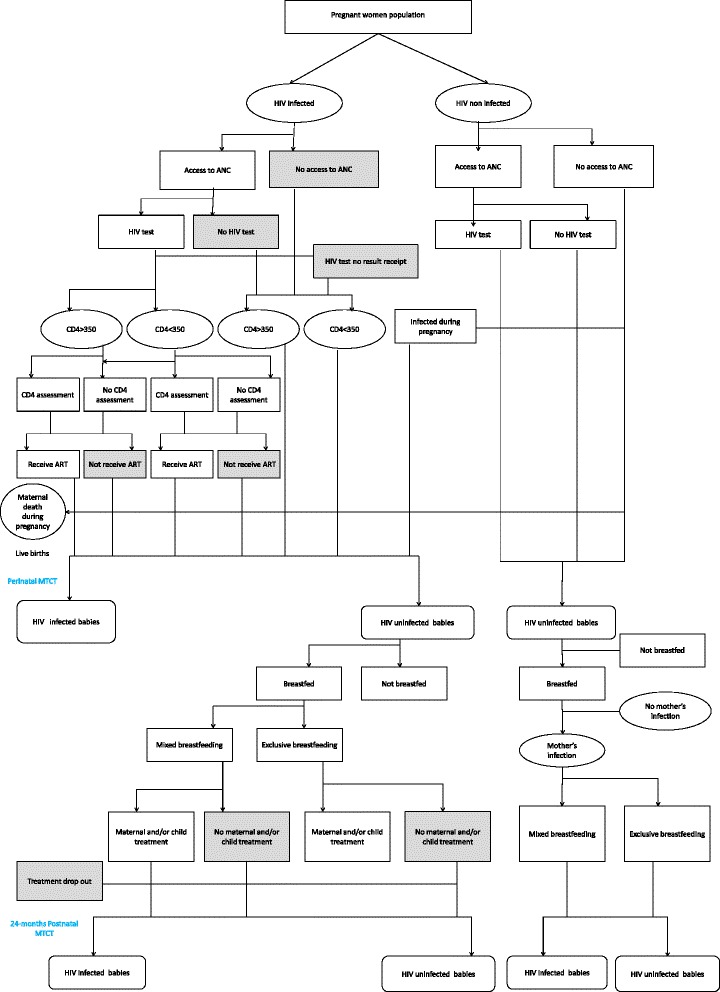
A discrete events computer simulation-based approach with stochastic structure was proposed to generate a cohort of pregnant women followed-up until 6 weeks post-partum, and optionally until complete breastfeeding cessation in both prevalent and incident lactating HIV-infected women. The different parameters of the simulation model were fixed using data sources available from the 2011 national registry surveys, and from external cohorts in Cameroon. Different PMTCT coverages were simulated to assess their impact on MTCT. Available data show a low coverage of PMTCT services in Cameroon in 2011.
Based on a simulation approach on a population of 995, 533 pregnant women, the overall residual MTCT rate in 2011 was estimated to be 22.1% (95 % CI: 18.6%-25.2%), the 6-week perinatal MTCT rate among prevalent HIV-infected mothers at delivery is estimated at 12.1% (95% CI: 8.1%-15.1%), with an additional postnatal MTCT rate estimated at 13.3% (95% CI: 9.3%-17.8%). The MTCT rate among children whose mothers seroconverted during breastfeeding was estimated at 20.8% (95% CI: 14.1%-26.9%). Overall, we estimated the number of new HIV infections in children in Cameroon to be 10, 403 (95% CI: 9, 054-13, 345) in 2011. When PMTCT uptake have been fixed at 100%, 90% and 80%, global MTCT rate failed to 0.9% (9% CI: 0.5%-1.7%), 2.0% (95% CI: 0.9%-3.2%) and 4.3% (95% CI: 2.4%-6.7%) respectively.
This model is helpful to provide MTCT estimates to guide the national HIV policy in Cameroon. Increasing supply and uptake of PMTCT services among prevalent HIV infected pregnant women, as well as HIV-prevention interventions including the offer and acceptance of HIV testing and counselling in lactating women could reduce significantly the residual HIV MTCT in Cameroon. A public health effort should be made to encourage health care workers and pregnant women to use PMTCT services until complete breastfeeding cessation.
尽管在预防母婴传播艾滋病毒(PMTCT)方面取得了进展,但喀麦隆的儿童艾滋病毒疫情仍然令人担忧。2010年喀麦隆孕妇群体中的艾滋病毒感染率为7.6%。需要了解儿童艾滋病毒疫情的严重程度,以便为政策制定者提供信息。我们开发了一个随机模拟模型,根据2011年喀麦隆PMTCT级联不同步骤中观察到的服务利用情况,估计通过母婴传播感染艾滋病毒的新发病例数。还评估了不同水平的PMTCT服务利用情况。
提出了一种基于离散事件计算机模拟且具有随机结构的方法,以生成一组孕妇队列,并随访至产后6周,对于感染艾滋病毒的现患和新发哺乳期妇女,可选择随访至完全停止母乳喂养时。利用2011年国家登记调查以及喀麦隆外部队列的可用数据源来确定模拟模型的不同参数。模拟了不同水平PMTCT覆盖率以评估其对母婴传播的影响。现有数据显示2011年喀麦隆PMTCT服务的覆盖率较低。
基于对995,533名孕妇群体的模拟方法,2011年总体残余母婴传播率估计为22.1%(95%可信区间:18.6% - 25.2%),分娩时感染艾滋病毒的现患母亲的6周围产期母婴传播率估计为12.1%(95%可信区间:8.1% - 15.1%)另外产后母婴传播率估计为13.3%(95%可信区间:9.3% - 17.8%)。母亲在母乳喂养期间血清转化的儿童中的母婴传播率估计为20.8%(95%可信区间:14.1% - 26.9%)。总体而言,我们估计2011年喀麦隆儿童中新发艾滋病毒感染病例数为10,403例(95%可信区间:9,054 - 13,345例)。当PMTCT服务利用率分别设定为100%、90%和80%时,总体母婴传播率分别降至0.9%(9%可信区间:0.5% - 1.7%)、2.0%(95%可信区间:0.9% - 3.2%)和4.3%(95%可信区间:2.4% - 6.7%)。
该模型有助于提供母婴传播估计数,以指导喀麦隆的国家艾滋病毒政策。增加现患感染艾滋病毒孕妇中PMTCT服务的供应和利用,以及包括为哺乳期妇女提供和接受艾滋病毒检测与咨询在内的艾滋病毒预防干预措施,可显著降低喀麦隆残余的艾滋病毒母婴传播率。应做出公共卫生努力,鼓励医护人员和孕妇使用PMTCT服务,直至完全停止母乳喂养。