Angele Bernhard, Slattery Timothy J, Rayner Keith
Department of Psychology, Faculty of Science and Technology, Bournemouth University, Fern Barrow, Poole, BH125BB, Dorset, UK.
Department of Psychology, University of California San Diego, San Diego, CA, USA.
Psychon Bull Rev. 2016 Aug;23(4):1241-9. doi: 10.3758/s13423-015-0995-0.
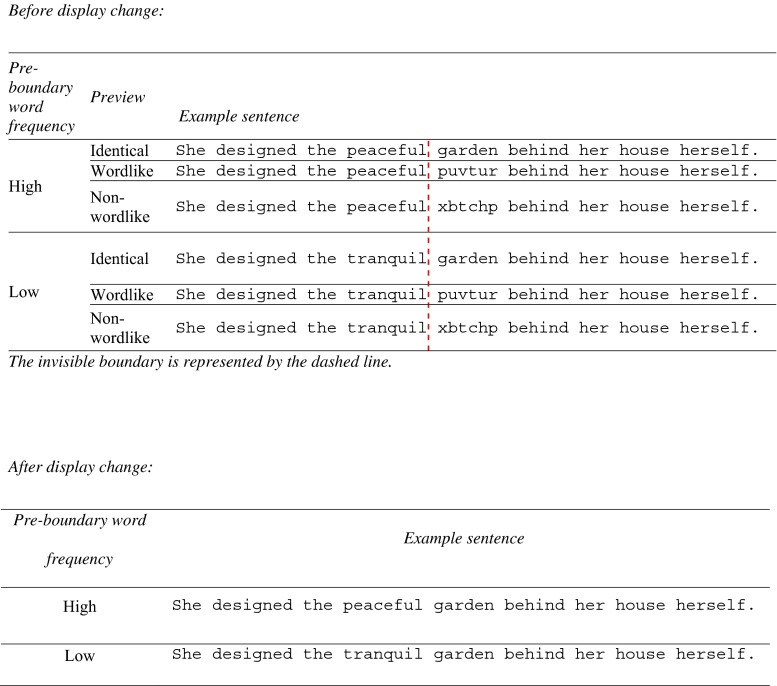
We used a display change detection paradigm (Slattery, Angele, & Rayner Human Perception and Performance, 37, 1924-1938 2011) to investigate whether display change detection uses orthographic regularity and whether detection is affected by the processing difficulty of the word preceding the boundary that triggers the display change. Subjects were significantly more sensitive to display changes when the change was from a nonwordlike preview than when the change was from a wordlike preview, but the preview benefit effect on the target word was not affected by whether the preview was wordlike or nonwordlike. Additionally, we did not find any influence of preboundary word frequency on display change detection performance. Our results suggest that display change detection and lexical processing do not use the same cognitive mechanisms. We propose that parafoveal processing takes place in two stages: an early, orthography-based, preattentional stage, and a late, attention-dependent lexical access stage.
我们采用了一种显示变化检测范式(斯莱特里、安格勒和雷纳,《人类感知与表现》,第37卷,1924 - 1938页,2011年)来研究显示变化检测是否利用正字法规则,以及检测是否受到触发显示变化的边界之前单词的加工难度的影响。当显示变化是从非单词样的预览变为其他时,与从单词样的预览变为其他相比,受试者对显示变化的敏感度显著更高,但预览对目标单词的促进效应不受预览是单词样还是非单词样的影响。此外,我们没有发现边界前单词频率对显示变化检测性能有任何影响。我们的结果表明,显示变化检测和词汇加工并不使用相同的认知机制。我们提出,副中央凹加工分两个阶段进行:一个早期的、基于正字法的、前注意阶段,以及一个后期的、依赖注意的词汇通达阶段。