Kuwabara Masanari, Motoki Yoko, Ichiura Kayoko, Fujii Mizue, Inomata Chisato, Sato Hiroki, Morisawa Taichiro, Morita Yoshinori, Kuwabara Kazumichi, Nakamura Yosikazu
Department of Cardiology, Toranomon Hospital, Tokyo, Japan Department of Cardiology, St Luke's International Hospital, Tokyo, Japan Department of Public Health, Jichi Medical University, Shimotsuke, Japan.
Department of Obstetrics, Gynecology and Molecular Reproductive Science, Yokohama City University Graduate School of Medicine, Yokohama, Japan.
BMJ Open. 2016 Jan 14;6(1):e009870. doi: 10.1136/bmjopen-2015-009870.
To clarify the association between toothbrushing and risk factors for cardiovascular disease--namely, hypertension (HT), diabetes mellitus (DM), dyslipidaemia (DL), hyperuricaemia (HUA) and chronic kidney disease (CKD).
A large-scale, single-centre, cross-sectional study.
St Luke's International Hospital, Center for Preventive Medicine, Tokyo, Japan, between January 2004 and June 2010.
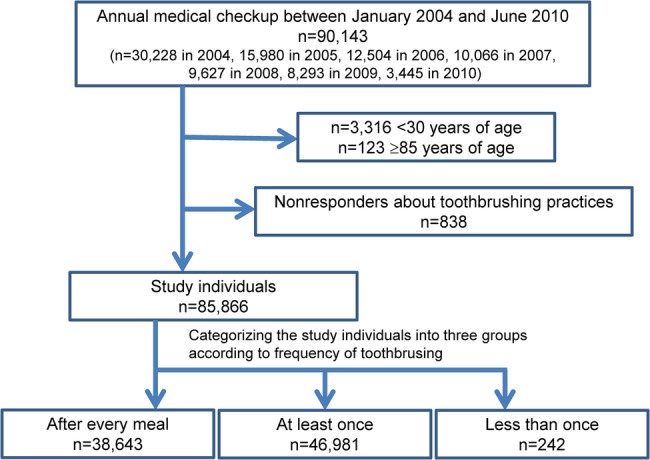
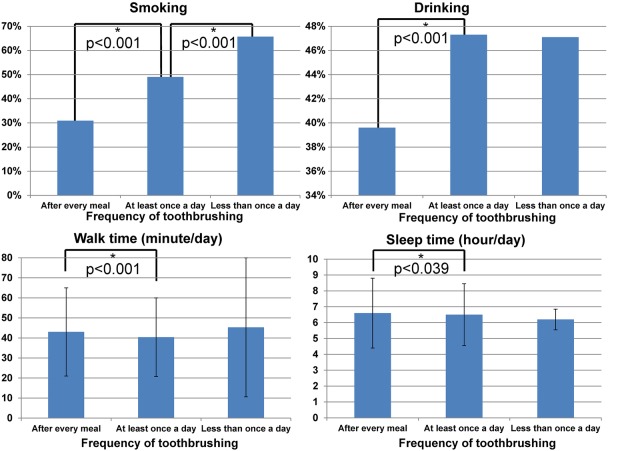
This study examined the toothbrushing practices of 85,866 individuals according to the 3-category frequency criterion: 'after every meal', 'at least once a day' and 'less than once a day'. The ORs by frequency were calculated for the prevalences of HT, DM, DL, HUA and CKD according to binominal logistic regression analyses adjusted for age, gender, body mass index and lifestyle habits--smoking, drinking, walk time and sleep time.
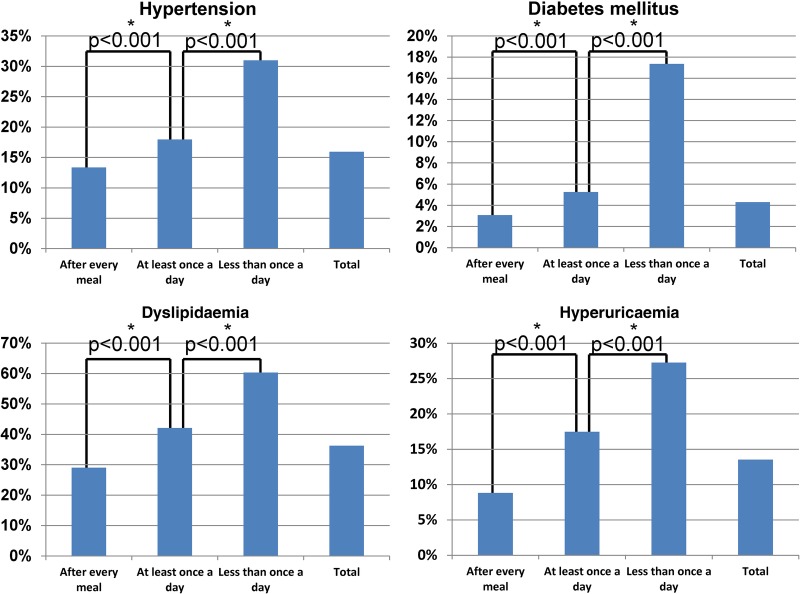
The prevalences of the risk factors were as follows: HT ('after every meal': 13.3%, 'at least once a day': 17.9% and 'less than once a day': 31.0%), DM (3.1%, 5.3% and 17.4%, respectively), DL (29.0%, 42.1% and 60.3%, respectively), HUA (8.6%, 17.5% and 27.2%, respectively) and CKD (3.8%, 3.1% and 8.3%, respectively). The prevalences were significantly higher in the 'less than once a day' group than in the 'after every meal' group for DM (OR=2.03; 95% CI 1.29 to 3.21) and DL (OR=1.50; 95% CI 1.06 to 2.14), but not for HT, HUA and CKD.
Even taking into account lifestyle habits, a lower frequency of toothbrushing was associated with high prevalences of DM and DL. Toothbrushing practices may be beneficial for oral health improvement and also for prevention of certain systemic diseases.
阐明刷牙与心血管疾病风险因素之间的关联,即高血压(HT)、糖尿病(DM)、血脂异常(DL)、高尿酸血症(HUA)和慢性肾脏病(CKD)。
大规模、单中心横断面研究。
2004年1月至2010年6月期间,日本东京圣路加国际医院预防医学中心。
本研究根据三类频率标准检查了85866人的刷牙习惯:“每餐饭后”、“每天至少一次”和“每天少于一次”。根据二项逻辑回归分析计算频率的比值比(OR),该分析针对年龄、性别、体重指数和生活习惯(吸烟、饮酒、步行时间和睡眠时间)进行了调整,以确定HT、DM、DL、HUA和CKD的患病率。
风险因素的患病率如下:HT(“每餐饭后”:13.3%,“每天至少一次”:17.9%,“每天少于一次”:31.0%),DM(分别为3.1%、5.3%和17.4%),DL(分别为29.0%、42.1%和60.3%),HUA(分别为8.6%、17.5%和27.2%)和CKD(分别为3.8%、3.1%和8.3%)。DM(OR = 2.03;95%CI 1.29至3.21)和DL(OR = 1.50;95%CI 1.06至2.14)的患病率在“每天少于一次”组中显著高于“每餐饭后”组,但HT、HUA和CKD并非如此。
即使考虑生活习惯,较低的刷牙频率也与DM和DL的高患病率相关。刷牙习惯可能有益于改善口腔健康,也有助于预防某些全身性疾病。