Nguyen Kien, Whitford Paul C
Department of Physics, Northeastern University, Dana Research Center 111, 360 Huntington Avenue, Boston, Massachusetts 02115, USA.
Nat Commun. 2016 Feb 3;7:10586. doi: 10.1038/ncomms10586.
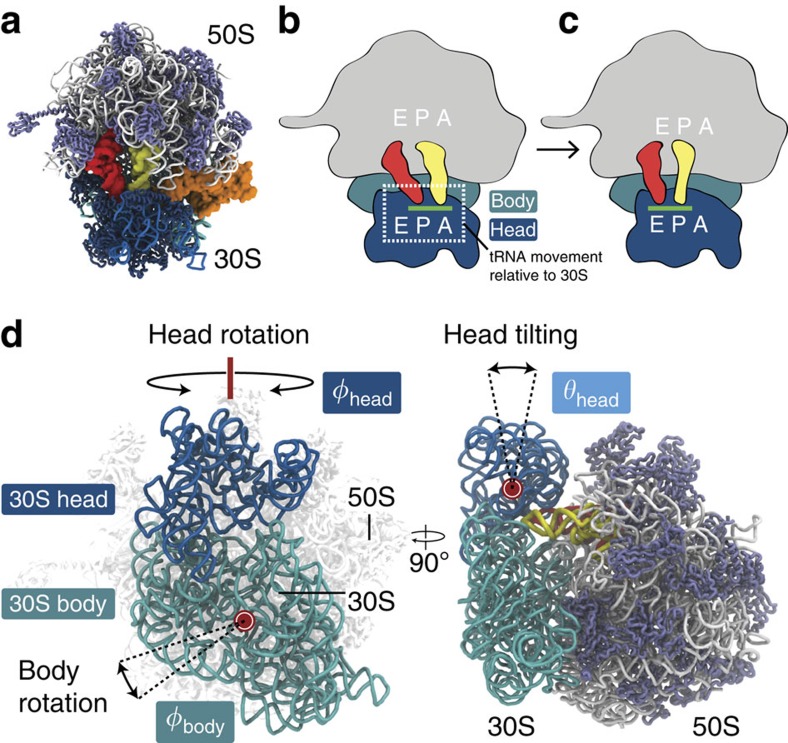
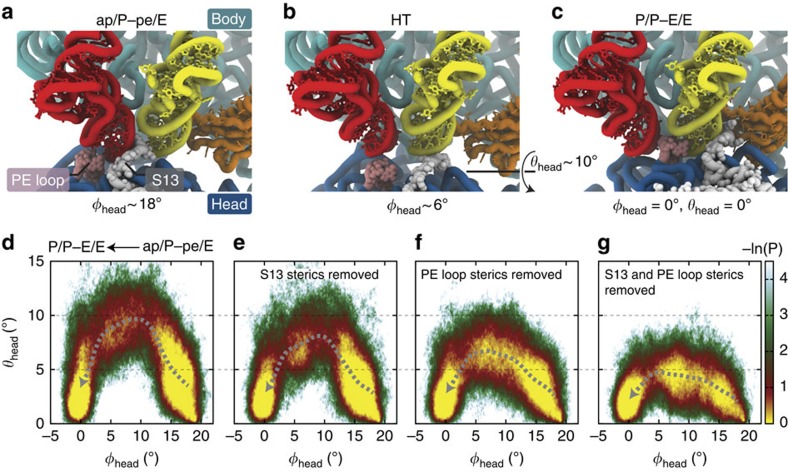
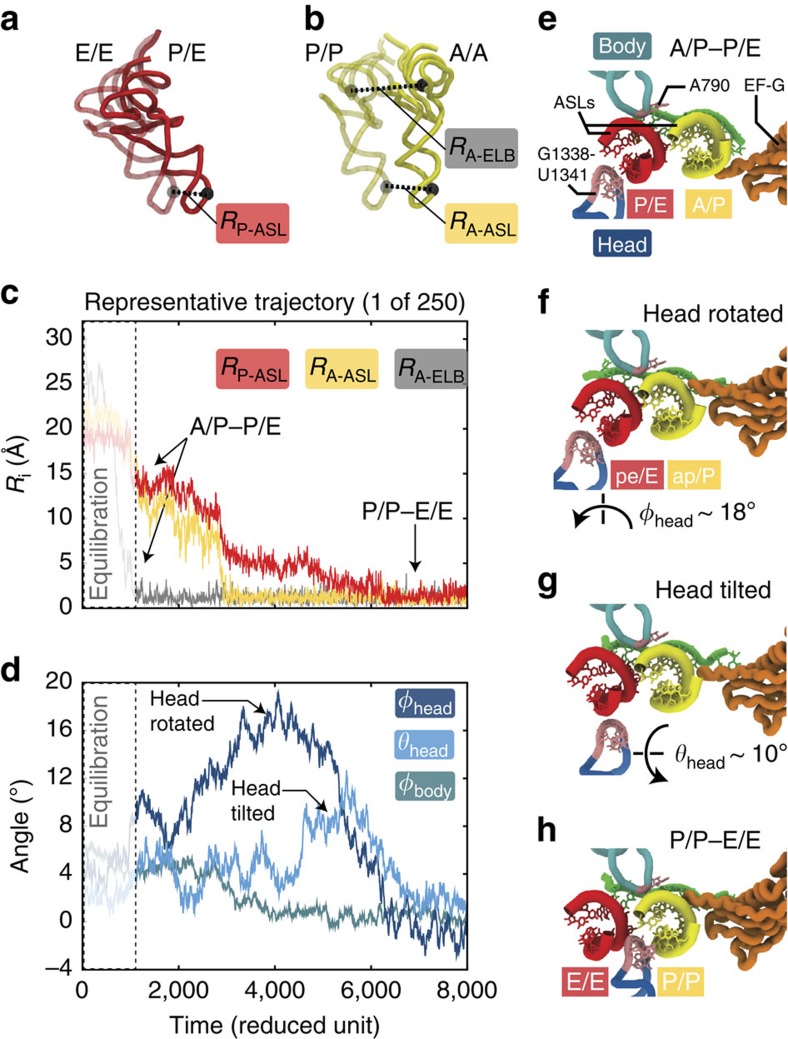
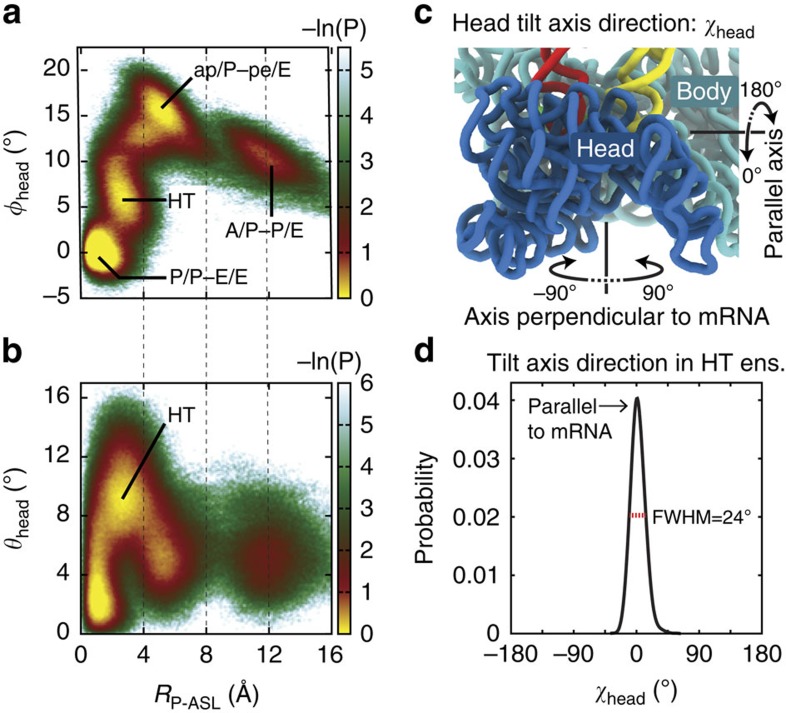
Translocation of mRNA and tRNA through the ribosome is associated with large-scale rearrangements of the head domain in the 30S ribosomal subunit. To elucidate the relationship between 30S head dynamics and mRNA-tRNA displacement, we apply molecular dynamics simulations using an all-atom structure-based model. Here we provide a statistical analysis of 250 spontaneous transitions between the A/P-P/E and P/P-E/E ensembles. Consistent with structural studies, the ribosome samples a chimeric ap/P-pe/E intermediate, where the 30S head is rotated ∼18°. It then transiently populates a previously unreported intermediate ensemble, which is characterized by a ∼10° tilt of the head. To identify the origins of head tilting, we analyse 781 additional simulations in which specific steric features are perturbed. These calculations show that head tilting may be attributed to specific steric interactions between tRNA and the 30S subunit (PE loop and protein S13). Taken together, this study demonstrates how molecular structure can give rise to large-scale collective rearrangements.
信使核糖核酸(mRNA)和转运核糖核酸(tRNA)通过核糖体的易位与30S核糖体亚基头部结构域的大规模重排相关。为了阐明30S头部动力学与mRNA-tRNA位移之间的关系,我们使用基于全原子结构的模型进行分子动力学模拟。在此,我们对A/P-P/E和P/P-E/E集合之间的250次自发转变进行了统计分析。与结构研究一致,核糖体采样了一种嵌合的ap/P-pe/E中间体,其中30S头部旋转了约18°。然后,它短暂地占据了一个以前未报道的中间体集合,其特征是头部倾斜约10°。为了确定头部倾斜的起源,我们分析了另外781次模拟,其中特定的空间特征受到了扰动。这些计算表明,头部倾斜可能归因于tRNA与30S亚基(PE环和蛋白质S13)之间的特定空间相互作用。综上所述,这项研究展示了分子结构如何导致大规模的集体重排。