Chen Jun, Ryu Euijung, Hathcock Matthew, Ballman Karla, Chia Nicholas, Olson Janet E, Nelson Heidi
Department of Health Sciences Research, Mayo Clinic, Rochester, Minnesota, United States; Microbiome Program, Center for Individualized Medicine, Mayo Clinic, Rochester, Minnesota, United States.
Department of Health Sciences Research, Mayo Clinic , Rochester, Minnesota , United States.
PeerJ. 2016 Jan 7;4:e1514. doi: 10.7717/peerj.1514. eCollection 2016.
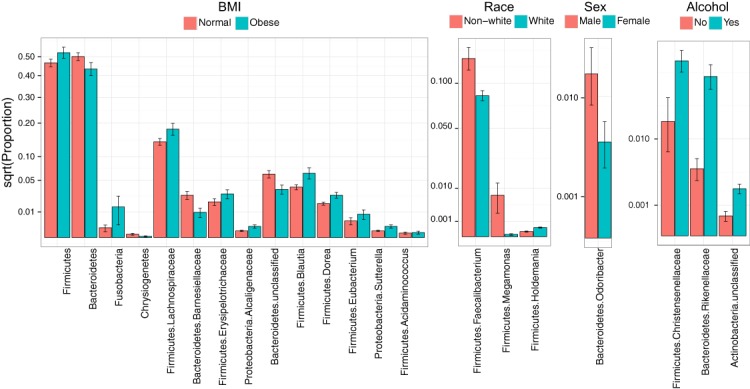
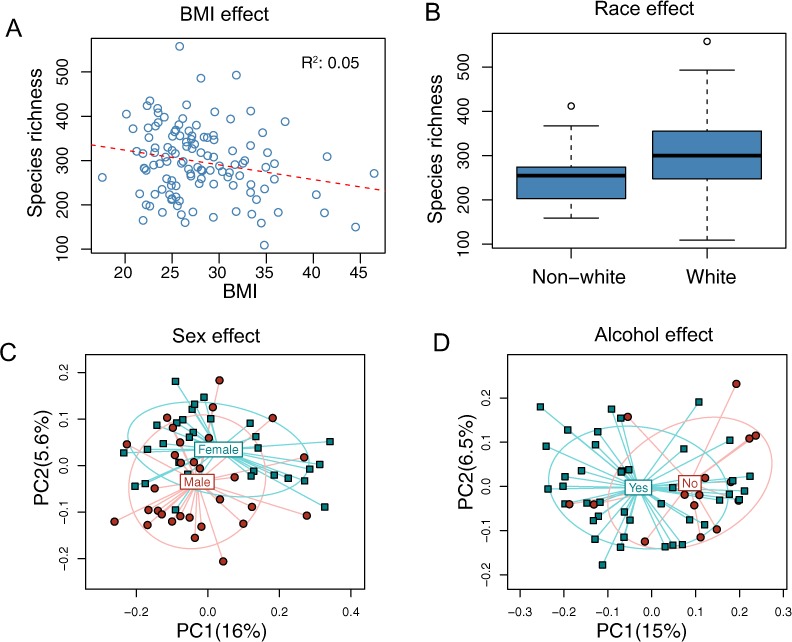
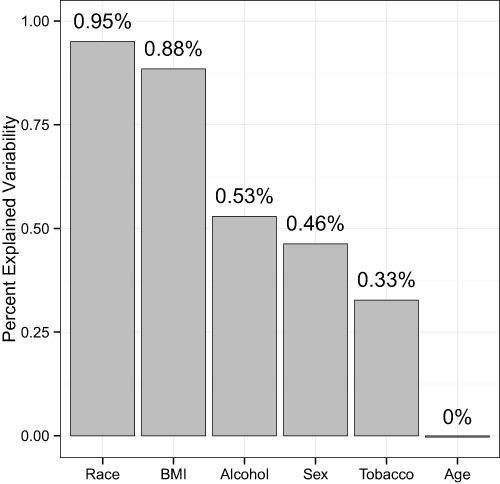
The clinical utility of microbiome biomarkers depends on the reliable and reproducible nature of comparative results. Underappreciation of the variation associated with common demographic, health, and behavioral factors may confound associations of interest and generate false positives. Here, we present the Midwestern Reference Panel (MWRP), a resource for comparative gut microbiome studies conducted in the Midwestern United States. We analyzed the relationships between demographic and health behavior-related factors and the microbiota in this cohort, and estimated their effect sizes. Most variables investigated were associated with the gut microbiota. Specifically, body mass index (BMI), race, sex, and alcohol use were significantly associated with microbial β-diversity (P < 0.05, unweighted UniFrac). BMI, race and alcohol use were also significantly associated with microbial α-diversity (P < 0.05, species richness). Tobacco use showed a trend toward association with the microbiota (P < 0.1, unweighted UniFrac). The effect sizes of the associations, as quantified by adjusted R(2) values based on unweighted UniFrac distances, were small (< 1% for all variables), indicating that these factors explain only a small percentage of overall microbiota variability. Nevertheless, the significant associations between these variables and the gut microbiota suggest that they could still be potential confounders in comparative studies and that controlling for these variables in study design, which is the main objective of the MWRP, is important for increasing reproducibility in comparative microbiome studies.
微生物组生物标志物的临床效用取决于比较结果的可靠性和可重复性。对与常见人口统计学、健康和行为因素相关的变异认识不足,可能会混淆感兴趣的关联并产生假阳性结果。在此,我们展示了中西部参考面板(MWRP),这是一个用于在美国中西部地区进行的比较肠道微生物组研究的资源。我们分析了该队列中人口统计学和健康行为相关因素与微生物群之间的关系,并估计了它们的效应大小。所研究的大多数变量都与肠道微生物群有关。具体而言,体重指数(BMI)、种族、性别和饮酒与微生物β多样性显著相关(P < 0.05,非加权UniFrac)。BMI、种族和饮酒也与微生物α多样性显著相关(P < 0.05,物种丰富度)。吸烟与微生物群呈现出关联趋势(P < 0.1,非加权UniFrac)。基于非加权UniFrac距离通过调整后的R(2)值量化的关联效应大小较小(所有变量均< 1%),表明这些因素仅解释了总体微生物群变异性的一小部分。然而,这些变量与肠道微生物群之间的显著关联表明,它们在比较研究中仍可能是潜在的混杂因素,并且在研究设计中控制这些变量(这是MWRP的主要目标)对于提高比较微生物组研究的可重复性很重要。