Sargent Charli, Zhou Xuan, Matthews Raymond W, Darwent David, Roach Gregory D
Appleton Institute for Behavioural Science, Central Queensland University, P.O. Box 42, Goodwood 5034, Australia.
Int J Environ Res Public Health. 2016 Jan 29;13(2):170. doi: 10.3390/ijerph13020170.
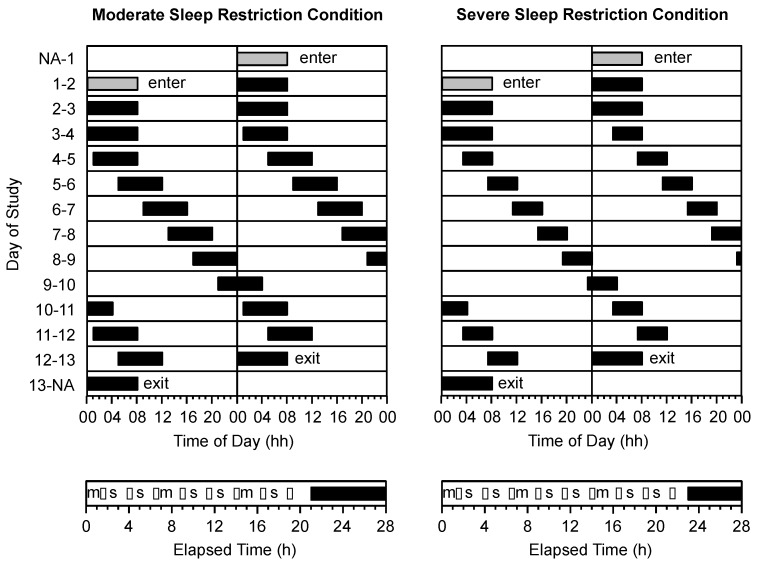
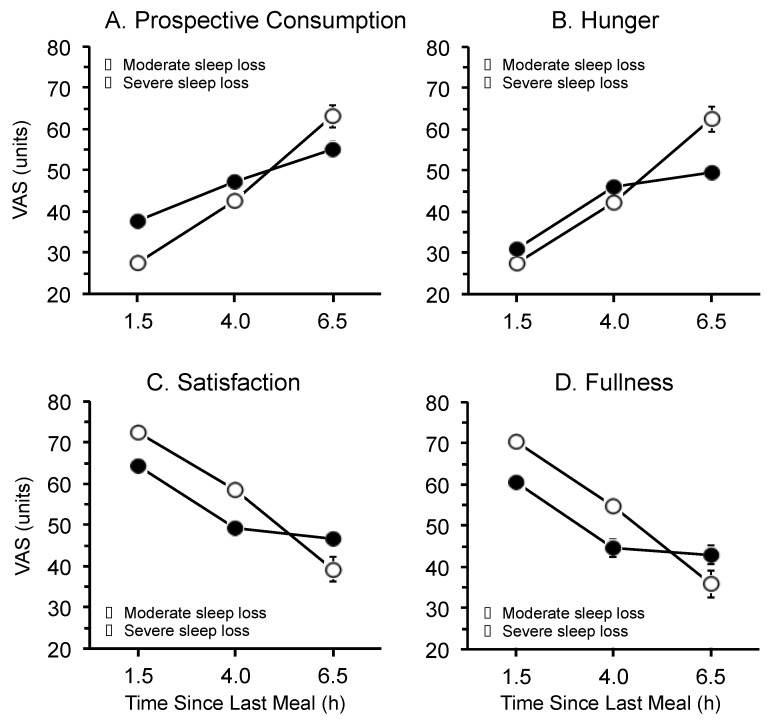
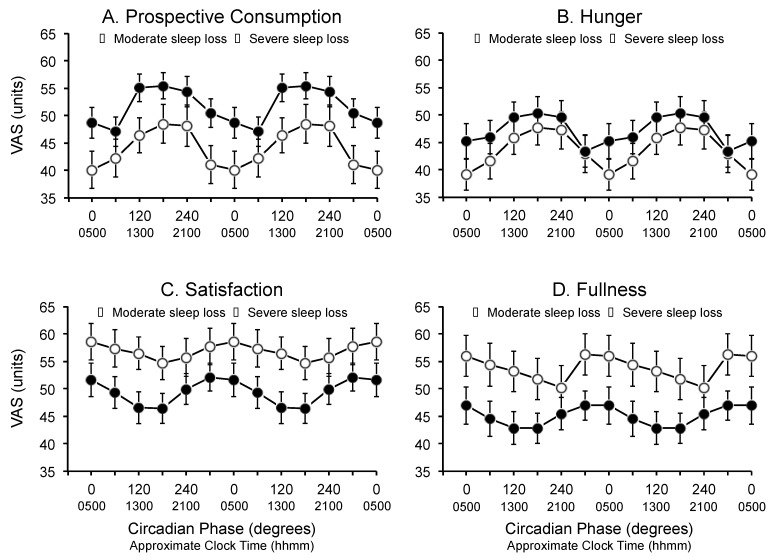
The impact of sleep restriction on the endogenous circadian rhythms of hunger and satiety were examined in 28 healthy young men. Participants were scheduled to 2 × 24-h days of baseline followed by 8 × 28-h days of forced desynchrony during which sleep was either moderately restricted (equivalent to 6 h in bed/24 h; n = 14) or severely restricted (equivalent to 4 h in bed/24 h; n = 14). Self-reported hunger and satisfaction were assessed every 2.5 h during wake periods using visual analogue scales. Participants were served standardised meals and snacks at regular intervals and were not permitted to eat ad libitum. Core body temperature was continuously recorded with rectal thermistors to determine circadian phase. Both hunger and satiety exhibited a marked endogenous circadian rhythm. Hunger was highest, and satiety was lowest, in the biological evening (i.e., ~17:00-21:00 h) whereas hunger was lowest, and satiety was highest in the biological night (i.e., 01:00-05:00 h). The results are consistent with expectations based on previous reports and may explain in some part the decrease in appetite that is commonly reported by individuals who are required to work at night. Interestingly, the endogenous rhythms of hunger and satiety do not appear to be altered by severe--as compared to moderate--sleep restriction.
在28名健康年轻男性中研究了睡眠限制对饥饿和饱腹感内源性昼夜节律的影响。参与者先经历2个24小时的基线期,随后是8个28小时的强制失同步期,在此期间睡眠要么受到适度限制(相当于每24小时卧床6小时;n = 14),要么受到严重限制(相当于每24小时卧床4小时;n = 14)。在清醒期间,每隔2.5小时使用视觉模拟量表评估自我报告的饥饿感和饱腹感。参与者按固定间隔提供标准化餐食和零食,不允许随意进食。使用直肠热敏电阻连续记录核心体温以确定昼夜节律相位。饥饿感和饱腹感均表现出明显的内源性昼夜节律。在生理傍晚(即~17:00 - 21:00时)饥饿感最强,饱腹感最低,而在生理夜间(即01:00 - 05:00时)饥饿感最低,饱腹感最高。这些结果与基于先前报告的预期一致,并且在一定程度上可以解释夜间工作的个体普遍报告的食欲下降现象。有趣的是,与适度睡眠限制相比,严重睡眠限制似乎并未改变饥饿和饱腹感的内源性节律。