Sos Brandon Chin, Fung Ho-Lim, Gao Derek Rui, Osothprarop Trina Faye, Kia Amirali, He Molly Min, Zhang Kun
Department of Bioengineering, University of California San Diego, 9500 Gilman Drive, La Jolla, CA, USA.
Biomedical Sciences Graduate Program, University of California San Diego, 9500 Gilman Drive, La Jolla, CA, USA.
Genome Biol. 2016 Feb 4;17:20. doi: 10.1186/s13059-016-0882-7.
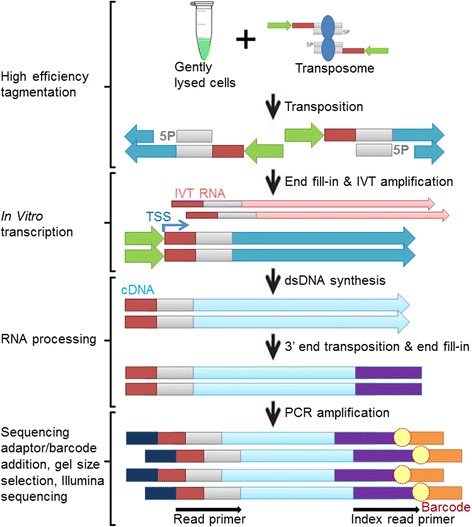
Chromatin accessibility captures in vivo protein-chromosome binding status, and is considered an informative proxy for protein-DNA interactions. DNase I and Tn5 transposase assays require thousands to millions of fresh cells for comprehensive chromatin mapping. Applying Tn5 tagmentation to hundreds of cells results in sparse chromatin maps. We present a transposome hypersensitive sites sequencing assay for highly sensitive characterization of chromatin accessibility. Linear amplification of accessible DNA ends with in vitro transcription, coupled with an engineered Tn5 super-mutant, demonstrates improved sensitivity on limited input materials, and accessibility of small regions near distal enhancers, compared with ATAC-seq.
染色质可及性反映了体内蛋白质与染色体的结合状态,被认为是蛋白质与DNA相互作用的一个信息丰富的替代指标。DNase I和Tn5转座酶分析需要数千到数百万个新鲜细胞才能进行全面的染色质图谱绘制。将Tn5转座标签技术应用于数百个细胞会产生稀疏的染色质图谱。我们提出了一种转座体超敏位点测序分析方法,用于对染色质可及性进行高灵敏度表征。与ATAC-seq相比,通过体外转录对可及性DNA末端进行线性扩增,并结合工程化的Tn5超级突变体,在有限的输入材料上显示出更高的灵敏度,以及远端增强子附近小区域的可及性。